Key Takeaways
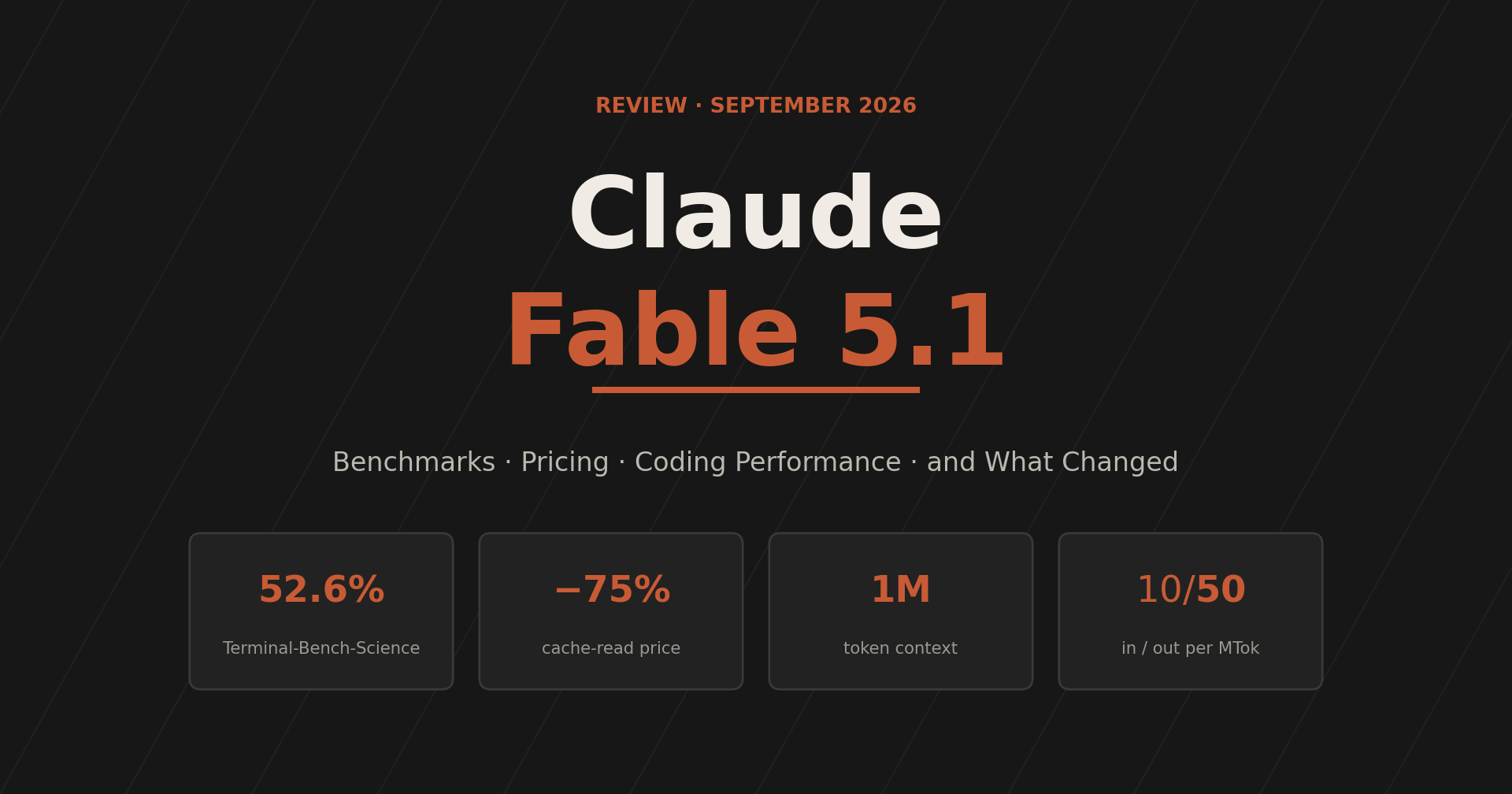
- Lower Cost: 25% lower typical workload cost, with highly agentic workloads costing up to 45% less than Claude Fable 5.
- Stronger Coding: 55.8% on Terminal-Bench 4.0, compared with 42.0% for Fable 5 and 52.3% for Opus 5.
- Larger Context: Up to 1M tokens of context and 128K output tokens.
- API Pricing: $10/M input, $50/M output, and just $0.25/M for cache reads.
My Short Take on Claude Fable 5.1
After reading the launch numbers, the first thing that stood out to me was not a single benchmark score. It was the combination of better long-horizon performance and cheaper cached context.
That matters because coding agents rarely solve a serious task in one prompt. They inspect a repository, read files, call tools, revise a plan, run tests, inspect errors, and repeat. In that workflow, the same context can be sent again and again. Anthropic says Fable 5.1’s cache-read price is 75% lower than Fable 5’s, with estimated savings of about 25% on typical workloads and up to roughly 45% on highly agentic workloads.
My rule of thumb: Fable 5.1 makes the most sense when the task is long, tool-heavy, and expensive to get wrong. For short questions, simple edits, or routine drafting, I would not automatically pay for the flagship.
What Actually Changed From Fable 5 to Fable 5.1?
The easy answer is “better benchmarks.” The more useful answer is that Anthropic is pushing Fable 5.1 toward long-running agent work that needs repeated context.
| Area | Fable 5 | Fable 5.1 | Why I care |
|---|---|---|---|
| Input price | $10 / MTok | $10 / MTok | No list-price increase. |
| Output price | $50 / MTok | $50 / MTok | Output remains premium-priced. |
| Cache reads | $1 / MTok | $0.25 / MTok | Biggest economic change for repeated context. |
| Context | 1M tokens | 1M tokens | Useful for large repositories and research. |
| Max output | — | 128K tokens | Supports long multi-step runs. |
| Thinking | Advanced | Always on; effort can be tuned | Lets quality and cost be balanced per task. |
Claude Fable 5.1 Benchmarks: What the Numbers Tell Me
Anthropic’s benchmark table is useful, but I would not read it as “Fable 5.1 wins everything, therefore it wins every real-world task.” Benchmark harnesses, tool access, effort settings, safeguards, and task selection all affect the result.
| Benchmark | Fable 5.1 | Fable 5 | My interpretation |
|---|---|---|---|
| Terminal-Bench-Science 0.1 | 52.6% | 24.7% | The largest headline jump; especially relevant to agentic technical research. |
| Terminal-Bench 4.0 | 55.8% | 42.0% | Meaningful improvement on terminal-based agent coding. |
| GDPval-AA v2 | 1853 | 1723 | Suggests the improvement is not limited to coding. |
| OSWorld 2.0 partial | 77.9% | 72.9% | Useful evidence for computer-use workflows. |
| Humanity’s Last Exam | 60.9% / 65.0% with tools | 57.8% / 63.8% | More modest improvement on broad reasoning. |
Important caveat: these are primarily Anthropic-reported evaluations. Anthropic also notes that production safeguards intervened on some benchmark tasks, so the scores need to be interpreted in context rather than treated as universal rankings.
What I Would Test as a Coding Enthusiast
I would not start with a toy “write a calculator” prompt. A better test is a repository-level task where the model has to understand existing code, make a change, run tests, and recover from failure.
My test prompt
You are working inside an existing production repository.

1. Inspect the project structure before changing anything.
2. Identify the relevant implementation, tests, and configuration.
3. Explain the smallest safe implementation plan.
4. Implement the change without rewriting unrelated code.
5. Run the relevant tests and linters.
6. If a test fails, inspect the failure and fix the root cause.
7. Re-run the affected tests.
8. Summarize exactly what changed, what was verified, and what remains uncertain.

Do not stop after producing code. The task is complete only after verification.
This is where I expect Claude Fable 5.1 to show its advantage. The model is designed for tasks where the hard part is not generating code, but staying oriented across many steps.
Fable 5.1 vs Fable 5 vs Opus 5
| Model | Best fit | Price | My pick |
|---|---|---|---|
| Fable 5.1 | Long-running agents, demanding coding, research | $10 / $50 | Complex multi-step work |
| Fable 5 | Existing workflows already tuned around it | $10 / $50 | Only if migration risk matters |
| Opus 5 | Strong reasoning with lower list cost | $5 / $25 | Shorter or cost-sensitive tasks |
The interesting part is that Fable 5.1 does not simply replace Opus 5 because it has a higher benchmark score. Its premium is easier to justify when the task is long-horizon and cache-heavy. If I only need a compact answer or a small code patch, I would question the extra spend.
Claude Fable 5.1 vs GPT-6 Astra vs Gemini 3.8 Flash
| Model | Strongest angle | Where I’d use it |
|---|---|---|
| Claude Fable 5.1 | Long-horizon coding and agentic knowledge work | Repositories, autonomous coding, research workflows |
| GPT-6 Astra | Computer use, coding, cybersecurity | Cross-app workflows and general agent tasks |
| Gemini 3.8 Flash | Multimodal speed and native video/audio handling | Video-heavy and multimodal workflows |
This is where I would avoid declaring a single “best AI model.” Gemini 3.8 Flash has a meaningful multimodal advantage for native video and audio workflows, while Fable 5.1 is much more compelling when the core problem is sustained reasoning over code and tools. The right choice depends on the workflow, not the leaderboard headline.
Claude Fable 5.1 Pricing and the Cache-Read Story
Fable 5.1 costs $10 per million input tokens and $50 per million output tokens. Those headline rates are unchanged from Fable 5. The important change is cache reads: $0.25 per million tokens, down 75% from $1.
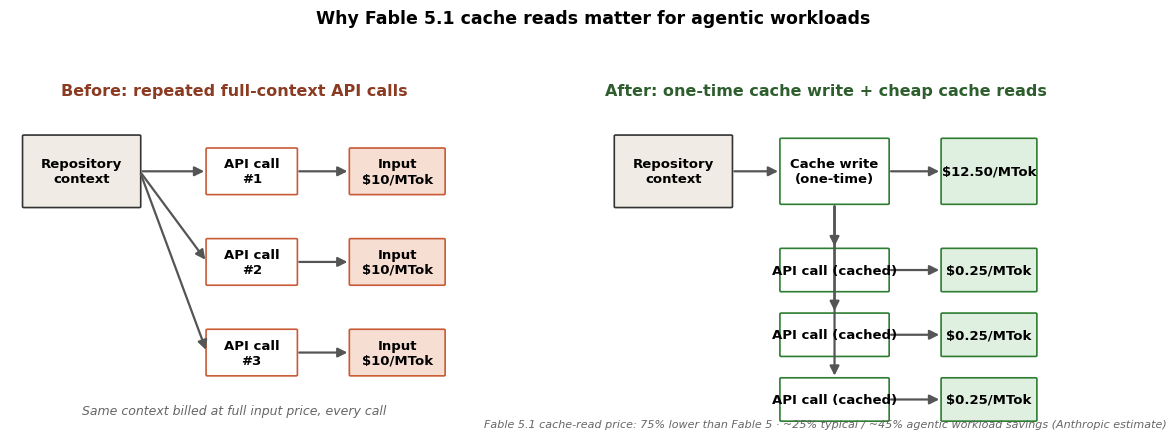
For an agent that repeatedly sends the same repository context, tool instructions, or research state, that can matter much more than a small change in the base input price.
Think of it this way: Fable 5.1 is not “75% cheaper.” The cache-read component is 75% cheaper. Anthropic estimates that translates to roughly 25% lower typical workload cost and up to around 45% lower cost for highly agentic workloads.
API, Context Window, and Migration Notes
The API model ID is claude-fable-5-1. Fable 5.1 supports a 1M-token context window and up to 128K output tokens. Adaptive thinking is always on, and the recommended effort level depends on the environment and task.
Things I would check before migrating
- Forced tool-use behavior can differ and may require code changes.
- Thinking blocks have compatibility constraints when moving between model generations.
- Editing earlier turns can invalidate previous thinking blocks.
- Do not compare cost using list price alone; cache hit rate and output volume matter.
If you have an existing production agent, I would run a matched evaluation set before switching models. The right metric is not “which model has the highest benchmark score?” but “which model finishes my actual tasks with the lowest acceptable cost and failure rate?”
What Problem Is Claude Fable 5.1 Actually Trying to Solve?
When I look past the launch headlines, I think the most important change is not simply that Fable 5.1 is “smarter.” The more useful description is that Anthropic is optimizing it for work that does not fit neatly into one prompt and one answer.
A normal chatbot task might look like this: ask a question, get an answer, and move on. A coding agent is different. It may need to inspect a repository, understand unfamiliar code, search for references, modify several files, run tests, interpret failures, revise the implementation, and repeat the cycle. The model has to stay coherent while the task gets longer.
That is why I would judge Fable 5.1 less by a five-minute chat and more by how well it handles a messy two-hour engineering task. Anthropic positions the model for demanding reasoning and long-horizon agentic work, and its benchmark mix reflects that emphasis. Anthropic’s launch results show particularly large gains on terminal, scientific-agent, automation, and coding workloads.
My interpretation: Fable 5.1 is most interesting when the task has a feedback loop. If the job is simply “write me a 300-word answer,” I would not pay for a frontier long-horizon model just because it exists.
1M Context: What It Means in a Real Coding Workflow
The 1-million-token context window is one of the easiest specifications to quote and one of the easiest to misunderstand. A huge context window does not automatically make a model better at every task. Its practical value comes from reducing how often I have to split a long project into artificial pieces.
For a large repository
Instead of repeatedly explaining the architecture, I can give an agent access to the repository and let it inspect the relevant modules, configuration, tests, documentation, and dependency relationships. The important shift is not “I can paste a million tokens.” It is “the agent has room to keep more of the working state available while it investigates.”
For debugging
Long logs are a good example. A difficult production bug may involve an error message, several related files, a recent change, test output, and a sequence of failed fixes. A model with more context can keep those pieces available rather than forcing me to summarize the investigation every few turns.
For research
The same idea applies outside coding. A long research task can include source material, notes, intermediate findings, tables, and competing hypotheses. Fable 5.1 is designed for that kind of sustained work, rather than only short-form question answering.
One warning: I would not treat 1M context as an invitation to dump everything into every request. Good retrieval, tool use, task decomposition, and selective context are still important. More context is a capability, not a substitute for good agent design.
The Coding Tasks Where I Would Expect Claude Fable 5.1 to Shine
1. Existing-code debugging
This is probably more representative than asking an AI to build a toy app from scratch. Give the agent a real repository, a failing test, logs, and constraints. The challenge is understanding what already exists before changing it.
2. Multi-file refactoring
Long refactors require consistency. Changing an interface may affect implementations, tests, documentation, configuration, and callers. The model needs to track those relationships rather than producing isolated snippets.
3. Test-driven iteration
I would ask the model to make a small change, run the relevant tests, inspect the failure, and continue. This turns coding into an execution loop rather than a one-shot generation task.
4. Repository archaeology
Sometimes the hardest part is finding out why the code works the way it does. A long-running agent can search commits, configuration, tests, and call paths before proposing a change.
5. Technical research
Fable 5.1 is also interesting when coding requires research: comparing libraries, reading documentation, checking implementation details, and turning findings into a working patch.
6. Unattended work
This is where the model’s positioning becomes most relevant. The value rises when I can assign a clearly scoped task and let the agent work through multiple steps while I focus elsewhere.
How I Read the Claude Fable 5.1 Benchmark Results
Anthropic’s benchmark table is unusually useful because it is not a single “intelligence score.” It covers different kinds of work. I would group the results into four buckets: terminal work, scientific investigation, knowledge work, and computer use.
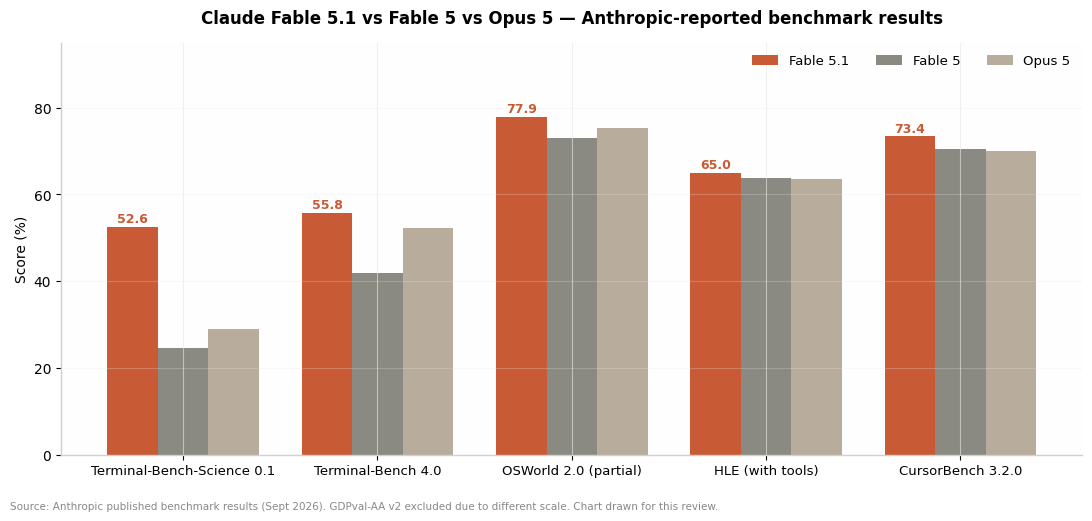
| Benchmark | Fable 5.1 | Fable 5 | Opus 5 | What I take from it |
|---|---|---|---|---|
| Terminal-Bench-Science 0.1 | 52.6% | 24.7% | 29.0% | A major jump on end-to-end scientific terminal work |
| Terminal-Bench 4.0 | 55.8% | 42.0% | 52.3% | Strong evidence for longer terminal-agent tasks |
| GDPval-AA v2 | 1853 | 1723 | 1824 | Fable 5.1 moves slightly ahead of Opus 5 |
| OSWorld 2.0 partial | 77.9% | 72.9% | 75.4% | Better computer-use task completion |
| OSWorld 2.0 strict | 41.7% | 36.1% | 39.6% | The gain remains under a stricter success definition |
| Humanity’s Last Exam, tools | 65.0% | 63.8% | 63.6% | Improvement, but not a dramatic lead |
| CursorBench 3.2.0 | 73.4% | 70.5% | 70.0% | Small but meaningful edge on agentic coding |
These figures come from Anthropic’s published results and benchmark analyses.
The number that caught my attention: Terminal-Bench-Science
Fable 5.1 reaches 52.6%, compared with 24.7% for Fable 5. That is not a tiny version bump. It suggests a meaningful improvement in the model’s ability to plan and execute a multi-step technical investigation instead of only answering scientific questions.
The more practical coding signal: Terminal-Bench 4.0
Fable 5.1 scores 55.8%, ahead of Fable 5 at 42.0% and Opus 5 at 52.3%. For me, this is easier to translate into a developer workflow because terminal agents have to inspect state, use tools, recover from mistakes, and finish a task.
But not every benchmark gap is huge
GDPval-AA v2 is 1853 for Fable 5.1 versus 1824 for Opus 5. That is a lead, but it is not a reason to conclude that Fable 5.1 dominates every professional knowledge task. Benchmark selection, task distribution, effort settings, tool access, and evaluation methodology all matter.
My rule for reading benchmarks: use them to identify the kinds of work a model is becoming better at. Do not turn a collection of benchmark scores into a universal ranking.
Agentic Work Is the Bigger Story Than Chat
One of the more interesting numbers in Anthropic’s results is AutomationBench: Fable 5.1 scores 31.4%, compared with 17.1% for Fable 5 and 26.9% for Opus 5. The gap matters because business automation is usually a chain of actions rather than a single generation step.
Imagine a workflow that reads a request, finds information in several systems, updates a record, checks the result, handles an exception, and reports what happened. A model can be excellent at each individual step and still fail at the overall task if it loses state or makes one bad decision halfway through.
That is why I think “agentic” should be treated as a separate product capability. The question is no longer only Can the model answer this? It becomes Can the model keep making sensible decisions as the task evolves?
Claude Fable 5.1 Pricing: The Important Part Is Not the Sticker Price
Fable 5.1 keeps the headline API rates at $10 per million input tokens and $50 per million output tokens. The more interesting change is cache reads, which Anthropic prices at $0.25 per million tokens. Anthropic estimates typical workloads can cost about 25% less and highly agentic workloads up to about 45% less, largely because agent workflows repeatedly reuse context.
| Cost item | Fable 5.1 | Why I care |
|---|---|---|
| Input | $10 / MTok | Important for large repository and document ingestion |
| Output | $50 / MTok | Important when agents generate long reasoning or code |
| Cache read | $0.25 / MTok | Especially relevant to repeated agent context |
| Batch API | 50% discount | Useful for asynchronous workloads |
Why cache matters more for agents
Suppose an agent repeatedly works with the same repository context. In a simple chatbot interaction, I might think about input tokens as “what I sent this turn.” In an agent, the same underlying information can be revisited many times. Cheap cache reads therefore change the economics of the entire workflow rather than just the price of one prompt.
This is one reason I would compare models by cost per completed task, not only cost per million tokens. A cheaper model that needs many more retries can be more expensive than a premium model that finishes the task in fewer cycles.
Fable 5.1 vs Opus 5: Which One Would I Pick?
I would not interpret Fable 5.1’s launch as “Opus 5 is obsolete.” Anthropic itself positions Fable 5.1 specifically for demanding reasoning and long-horizon agentic work, while Opus 5 remains positioned for complex projects, agents, coding, and enterprise work.
| Scenario | My first choice | Why |
|---|---|---|
| Long-running coding agent | Fable 5.1 | Strong terminal and agentic coding results |
| Large repository investigation | Fable 5.1 | 1M context and long-horizon positioning |
| General complex project | Opus 5 or Fable 5.1 | Benchmark differences are workload-dependent |
| Simple everyday request | Lower-cost model | No reason to pay frontier-model economics |
| Highly specialized workflow | Run your own eval | Your failure modes matter more than aggregate rankings |
Fable 5.1 vs GPT-6 Astra vs Gemini 3.8 Flash
The interesting comparison in September 2026 is not “which model wins everything?” It is that the three platforms are increasingly optimized around different workflows.
| Area | Fable 5.1 | GPT-6 Astra | Gemini 3.8 Flash |
|---|---|---|---|
| Long-horizon coding | Very strong | Very strong | Strong |
| Agentic terminal work | Core strength | Core strength | Strong |
| Context | 1M tokens | Large-context workflow | 1M tokens |
| Native video/audio input | Not the primary differentiator | Not the primary differentiator | Major advantage |
| Best reason to choose it | Long-running coding and knowledge work | Broad OpenAI agent ecosystem | Fast multimodal/video workflows |
Gemini 3.8 Flash’s native video and audio handling is an important differentiator: current coverage notes that it can directly process video, audio, PDFs, images, and text, while Fable 5.1’s main advantage is more concentrated around complex reasoning and extended agentic work.
So if my project is a codebase migration, I would lean toward Fable 5.1. If I am building a system that needs to understand long videos directly, Gemini’s multimodal strengths become much more relevant. That is a better comparison than declaring one model universally “best.”
A Better Way to Test Fable 5.1 Yourself
If I wanted to evaluate Fable 5.1 seriously, I would not start with a toy coding prompt such as “build a todo app.” I would use a real repository or a deliberately messy project where the model has to discover context before changing anything.
You are working on an existing production-style repository.

1. Inspect the repository structure before changing files.
2. Identify the likely root cause of the reported issue.
3. Explain which files and dependencies are relevant.
4. Create a short implementation plan.
5. Implement the smallest safe fix.
6. Run the relevant tests or validation commands.
7. If a test fails, investigate the failure instead of guessing.
8. Review your own changes for regressions.
9. Summarize what changed, what was verified, and what remains uncertain.

Do not rewrite unrelated code. Preserve existing conventions.
This kind of evaluation measures the behavior I actually care about: investigation, planning, tool use, implementation, verification, and recovery.
Where I Would Still Be Careful
Long context can create false confidence
A model can have access to a huge amount of information and still focus on the wrong files or infer a false relationship. I would still require tests, source verification, and human review for important changes.
Benchmark wins are not production guarantees
Anthropic’s benchmark improvements are meaningful, but your repository, language stack, test quality, tooling, and prompt design can change the result dramatically.
Agent autonomy needs boundaries
The more capable an agent becomes, the more important permissions and rollback mechanisms become. I would give a coding agent access to a controlled branch or workspace before allowing it to modify production systems.
Cost can still grow quickly
Lower cache-read pricing helps, but long-running agents can still consume substantial output tokens. I would monitor cost per completed task and set practical budgets rather than assuming the model is automatically inexpensive.
Further reading: 14 Best AI Video Generation Models Worth Trying in 2026
Who Should Use Claude Fable 5.1?
Coding agentsLarge repositoriesLong research tasksComputer-use workflowsEnterprise automation
Use it if: your task takes many steps, requires repeated context, involves tools, or has a high cost of failure.
Maybe skip it if: you mostly write emails, summarize short documents, generate simple snippets, or need the cheapest possible answer per request.
My Verdict
Claude Fable 5.1 feels less like a routine point release and more like an attempt to make frontier models economically practical for agentic work.
The benchmark gains are impressive, especially on terminal and scientific-agent tasks. But the part I find more interesting is the combination of longer-horizon capability, configurable effort, a 1M-token context, and dramatically cheaper cache reads.
If I were choosing a model for a serious coding agent today, Fable 5.1 would be on my shortlist immediately. I just would not use it blindly for every request. The premium makes the most sense when the model has enough work to do.
Claude Fable 5.1 FAQ
What is Claude Fable 5.1?
Claude Fable 5.1 is Anthropic’s frontier model for demanding coding, knowledge work, research, and long-running agentic tasks. It launched on September 1, 2026.
How much does Claude Fable 5.1 cost?
The list price is $10 per million input tokens and $50 per million output tokens. Cache reads cost $0.25 per million tokens.
What is the Claude Fable 5.1 context window?
Fable 5.1 supports a 1M-token context window and up to 128K output tokens.
Is Claude Fable 5.1 good for coding?
Yes. Coding and long-running agentic work are its primary positioning. Anthropic reports major gains over Fable 5 on Terminal-Bench and related evaluations.
Claude Fable 5 vs Fable 5.1: should I upgrade?
For long-running, cache-heavy agent workflows, the lower cache-read price and stronger benchmark performance make Fable 5.1 a compelling upgrade. For simple workloads, the benefit may not justify changing a stable production setup.
What is the Claude Fable 5.1 API model ID?
The model ID is claude-fable-5-1.
How does Fable 5.1 compare with Gemini 3.8 Flash?
Fable 5.1 is aimed more directly at demanding reasoning, coding, and long-horizon agents. Gemini 3.8 Flash has a notable native multimodal advantage for video and audio workflows.