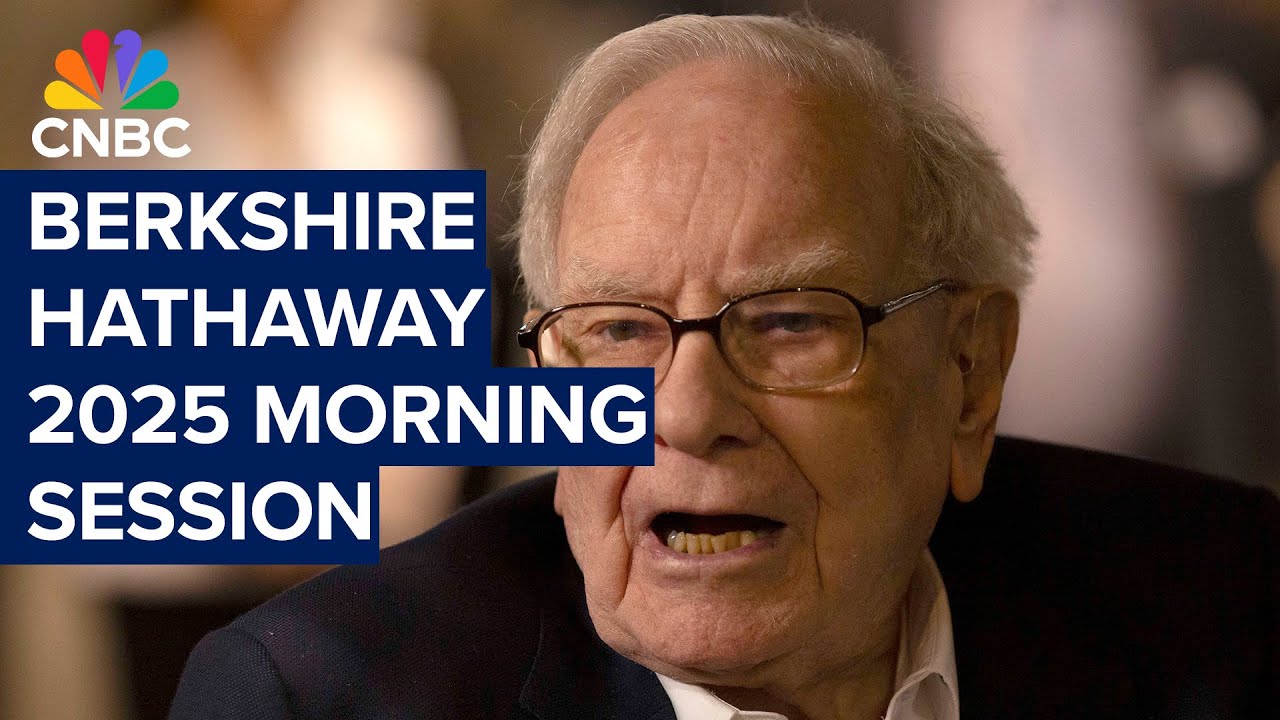
📺 Today’s recommended deep-dive video: https://www.youtube.com/watch?v=or0rgxnkOfE
Patience, Cash, and the Next Fifty Years: Lessons from the 60th Berkshire Meeting
Warren Buffett reflects on a record-breaking year for Berkshire’s subsidiaries while navigating a historic $335 billion cash pile. Alongside Greg Abel and Ajit Jain, he outlines why doing nothing is often the most productive strategy in a world obsessed with short-term volatility and AI hype.
Core Question: How does Berkshire Hathaway maintain its competitive edge in an era of AI, aggressive private equity competition, and shifting global trade dynamics?
Highlights
- The rationale behind the $335 billion cash hoard and the wait for “fat pitches.”
- Why Berkshire views its 5% stake in Japanese trading firms as a 50-year commitment.
- Geico’s massive operational turnaround, involving a workforce reduction of 20,000 employees.
- The specific leadership qualities that make Greg Abel the definitive successor to the Buffett legacy.
⏱️ Reading time: approx. 12 minutes · Saves you about 138 minutes vs. watching.
Want to take notes while watching? Click the image below and let AI Notebook capture the key points for you 👇

The $335 Billion Question: Why Berkshire is Hoarding Cash
The Strategic Value of “Fat Pitches”
Berkshire Hathaway is currently sitting on a mountain of cash, roughly $335 billion in Treasuries, which represents a massive opportunistic reserve for future market distress.
This hoard exists not because Buffett is pessimistic about America, but because he refuses to buy just for the sake of being fully invested when “fat pitches” are absent. He prefers to wait for moments of extreme market dysfunction where Berkshire’s liquidity can be deployed at highly favorable rates, even if that means waiting years for the right call.
While critics argue that holding so much cash drags on performance during bull markets, the Oracle of Omaha maintains that the long-term record is built on irregular, high-conviction behavior rather than steady, mediocre participation. If a hundred-billion-dollar opportunity arose tomorrow that offered clear value and safety, he wouldn’t hesitate to spend it, but he refuses to force a trade in an orderly, expensive market.

💡 Digging Deeper
Q: Is the cash pile a de-risking strategy for the leadership transition?
A: No, Buffett explicitly stated he wouldn’t withhold investing just to make Greg Abel look good later; the cash is simply a result of a lack of attractive opportunities.
Q: Why not buy back more Berkshire stock?
A: Berkshire only repurchases shares when they are significantly underpriced; furthermore, a new 1% government tax on buybacks has made this slightly less attractive.
Q: Will Berkshire ever act fast?
A: Yes, Buffett emphasized that while patience is key, you must be willing to say “yes” in five seconds when the right deal, like the 1966 Ben Rosner acquisition, finally appears.
The Global Stage: Japan, Trade, and Currency
The Fifty-Year Bet on Japan
Berkshire’s investment in five Japanese trading companies has evolved into a cornerstone of the portfolio, with an initial $20 billion investment that Buffett wishes could be $100 billion.
The relationship is built on mutual respect and a “super long-term” vision, with Greg Abel taking the lead on maintaining ties with management. Because these companies cover diverse global interests, they serve as a unique proxy for global growth while remaining rooted in Japanese business customs that Buffett admires.
To mitigate currency risk, Berkshire has matched these purchases with yen-denominated debt, taking advantage of incredibly low interest rates in Japan to create a “perfect relationship” where the carry cost is minimal compared to the returns.
💡 Digging Deeper
Q: Will Berkshire sell these Japanese stocks to realize profits?
A: Absolutely not; Buffett stated they have no intention of selling and expect to hold these positions for decades, if not forever.
Q: How does Buffett view the rising trade deficits and tariffs?
A: He views trade as a tool for prosperity, not a weapon of war, arguing that balanced trade is healthier for a world with unstable nuclear-armed nations.
Insurance, AI, and the Human Edge
The Geico Turnaround
Under Todd Combs, Geico has undergone a radical transformation, catching up in telematics and drastically improving its ability to match rate to risk.
The company managed to reduce its workforce by 20,000 people—from 50,000 down to 30,000—which resulted in a $2 billion annual savings and a combined ratio in the 80s, a level of profitability Buffett hadn’t expected to see.
Despite this success, Ajit Jain warns that the “mission is not accomplished,” especially as the industry shifts toward autonomous vehicles and higher repair costs due to embedded technology.

💡 Digging Deeper
Q: Can AI replace Ajit Jain?
A: Buffett joked that he wouldn’t trade Ajit for all the AI in the world, emphasizing that human intuition in insurance is still an irreplaceable asset.
Q: How do autonomous vehicles change the business?
A: The industry will likely shift from “operator error” coverage to “product liability,” though safer cars might be offset by much higher costs per repair.
Q: Why is Berkshire avoiding the life insurance deals being done by private equity firms like Apollo or Blackstone?
A: Ajit Jain noted that these firms use higher leverage and credit risks that Berkshire finds unattractive; they have effectively “put up the white flag” in that specific segment.
Key Takeaways
The 60th annual meeting reinforced the idea that Berkshire Hathaway is not just a collection of businesses, but a culture of extreme trust and intellectual honesty. Buffett’s praise for Tim Cook—noting that Cook has made Berkshire more money than Buffett himself—highlights a willingness to cede credit to capable managers. This humility is a core pillar of the Berkshire model, allowing the company to attract top-tier talent who want to work for a “hands-off” owner.
The mountain of cash remains a polarizing topic, but Buffett’s logic is consistent: he is a “treasure hunter” waiting for a specific type of gold. By refusing to succumb to the FOMO (Fear Of Missing Out) that drives many institutional investors, Berkshire remains the ultimate “lender of last resort” for the American economy. As the world becomes more complex with AI and fiscal instability, Berkshire’s simplicity remains its greatest strength.
Ultimately, the transition to Greg Abel appears seamless because Abel has already “found the sound.” He shares the same temperament and long-term vision that Buffett and Munger spent decades cultivating. For shareholders, the message is clear: the principles remain the same, even as the faces at the table eventually change.
Q&A
Q1: Why does Buffett prefer stocks over real estate for Berkshire?
A: Stocks are anonymous, liquid, and can be transacted in billions in minutes, whereas real estate involves grueling negotiations that can take years to finalize.
Q2: What is Buffett’s view on the US dollar and fiscal policy?
A: He is concerned about the government’s tendency to debase currency over time, noting that fiscal policy is one of the few things that truly scares him.
Q3: How does Berkshire view the competition from private equity in insurance?
A: Berkshire refuses to compete with the aggressive leverage and credit risks taken by PE firms in the life insurance space, choosing to maintain its underwriting discipline instead.
Q4: What was Buffett’s advice to the young investor from Massachusetts?
A: Associate with people who are better than you, and look for a job you would do even if you didn’t need the money.
Q5: What is the significance of the “60th Anniversary Book” mentioned?
A: It was a labor of love by Carrie Sova that sold 4,400 copies in a single day, with all proceeds going to the Stephen Center for the homeless.
Q6: Why is BNSF Railway’s performance a point of focus?
A: While it remains an incredible asset, Buffett and Abel noted it is not currently earning what it should be, and they are actively working to solve its operational issues.
Q7: Has the recent market volatility in early 2024 changed Buffett’s outlook?
A: Not at all; he views a 15% market move as “nothing” compared to the 50% drops he has witnessed three times during his tenure at Berkshire.