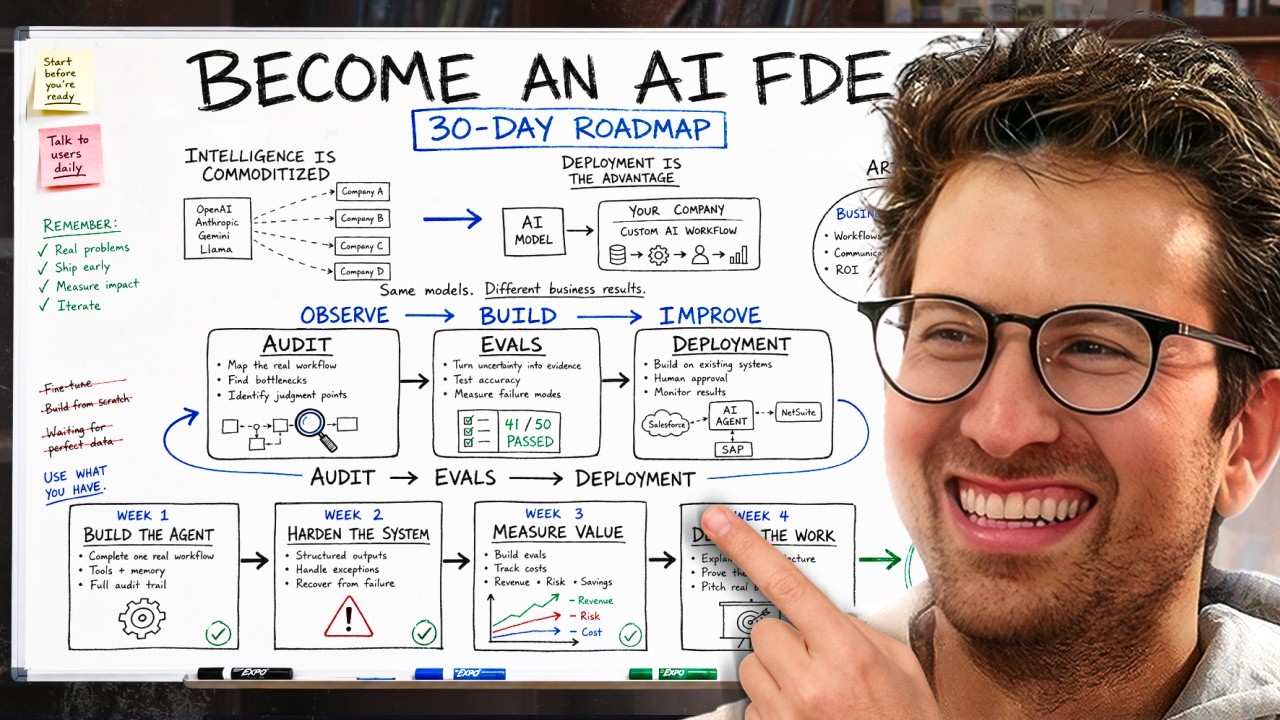
📺 Today’s recommended deep-dive video: https://www.youtube.com/watch?v=zXysLUTLjw4
The Million-Dollar Role: Your 30-Day Playbook for Forward Deployed Engineering
As frontier models like GPT-4 and Claude 3.5 become accessible to every organization, the competitive advantage is shifting from “who has the AI” to “who knows how to deploy it.” In this masterclass, Voss from Veric Agents breaks down the rise of the Forward Deployed Engineer (FDE)—the rare professional capable of bridging the gap between raw intelligence and messy business reality.
Core Question: How can technical professionals transition into Forward Deployed Engineering to command seven-figure salaries by solving the AI deployment gap?
Highlights
- Intelligence is a Commodity: Since every company can buy the same models, the “moat” has shifted from model access to customized, site-specific deployment.
- The Palantir Blueprint: Originally popularized by Palantir, the FDE role combines on-site consulting with deep technical implementation to solve unique enterprise pain points.
- The Judgment Gap: 95% of AI pilots fail because companies “token max” instead of using deterministic logic, human-in-the-loop systems, and rigorous evaluations.
- A 30-Day Roadmap: You can break into the field by building agents that solve non-happy-path exceptions rather than just basic chat completions.
⏱️ Reading time: approx. 6 minutes · Saves you about 46 minutes vs. watching.
Want to take notes while watching? Click the image below and let AI Notebook capture the key points for you 👇

Defining the New Edge in the Age of AI
From Intelligence Moats to Deployment Moats
The fundamental reality of today’s market is that every company can now buy intelligence off the shelf, meaning that foundational model capabilities are no longer a unique advantage. When every enterprise uses the same stack—Cursor, GitHub Copilot, and frontier models—the competitive edge moves to the “how” and “why” of application rather than the “what.”
Deployment is the final frontier of value.
An AI Forward Deployed Engineer serves as the critical bridge between general intelligence and specific company context, ensuring that models are tuned to handle the idiosyncratic processes of a 5,000-person organization. Without this specialized role, companies fall into the trap of “token maxing,” where they throw raw compute at problems without understanding the underlying business logic or cost structures.

💡 Digging Deeper
Q: Where did the term FDE actually originate?
A: It was popularized by Palantir, who sent engineers on-site to the military and government to customize their data ontology for specific, high-stakes missions.
Q: What is the current salary range for these roles?
A: Because they require a rare mix of elite coding and executive-level communication, salaries range from $150k base with heavy equity to over $1,000,000 for top-tier experts.
Q: Why do most AI pilots currently fail?
A: Most fail because they are designed for the “happy path” and lack the exception handling or “deterministic” guardrails necessary for enterprise-grade reliability.
The Three Pillars of FDE Success
Phase 1: Auditing the Messy Business Reality
The first stage of any FDE engagement is understanding that the documented SOP is almost never how work actually gets done on the factory floor or in the back office. An FDE must go “on-site”—either physically or through deep remote immersion—to interview staff and observe the thousands of undocumented exceptions that occur during a standard workday.
Real business processes are messy, fragmented, and hidden in people’s heads.
You cannot automate a process you don’t understand, and most technical teams fail because they build for a clean version of reality that doesn’t exist in a legacy ERP. By sitting with a procurement officer or a salesperson for eight hours, the FDE identifies where data drifts, where columns are re-keyed by hand, and where the “real” logic deviates from the official manual.
Phase 2: Technical Judgment and “The Sprint”
Once the reality is mapped, the FDE must decide where intelligence belongs and, perhaps more importantly, where it does not belong because the ROI simply isn’t there. This requires a “Slytherin-like” pragmatism: you aren’t just an engineer; you are an architect of cost, risk, and adoption who understands that a simple If-Then statement is often better than a hallucinating LLM.

💡 Digging Deeper
Q: How do you handle “allergic” reactions to the word “audit”?
A: Rebrand it as a “Design Sprint” or “Intelligence Sprint” to make it feel like a collaborative, fast-paced value add rather than a tax inspection.
Q: What makes a “Golden Data Set” in evals?
A: It is a collection of previous business outputs—like 5,000 past presentations or emails—that serve as the ground truth for measuring if the AI is actually improving.
The 30-Day Roadmap to Breaking In
Week 1-2: Mastering the Agentic Loop
Your first two weeks should be focused on building an agent that can complete a real-world loop, such as a finance reconciliation or an HR onboarding task. This isn’t just about prompting; it’s about building tool usage, guardrails, and—most importantly—a full audit trail so a human supervisor can see exactly what the agent did at every step.
Trust is built through transparency, not just accuracy.
By week two, you must shift your focus from the “happy path” to failure modes and exception handling, which is where the real value of an FDE is proven. If your agent can recover when a PDF is missing a signature or a spreadsheet column has drifted, you have built a system that is worth ten times more than a basic chat bot.
Week 3-4: Economic Optimization and the Pitch
The final two weeks are dedicated to making the system economically viable by testing cheaper models for sub-tasks and measuring the three metrics businesses care about: revenue uplift, risk mitigation, and cost savings. You must learn to defend your system like a VP, explaining the architecture to engineers and the ROI to the C-suite simultaneously.

Key Takeaways
The Forward Deployed Engineer is the “Art and Science” hybrid of the AI era, requiring the empathy of a consultant and the rigor of a software engineer. While “token maxing” was the trend of 2023, 2025 and beyond will belong to those who can integrate AI into legacy systems like Netsuite or SAP without demanding a total migration.
Success in this field comes down to de-risking the technology for the client; you are not just selling code, you are selling a promotion for the executive who hires you. By starting with a free or low-cost audit, you build the trust necessary to eventually manage the trillion-dollar “intelligence tap” that is currently changing hands in the global economy.
Q&A
Q1: Is an FDE just a glorified consultant?
A: No, because an FDE actually writes production-grade code. While consultants often leave a slide deck behind, an FDE leaves a working, integrated AI system that solves the problem.
Q2: Do I need to be model-agnostic?
A: Eventually, yes, but when starting out, Voss recommends mastering one ecosystem (like OpenAI or Anthropic) deeply before trying to switch, as the fundamental logic remains similar.
Q3: How do you measure success for non-deterministic tasks like creative writing?
A: Use a “Golden Data Set” of previous high-quality examples and implement a human-in-the-loop feedback mechanism to “fine-tune” the system’s judgment over time.
Q4: Should I charge for the initial audit?
A: Yes, because a high-quality audit is worth 10x its cost to a business. However, if you are just starting, doing it for free is a great way to “get your feet wet” and build a case study.
Q5: Can this role be done remotely?
A: It can, but being on-site for the initial audit is highly recommended. You uncover much more “hidden” process logic by watching someone work for 8 hours than you do in a 1-hour Zoom call.
Q6: What is the most important part of an agent’s architecture?
A: The audit trail. If you cannot show a client exactly why an agent made a decision, they will never have the confidence to deploy it in a production environment.
Q7: What are the “Three Buckets” of business measurement?
A: Revenue uplift, risk mitigation, and cost savings. Every FDE project must be measured against at least one of these to be considered successful.