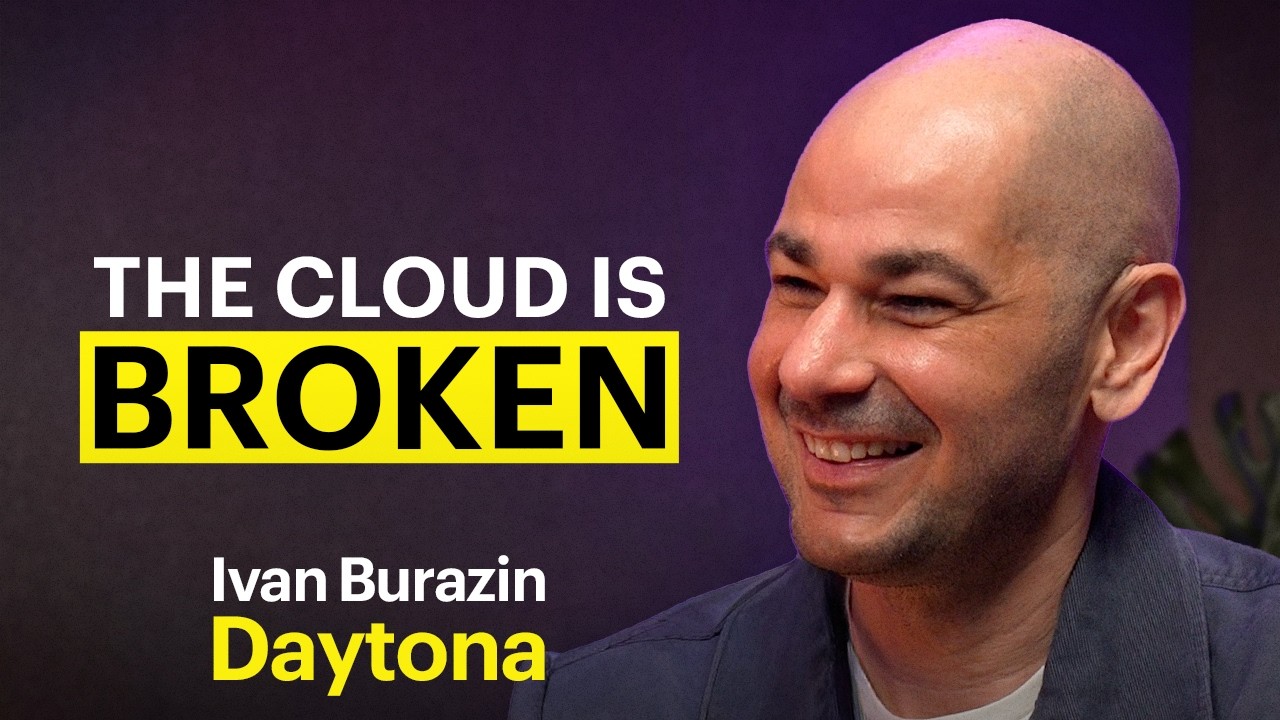
📺 Today’s recommended deep-dive video: https://www.youtube.com/watch?v=kMXJrzAa5fM
Why Every AI Agent Needs Its Own Computer: The Rise of the Sandbox
As AI agents evolve from simple chat interfaces into autonomous “digital knowledge workers,” they require more than just a large language model to be productive. They need a dedicated environment—a sandbox—where they can execute code, access the web, and manage tools without compromising the security of their host.
Core Question: Why is dedicated, stateful infrastructure necessary for AI agents to perform complex, multi-step tasks safely and efficiently?
Highlights
- The definition of a sandbox as a “composable computer” that serves as the “hands” for an agent’s “brain.”
- Why traditional stateless cloud architecture is incompatible with the stateful, long-running needs of modern agents.
- The technical trade-offs between micro VMs like Firecracker and heavier virtualization for tasks requiring GPUs or legacy OS support.
- A prediction of a looming global CPU shortage as agents and RL environments begin to outpace hardware availability.
⏱️ Reading time: approx. 12 minutes · Saves you about 53 minutes vs. watching.
Want to take notes while watching? Click the image below and let AI Notebook capture the key points for you 👇

The Sandbox as a Digital Workspace
Agents as Knowledge Workers
Think of an AI agent not as a script, but as a digital knowledge worker who requires the same tools you do.
To perform anything beyond simple text prediction, an agent needs a computer—a dedicated environment where it can install software, browse the web, and execute scripts without compromising your personal machine’s security. This is what we call a sandbox, a composable compute environment that provides isolation while granting the agent the “hands” it needs to interact with the world. Without this, an agent is just a brain in a jar, unable to actually execute the work it plans.
A sandbox is essentially a virtual Mac mini that you can “unplug” the moment an agent goes rogue or attempts to access sensitive data like your bank account without permission.
The Shift to Stateful Infrastructure
The biggest architectural hurdle in the current agent “supercycle” is the fundamental difference between how we used to build web apps and how agents actually work.
Traditional hyperscalers like AWS or Google Cloud were built for stateless applications where you want the app to remain exactly the same every time it loads, while the data lives elsewhere in a database. Agents are the opposite; they are highly stateful, meaning they change their environment as they work, installing new packages or moving files around, and they need that specific state to persist over long durations. You cannot treat an agent like a Lambda function that disappears after five minutes because the agent might need to work for days on a single complex project.

💡 Digging Deeper
Q: Why can’t I just run an agent on my local laptop?
A: You can, but it’s risky and inefficient. If you close your laptop, the agent stops working, and giving a model direct access to your local files is a massive security vulnerability if the agent “hallucinates” a reason to delete or leak data.
Q: What is the “Open Claude” analogy?
A: It’s the idea of giving Claude (or any model) a dedicated hardware “box” to play in. By giving the agent its own digital account, phone number for 2FA, and isolated machine, you treat it like a real employee with restricted permissions.
Engineering the Agent Stack
Choosing the Right Primitive
Not all sandboxes are created equal, and the “primitive” you choose depends entirely on the agent’s specific task requirements.
While many providers rely on Firecracker micro VMs because they are incredibly fast and lightweight, they lack the ability to support GPUs or complex nested environments like Android emulators. For more intensive tasks, engineering teams must look toward heavier virtualization like QEMU or hardened containers that provide a balance between security and performance. Daytona focuses on providing the “ergonomics” of compute, allowing a developer to spin up any of these environments through a single, consistent interface.
Speed is the ultimate feature here; if an agent has to wait two minutes for a computer to “boot up” before it can start a task, the productivity gain is lost.
Why Kubernetes Failed the Sandbox Test
When Daytona began building their v2 infrastructure, they realized that off-the-shelf schedulers like Kubernetes or Nomad simply weren’t designed for this use case.
Kubernetes is excellent for managing thousands of identical, stateless containers, but it struggles with the high-frequency “churn” of agent sandboxes that need to spin up in 60 milliseconds and run for unpredictable lengths of time. Ivan’s team had to write their own scheduler from scratch to handle the density and orchestration requirements of millions of concurrent, stateful machines. This custom layer allows them to live-migrate sandboxes between physical servers, ensuring that an agent can run for weeks even if the underlying hardware needs a reboot or a security patch.
Efficiency at this level is about squeezing every drop of performance out of the CPU and RAM, especially when dealing with millions of simultaneous users.

💡 Digging Deeper
Q: What is the benefit of a “snapshot” in a sandbox?
A: Snapshots allow an agent to “branch” its work. If an agent isn’t sure which path to take, it can save its current state, try one solution, and if it fails, instantly “roll back” to the exact moment before the mistake and try a different path.
Q: How does local storage improve performance?
A: Most cloud VMs use network-attached storage, which is slow. By using the local NVMe drive of the physical host, sandboxes can achieve tens of millions of IOPS, which is critical for agents doing heavy data processing or code compilation.
Distribution Lessons for Technical Founders
Humans at Scale
Many technical founders struggle with distribution because they treat it as an afterthought, but Ivan views marketing as a core engineering challenge: understanding “humans at scale.”
His background in organizing massive 4,000-person tech conferences taught him that a brand is simply a collection of perceptions—the “smell, the music, and the smile” of a product experience. Even if your technical specs are identical to a competitor, the winner is usually the one who provides the better experience, from the documentation’s tone to the speed of the SDK. If the user “feels” like the product is more robust and the team is more responsive, they will choose it every time.
Distribution is about creating preference through awareness, and awareness often comes from being willing to work through the “supercycle” while others are taking breaks.
Support as a Growth Engine
At Daytona, there are no dedicated sales people yet; instead, the growth is driven by a maniacal focus on fast, high-quality customer support.
Ivan advocates for a “First Response” protocol where a human acknowledges a problem almost instantly, which effectively “transfers” the anxiety of the technical issue from the customer to the provider. Once the user knows someone is on the case, they are remarkably patient, provided you meet your promised deadlines or update them before the deadline passes. This proactive communication builds more trust than a perfect, bug-free product ever could because it proves the team is invested in the user’s success.

💡 Digging Deeper
Q: Is the “NGMI” tweet strategy real?
A: It wasn’t “rage bait,” but it was a reflection of the intensity required during a market supercycle. Ivan notes that even people who disagreed with the sentiment ended up becoming customers because the tweet created massive awareness of the brand.
Q: What defines “ergonomics” in an SDK?
A: It’s the “feel” of the code. Good ergonomics mean the functions are named intuitively, the authentication is seamless, and the developer can go from “install” to “running agent” in under a minute.
Key Takeaways
The transition from chatbots to agents represents a fundamental shift in how we consume compute. We are moving away from a world where a user interacts with a single application to a world where a user manages a fleet of digital employees, each requiring its own dedicated, high-performance workstation in the cloud.
Sandboxes are the missing link in the agentic stack. While the AI models provide the reasoning, the sandbox provides the execution environment, security, and persistence. For developers, the goal is to make this infrastructure “invisible”—the agent should just have a computer that works, regardless of whether it’s running a simple Python script or a full Windows desktop environment.
Finally, hardware remains the ultimate constraint. As the demand for Reinforcement Learning (RL) and autonomous agents grows, we are likely to move from a GPU shortage into a CPU shortage. Companies that can optimize their scheduling and maximize hardware utilization will be the ones that survive the next phase of the AI evolution.
Q&A
Q1: What is the simplest definition of a sandbox?
A: A sandbox is a composable computer for AI agents—an isolated place where an agent can run code and use tools safely.
Q2: Why does an agent need a separate phone number?
A: For complex tasks like banking or enterprise software access, agents often encounter Two-Factor Authentication (2FA). Giving the agent its own number allows it to handle these security hurdles autonomously.
Q3: What is the difference between OpenAI’s Agent SDK and Anthropic’s Managed Agents?
A: OpenAI provides the “harness” (the SDK) to build agents, whereas Anthropic offers a fully managed service that wraps the model, harness, and sandbox into a single package.
Q4: Why did Daytona have to build a custom scheduler?
A: Existing tools like Kubernetes were built for stateless apps. Agents require stateful, long-running environments that can spin up in milliseconds, necessitating a purpose-built orchestrator.
Q5: Will agents eventually “learn” on the job?
A: Currently, models have “memory” via context, but they don’t fundamentally “learn” or get smarter from yesterday’s tasks without retraining or constant RL. This is a major area of future development.
Q6: What is the “End of Localhost”?
A: It’s the idea that developers (and agents) are moving away from running everything on their own laptops in favor of remote, standardized, and scalable cloud environments.
Q7: How does a sandbox prevent data leaks?
A: By using firewalls and secrets managers within the sandbox, you can restrict an agent so it can read data from a source but lacks the permissions to “spend” money or send data to unauthorized external servers.