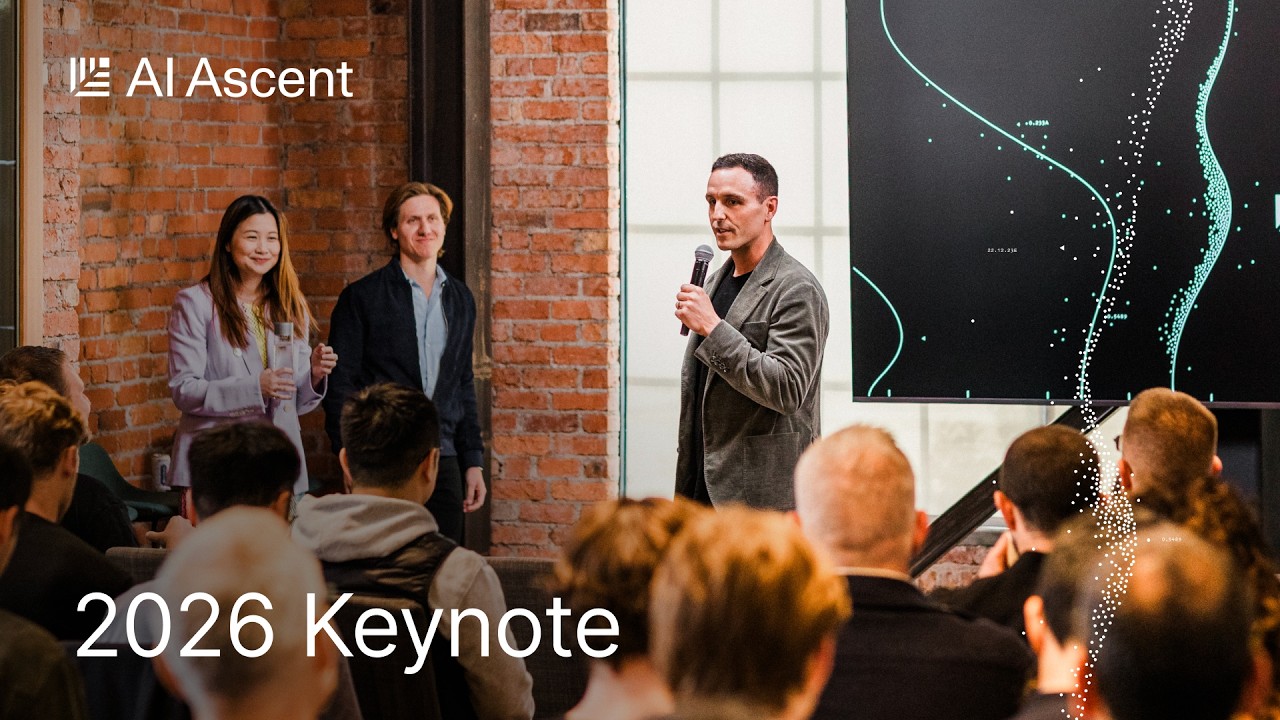
📺 Today’s recommended deep-dive video: https://www.youtube.com/watch?v=LRo33rnv6rQ
Beyond the Faster Horse: Navigating the $10 Trillion Agentic Revolution
The shift from software to services is creating an economic opportunity larger than the entire history of the cloud, moving us from “faster horses” to truly autonomous “cars.” As AI agents evolve from simple helpers into independent coworkers, the competitive landscape for founders is being rewritten through the lens of computation rather than communication.
Core Question: How can businesses capture value in a world where cognitive work is becoming a commodity as cheap and abundant as aluminum?
Highlights
- AI is the first technology wave to disrupt the $10 trillion services market, going far beyond the traditional software TAM.
- The “MAD” strategy (Motes, Affordance, Diffusion) is essential for builders working on top of foundation models.
- Long-horizon agents are transforming workflows from “interns that need management” to “dark factories” requiring zero human oversight.
- The “Industrial Revolution of Cognition” will eventually automate 99% of all thinking tasks on Earth, shifting human value toward relationship and intent.
⏱️ Reading time: approx. 6 minutes · Saves you about 26 minutes vs. watching.
Want to take notes while watching? Click the image below and let AI Notebook capture the key points for you 👇

The MAD Strategy for the Computation Era
From Distribution to Processing
We are currently transitioning from a revolution of communication to a revolution of computation. While the internet and mobile eras were defined by how information was distributed, AI is defined by how information is processed, which creates a fundamentally different “shape” of technological wave.
In this new environment, the ground moves underfoot daily because the underlying foundation models improve at a rate that far outpaces enterprise adoption. This “torrential rain” of new capabilities is a gift to challengers; in racing, you can’t pass fifteen cars in the sun, but you can pass them in the rain.
To survive this downpour, founders must adopt the “MAD” framework. This focuses on building Motes by looking “customer-back” rather than “tech-out,” creating Affordances that offer paths of least resistance for users, and exploiting the Diffusion gap between what models can do and what the market has actually implemented.
💡 Digging Deeper
Q: Why is “customer-back” better for building motes than “tech-out”?
A: Capabilities change every day, but customer problems are durable; wrapping your product around a specific user’s workflow provides a moat that a simple API update cannot easily destroy.
Q: What is the “Diffusion Gap”?
A: It is the growing space between the frontier capabilities of models like o1 or Claude 3.5 and the actual reality of how a Fortune 500 company operates.
The Rise of the Long-Horizon Agent
From Productivity to Autonomy
The defining shift of 2026 is the emergence of agents that don’t just assist humans but actually complete jobs. We have moved past the era of “faster horses”—tools that made you 20% more productive—into the era of “cars,” which make you 10x to 40x more effective by fundamentally changing the nature of work.
True agency requires three pillars: the “Brain” (reasoning and planning), the “Limbs” (tools like terminals, Slack, or web search), and the “Harness” (the persistence to iterate until a goal is met). When these three elements converge, we enter the realm of “dark factories,” where complex processes like cybersecurity or code migration happen entirely asynchronously without a human in the loop.
This shift means that “Services is the new Software.” Instead of buying a tool to help a lawyer, companies will soon simply “hire” an agent that performs the litigation or settles the contract. This scales infinitely with compute, whereas human services are notoriously difficult to scale.

💡 Digging Deeper
Q: What changed between the “failed” agents of 2022 and today?
A: The models can now sustain performance for hours rather than minutes, and reinforcement learning has given them the “driving school” training necessary to handle failure.
The Industrialization of Cognition
The Commodity of Intelligence
We are entering the “Industrial Revolution of Cognition,” a period that parallels the 18th-century shift in physical labor. Just as steam engines and electric motors eventually performed 99% of the world’s physical work, neural networks are on a trajectory to perform 99.9% of the world’s cognitive labor.
This transition will transform once-precious skills into commodities. Consider aluminum: in the mid-1800s, it was the most precious metal on Earth, capped on the Washington Monument and displayed at Tiffany’s. Once electrolysis made it cheap to extract, it became something we wrap sandwiches in and throw away. High-level PhD skills are the new aluminum; they will be so instantly invoked that they will be used once and discarded.
As we hand over cognition to machines, we must prepare for “Alien Design.” AI does not think like a human, and its solutions—whether in chip architecture or antenna design—will often be counter-intuitive and non-symmetrical, optimized by evolutionary algorithms rather than human aesthetic preferences.

💡 Digging Deeper
Q: If AI does all the work, what is left for humans?
A: The “Art of Unreason.” Just as photography pushed painters toward Impressionism and Expressionism, AI will push humans to focus on the things only we can provide: relationship, intent, and “heart.”
Key Takeaways
The transition from software to services represents a discontinuous change in the global economy. By moving from selling “tools” to selling “outcomes,” the tech industry is moving from a $500 billion software market to a $10 trillion services market. This is not just an incremental improvement; it is the arrival of the “car” in a world that was previously only looking for a faster horse.
Founders must embrace the “weirdness” of an agentic world where commerce happens between machines. Speed is the only true defense in this “rainy” environment. Projects that used to take three years can now be accomplished in three weeks or even a weekend, provided builders lean into the persistence and scale of long-horizon agents.
Ultimately, while the “bitter lesson” of computation ensures that machines will eventually be smarter than humans at most tasks, they cannot replace the human connection. The value of a business in the AI era will be measured by its ability to solve human problems, even if the “thinking” required to solve them has become as cheap as a gum wrapper.
Q&A
Q1: What is the practical definition of AGI used in this context?
A: Rather than a technical or sentient definition, AGI is viewed functionally: if you can dispatch an agent to do a job, and it can recover from failure and persist until that job is finished autonomously, that is AGI for all commercial and practical purposes.
Q2: How does “Claude Code” illustrate the shift in agency?
A: It represents the “intern” phase of agents. It allows a developer to stay at a higher level of abstraction, instructing the agent to handle complex migrations or rewrites that would normally take weeks, as seen in the Notion team rewriting 8 million lines of code in six weeks.
Q3: What are “Dark Factories” in the context of knowledge work?
A: These are systems where human review is removed entirely from the production loop. With sufficiently high guardrails, agents can spawn sub-agents to solve problems, push code, or manage security threats without waiting for a human to click “approve.”
Q4: Why does the speaker use the “Aluminum” story?
A: To illustrate that “value” is often tied to “scarcity.” When a technology (like electrolysis or AI) makes a scarce resource (like aluminum or intelligence) abundant, the price collapses, and the resource becomes a utility rather than a luxury.
Q5: What is the significance of the NASA antenna example?
A: It shows that machine-driven “Alien Design” is more efficient but less intuitive. AI will solve problems in ways that look “wrong” or “organic” to us because it isn’t limited by human biases toward symmetry or traditional geometry.
Q6: How should founders think about the “Services” market vs. the “Software” market?
A: Software is a fixed tool sold for a subscription fee. Services involve doing the actual work (legal, medical, creative). The services market is 10x to 20x larger because it captures the value of the labor itself, not just the tool used by the laborer.
Q7: What is the “Art of Unreason”?
A: It is the human response to automation. When machines can do “realistic” work perfectly, humans pivot to work that captures “the way the heart sees it,” emphasizing relationships and shared experiences over pure output.