📺 Today’s recommended deep-dive video: https://www.youtube.com/watch?v=9d899Ram9Bs
Beyond Human Limits: How AI Solved a Year-Old Physics Mystery in Minutes
Theoretical physics was long considered a bastion of human intellect that artificial intelligence could never breach, but recent breakthroughs have shattered that assumption. By solving particle interaction puzzles that had stumped experts for over a year, AI has officially crossed the threshold from a writing assistant to a superhuman scientific collaborator.
Core Question: Can modern reasoning models move beyond mere data recombination to provide genuine creative insights at the frontiers of quantum gravity and particle physics?
Highlights
- AI simplified “disgusting” physics equations with factorial complexity into elegant linear formulas.
- A Breakthrough Prize-winning physicist explains his transition from AI skeptic to being “AI-pilled.”
- The “Graviton Paper” was produced in weeks, shifting the human workload from calculation to verification.
- AI now acts as a “scout” in the unknown, allowing researchers to explore multiple theoretical paths simultaneously.
⏱️ Reading time: approx. 7 minutes · Saves you about 85 minutes vs. watching.
Want to take notes while watching? Click the image below and let AI Notebook capture the key points for you 👇

The End of AI Skepticism
From Email Assistant to Physics Partner
Theoretical physics research was once thought to be too special and complex for Large Language Models to handle. Alex Lubyansky, a winner of the 2024 New Horizons Breakthrough Prize, initially viewed AI as a tool for administrative tasks rather than the arduous mathematical derivations required for quantum field theory.
The perception shifted dramatically with the release of reasoning-focused models like GPT-O3, which performed calculations in eleven minutes that would have taken a human researcher days to complete. This wasn’t just text prediction; it was the execution of rigorous, multi-step logic that matched the precision of a trained professional.
The final “Move 37” moment occurred when a model reproduced Lubyansky’s own cutting-edge research on black hole symmetries in under thirty minutes. This specific problem involved finding hidden symmetries in the equations governing black hole perturbations—a task so difficult that only a handful of people worldwide could perform it. Seeing the AI solve it with only a minor “warmer” prompt convinced him that the trajectory of science had fundamentally changed.

💡 Digging Deeper
Q: What are “Love numbers” in this context?
A: Named after Augustus Love, these coefficients describe the tidal response of an object. While the Moon causes tides on Earth, black holes famously have “zero love,” meaning they don’t experience tides, a fact linked to hidden symmetries the AI was able to rediscover.
Q: How did the model solve the black hole symmetry problem?
A: After initially failing, the model was “primed” with a simpler flat-space version of the problem. Once it understood the underlying logic in a simpler environment, it successfully applied that intuition to the far more complex black hole space-time.
Q: Is this just “recombining” known training data?
A: While models use existing knowledge, their ability to apply mathematical theorems to unsolved problems suggests a form of creative insight. Lubyansky argues that human creativity itself may be a sophisticated form of recombination, making the distinction less relevant in practice.
The Gluon Breakthrough
Crushing Factorial Complexity
The first major scientific milestone involved “single-minus gluon tree amplitudes,” which are functions describing the probabilities of particle interactions within the strong nuclear force. For decades, textbooks and lecture notes suggested these interactions were forbidden and resulted in a “zero” amplitude.
A team of human experts spent a year identifying a loophole: in specific “collinear” alignments, these interactions are actually non-zero. However, the resulting math was a “horrendous mess,” with the number of terms growing factorially—a super-exponential explosion of complexity that becomes impossible for humans to simplify as more particles are added to the system.
When the team fed these “disgusting” expressions into an internal OpenAI model, the AI didn’t just chug through the numbers. It identified a massive simplification, proposing a general formula where the complexity grew linearly rather than factorially. This was the single-minus equivalent of the famous Parke-Taylor formula from the 1980s, a result the human experts had been chasing unsuccessfully for an entire year.

Gravity and “Vibe Physics”
Extending the Discovery to Gravitons
Just three weeks after the gluon breakthrough, the team released a second paper extending the results to gravity. This accelerated pace was possible because the AI took the conceptual leap from the first paper and applied it to the much harder mathematics of gravitons—the theoretical quanta of gravity which possess spin-two complexity.
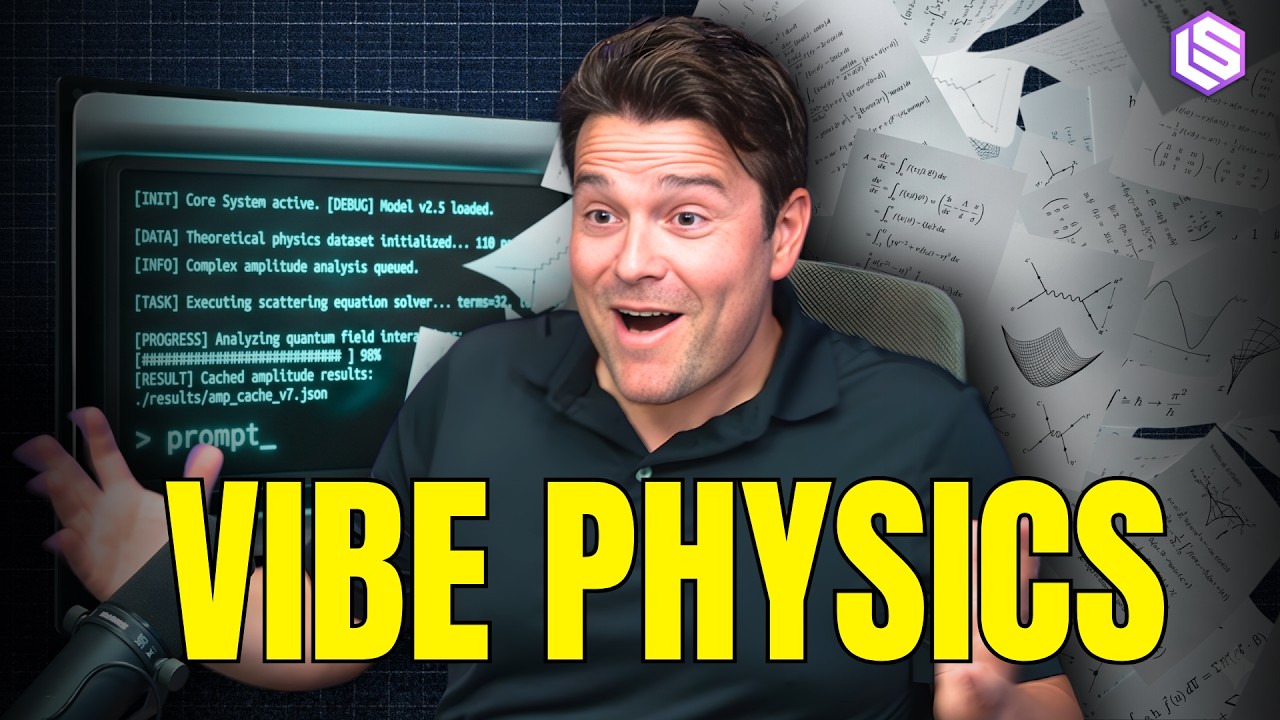
Lubyansky describes this interaction as “vibe physics,” where the researcher steers the model through a 110-page chat exchange. The AI suggested using the “directed matrix tree theorem,” a sophisticated mathematical tool the humans hadn’t initially considered. By performing the heavy lifting of the derivation, the AI allowed the physicists to focus on the high-level symmetry implications.
This shift moves the primary bottleneck of research from the labor of calculation to the rigor of verification. The humans spent the majority of their time checking the AI’s work rather than deriving it from scratch. This suggests a future where physicists act more like directors, using AI “scouts” to explore multiple theoretical directions simultaneously to see which ones bear fruit.

Key Takeaways
The emergence of reasoning-focused AI models has fundamentally altered the workflow of theoretical physics, reducing year-long hurdles to afternoon sessions. By simplifying equations that were previously considered too complex for human manipulation, AI is uncovering hidden patterns in the laws of nature, particularly in the study of quantum field theory and gravity.
However, this transition creates a new challenge for academia: how to train the next generation of scientists. If an AI can “crush” the foundational problems typically used to build a student’s confidence and skills, professors must find new ways to help students traverse the “desert of confusion” between coursework and the research frontier. The value of a physicist is shifting from their ability to calculate to their “taste”—the ability to identify which questions are worth asking.
The future of scientific publishing is likely to move away from static, terse papers toward interactive, AI-driven documents. As AI continues to scale, we may soon see models solve “decadal” problems that have stumped the entire global community for generations, signaling a new era of accelerated human-AI discovery.
Q&A
Q1: What exactly is a “scattering amplitude”?
A1: It is a complex number that, when squared, gives the probability of a specific particle interaction occurring in a collider, like the LHC. If you know all the amplitudes, you essentially know everything about the physical theory.
Q2: Why was the “linear growth” of terms such a big deal?
A2: Usually, adding more particles makes the math grow factorially (1, 2, 6, 24, 120, etc.), which quickly becomes unmanageable. Finding a linear relationship (where doubling particles only doubles the terms) makes the theory significantly more elegant and solvable.
Q3: How does AI help with the “confusion” of research?
A3: In traditional research, physicists spend days or weeks stuck on a roadblock. With AI, you can ask, “How does this result reconcile with this known fact?” and the model can often spot the missing link instantly, drastically reducing “stuck time.”
Q4: Did the AI write the entire physics paper?
A4: Not entirely. While the AI derived the math and proofs, humans like Andy Strominger wrote the introduction and abstract to provide the wider historical and theoretical context that AI still struggles to frame perfectly.
Q5: What is “AI slop” in the context of science?
A5: It refers to the influx of low-quality, AI-generated papers being submitted to the arXiv preprint server. This makes it harder for the community to find high-quality research and places a higher premium on “formal verification” and human oversight.
Q6: Can AI eventually discover new laws of physics?
A6: Lubyansky believes we are on that trajectory. While current models are excellent at “recombination” and solving well-posed problems, the next step is “creative leaps”—asking the right questions that no human has thought to ask yet.
Q7: Will AI replace graduate students?
A7: No, but it will change their training. Instead of spending a year on one calculation, they might spend that year learning how to “steer” AI to solve ten even harder problems, focusing more on the conceptual architecture of physics.