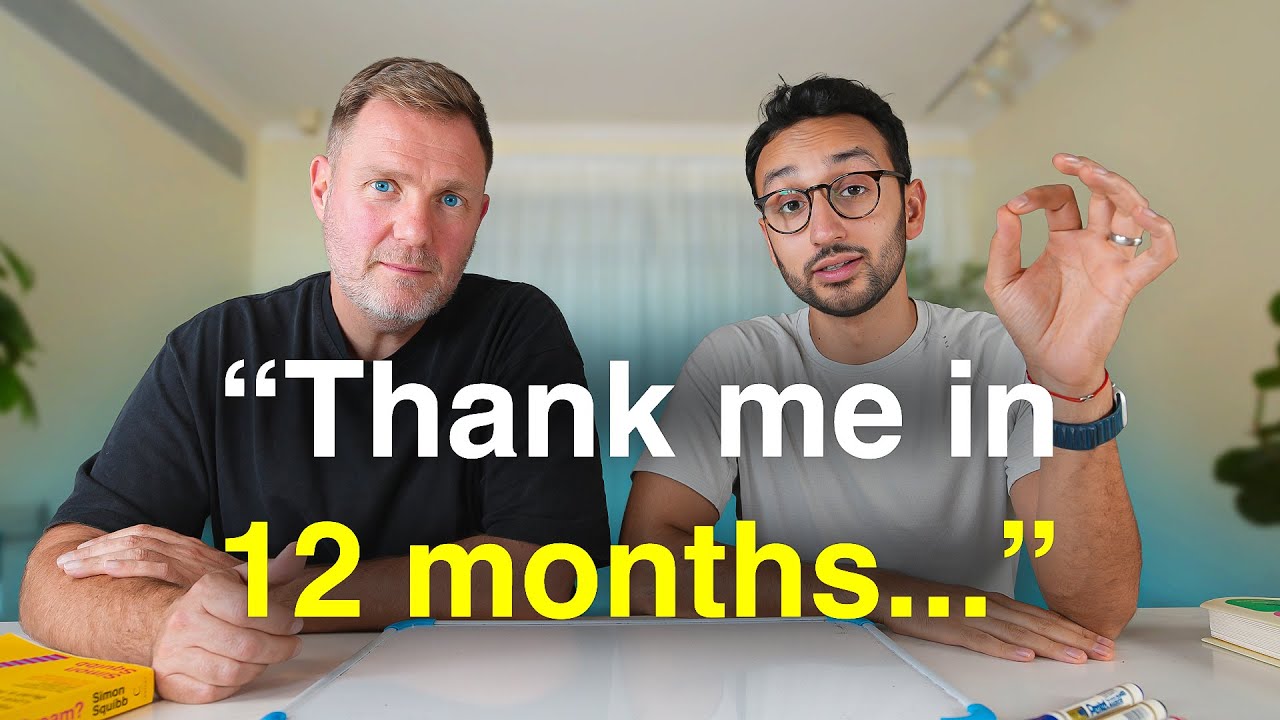
📺 Today’s recommended deep-dive video: https://www.youtube.com/watch?v=_of876Yi6V4
The 8-Step Blueprint to Escape Your 9-to-5 and Build a Multi-Million Dollar Business
Many professionals feel stuck in a cycle of dread, working jobs that offer financial stability but zero personal fulfillment. Ali Abdaal, a former doctor turned multi-millionaire entrepreneur, argues that anyone can transition into a life of freedom by following a specific, eight-step business framework.
Core Question: How can a professional systematically transition from a traditional career to a profitable lifestyle business without taking reckless risks?
Highlights
- Identify your “Freedom Number”—the specific monthly income (typically £3,000) that allows you to work by choice rather than necessity.
- Implement the “Rule of 7” to overcome perfectionism by committing to just seven iterations of your product or content.
- Shift from B2C to B2B services to leverage the psychology of business spending, where £5,000 is often viewed as a minor expense.
- Utilize the “Sell Before You Build” strategy through waitlists and pre-sales to validate demand before investing significant time.
⏱️ Reading time: approx. 10 minutes · Saves you about 47 minutes vs. watching.
Want to take notes while watching? Click the image below and let AI Notebook capture the key points for you 👇

Defining the Goal and Navigating the Streams
Finding Your Freedom Number
Ali’s journey began not with a dream of becoming a mogul, but with a simple observation of his senior colleagues in the medical field. When he asked doctors if they would stay if they won the lottery, half said they would quit instantly, and the other half admitted they only worked full-time to cover their mortgages. This realization led to the concept of the “Freedom Number,” which for Ali was £3,000 a month in passive or side income.
Money is only useful when cashed in for freedom, fun, or fulfillment.
If you can lower your cost of living, you effectively lower the barrier to entry for your own freedom. It is exponentially easier to build a side hustle that generates £2,000 a month than one that generates £20,000, and for many, that smaller number is all it takes to reclaim their time and exit the “fight or flight” mode of living paycheck to paycheck.

💡 Digging Deeper
Q: Why is freedom by itself potentially depressing?
A: Because freedom is a vacuum; without a sense of contribution or growth to fill it, most people lose their sense of purpose and identity.
Q: Is the “Career Stream” inherently bad?
A: Not at all; it offers stability and slow compounding, but it lacks the destiny-control found in owning your own “ship.”
The Mechanics of Starting and Staying Consistent
The Rule of 7 and Intentional Action
The biggest hurdle for most aspiring entrepreneurs is the illusion of certainty provided by the school system, which makes the inherent uncertainty of business feel terrifying. Ali suggests ignoring the “Rule of 100” and focusing on the “Rule of 7″—just do the thing seven times, whether that is seven videos or seven sales calls, to break the seal of perfectionism.
Perfectionism is usually just procrastination in a fancy suit.
To maintain this momentum, you must move beyond vague to-do lists and embrace calendar blocking. Ali notes that while professionals always use calendars for their 9-to-5 meetings, they rarely accord their side hustles the same respect. If a task isn’t cordoned off in a specific time block, it effectively doesn’t exist in the realm of high-stakes execution.

💡 Digging Deeper
Q: What is the most common reason people fail Ali’s YouTube course?
A: Despite paying thousands of dollars, 50% of students never submit the first assignment because they haven’t mastered their time or overcome the fear of a “janky” first attempt.
Q: How can you hack mentorship without actually knowing the mentor?
A: By curating the “five voices” you listen to most often via podcasts and books, effectively absorbing their mindset through digital proximity.
Monetization, Service Scaling, and the Price of Freedom
Sell Before You Build
One of the most expensive mistakes an entrepreneur can make is spending months building a product that no one wants to buy. The solution is a three-tier validation process: first, create a simple waitlist to gauge interest; second, launch a pre-sale to see if people will actually pull out their credit cards; and third, build the actual product only after the market has proven its demand.
Validation is the difference between a calculated risk and a blind gamble.
When it comes to pricing, Ali highlights a massive discrepancy between consumer (B2C) and business (B2B) psychology. A consumer might agonize over a £300 course, whereas a business will often view a £5,000 service as a negligible tax-deductible expense. By shifting your “Who Do You Serve” strategy toward businesses, you can reach your Freedom Number with far fewer clients.

💡 Digging Deeper
Q: Why is a bigger business sometimes easier to manage than a small one?
A: Once you scale past 40-50 people, you can afford professional middle management, allowing the founder to transition from an operator to a true owner.
Q: What does “leaving money on the table” mean in a lifestyle business?
A: It is the conscious decision to stop maximizing profit (e.g., doing fewer sponsorships) in order to maintain a higher quality of personal life and time freedom.
Key Takeaways
The transition from employee to entrepreneur is less about a sudden “leap of faith” and more about a calculated migration between streams. By defining a clear financial goal—the Freedom Number—you remove the ambiguity that leads to burnout. You aren’t trying to become Elon Musk; you are trying to buy back your Tuesday afternoons.
True consistency is achieved by lowering the bar for what counts as a win. Whether it’s a “crap” video or a single stretching session at the gym, not breaking the chain is more important than the quality of any single link. When this discipline is combined with a “sell before you build” mentality, the risk of failure drops significantly because you are only ever building what the market has already asked for.
Finally, remember that the cost of freedom changes as you grow. In the beginning, freedom is bought with hard work and extra income. Later, freedom is preserved by leaving money on the table and refusing to let your business interests own your time. Success is not just about how much you make, but how much of yourself you get to keep in the process.
Q&A
Q1: What exactly is a “Freedom Number”?
A: It is the specific amount of monthly income you need to cover your lifestyle and bills so that your day job becomes optional. For most in the UK/US, this is between £3,000 and £5,000.
Q2: Why does Ali recommend the “Rule of 7” instead of a larger number?
A: Large numbers like 100 are overwhelming. Committing to just seven iterations is psychologically manageable and usually enough to build a basic habit and overcome the initial fear of starting.
Q3: How do you validate a business idea without spending money?
A: Create a simple landing page with a waitlist. If people are willing to give you their email address or pre-pay for a “beta” version, the idea is validated. If not, you’ve saved months of wasted effort.
Q4: Is entrepreneurship actually riskier than a career?
A: Not necessarily. In a career, you have a single point of failure (your boss/company). In entrepreneurship, especially with a personal brand or multiple clients, you own the equity and have diversified income sources.
Q5: What is the difference between an operator and an owner?
A: An operator is essential to the daily functions of the business; if they stop, the money stops. An owner has built systems and teams (or middle management) so the business functions and grows without their direct daily involvement.
Q6: Why is B2B (Business to Business) better for beginners than B2C (Business to Consumer)?
A: Businesses have higher budgets and see services as investments or tax write-offs. It is much easier to find three businesses to pay you £1,000 than to find 100 individuals to pay you £30.
Q7: How does “accountability” help with consistency?
A: Humans are social creatures who hate losing face or money. By using community pressure or financial stakes (like paying a friend if you don’t post), you create a consequence for inaction similar to the threat of being fired from a job.