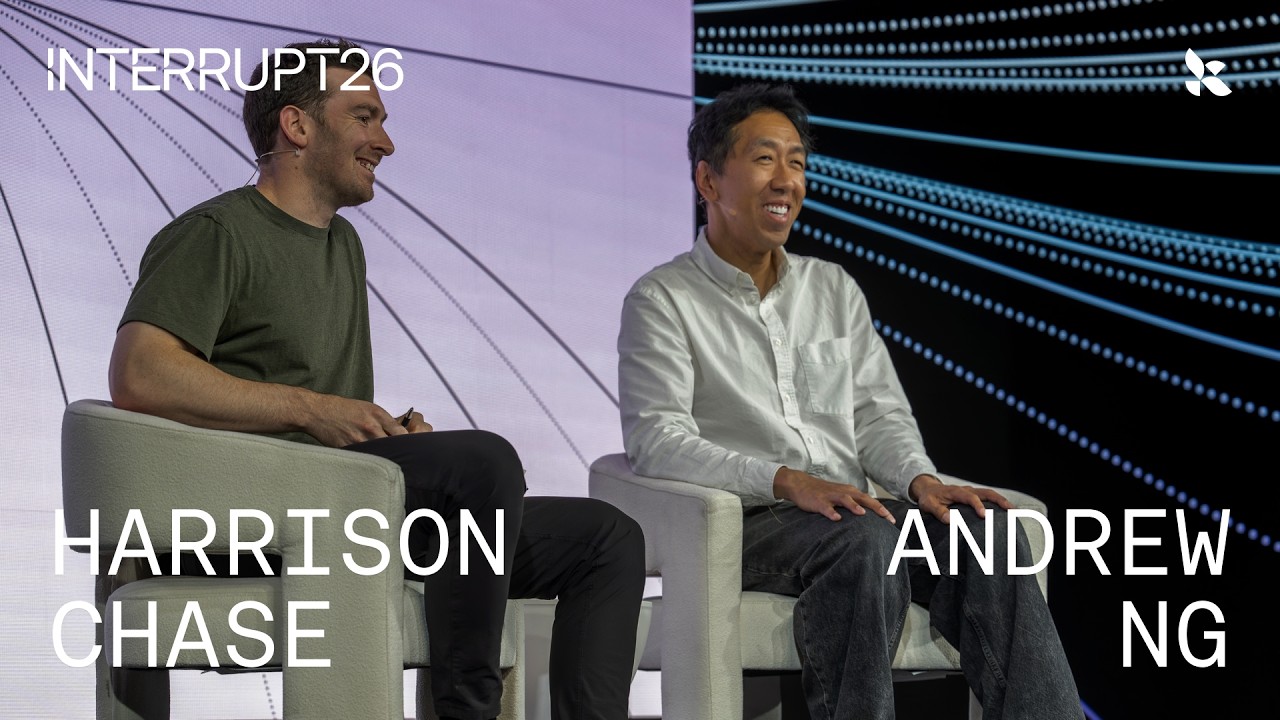
📺 Today’s recommended deep-dive video: https://www.youtube.com/watch?v=OaRhpwz_TGM
Beyond the Code: Andrew Ng on the Agentic Future of Software and Enterprise
Andrew Ng returns to the stage to discuss why software development is accelerating at an unprecedented pace and what that means for business operations. He moves beyond the “AI hype” to explore the practical reality of agentic workflows and the new bottlenecks facing the modern enterprise.
Core Question: How will agentic workflows and coding assistants fundamentally reshape the structure of software teams and corporate growth strategies?
Highlights
- The shift from specialized silos to small pods of “high-context generalists.”
- Why the “Product Management Bottleneck” is expanding into marketing, legal, and design.
- The necessity of top-down workflow redesign to achieve meaningful business ROI.
- Rearchitecting data strategy to prioritize unstructured data for “agent-readiness.”
⏱️ Reading time: approx. 7 minutes · Saves you about 25 minutes vs. watching.
Want to take notes while watching? Click the image below and let AI Notebook capture the key points for you 👇

The New Architecture of Software Engineering
From Coders to Combinatorial Builders
The world of software engineering is currently being turned upside down by coding agents like Claude Code and OpenAI’s latest tools.
Andrew Ng observes that while building code used to be the primary constraint, we have now reached a point where the bottleneck has shifted entirely. When an engineer can produce features ten times faster, the surrounding ecosystem—marketing, legal compliance, and product scoping—suddenly finds itself unable to keep pace with the sheer volume of output being produced by these AI-augmented developers.
In the past, waiting a week for a legal sign-off was acceptable because the feature took three months to build. Today, if the code is finished in an afternoon, a week-long legal review becomes a crushing organizational anchor that prevents rapid iteration.
Consequently, the structure of the modern engineering team is evolving toward small “pods” of one to ten highly empowered generalists. These individuals are deep technical experts who use AI to “level up” in areas where they lack formal training, such as drafting marketing copy or preliminary terms of service. This allows a team of two humans to effectively perform five functional roles, maintaining high context and momentum without the friction of traditional departmental hand-offs.

💡 Digging Deeper
Q: Why are coding agents accelerating faster than other AI tools?
A: The feedback loop is immediate; an agent can write, run, and test code autonomously, allowing for rapid self-correction that isn’t as easily replicated in creative writing or general reasoning.
Q: What is the “pigeonhole principle” in team design?
A: If a project requires five functional roles but you only have two people to maintain speed, those individuals must play multiple roles; AI acts as the bridge that makes them “less bad” at their non-primary skills.
Q: How does Context Hub fit into this?
A: It acts as a “Stack Overflow for agents,” providing the latest documentation and API keys that models might have missed due to their training knowledge cut-off dates.
Transforming Enterprise Workflows for Growth
Moving Beyond Incremental Efficiency
Every major enterprise is currently hunting for AI ROI, yet many are trapped in a “thousand flowers bloom” strategy that only yields marginal gains.
Ng argues that bottom-up innovation typically results in point solutions—small efficiency boosts that save an hour here or there but don’t move the needle for the board. To truly capture the value of AI, leadership must engage in top-down redesigns of entire business processes, such as transforming a week-long loan application into a “ten-minute approval” product.
This level of transformation requires someone with the authority to bridge departmental gaps between marketing, data infrastructure, and final diligence.
Furthermore, while cost savings are the easiest metric to track, the real prize is driving business growth. Cost savings have a hard floor—you can only save 100% of a budget—but growth has no ceiling. The most successful enterprises are moving away from spreadsheets of 300 minor AI ideas and instead placing a handful of “swing-for-the-fences” bets that rethink how they interact with their customers from the ground up.
💡 Digging Deeper
Q: Why is “top-down” necessary for the best AI results?
A: Only leadership has the scope to change how different departments (like marketing and legal) interact to support a new, AI-speed workflow.
Q: What should companies do with their lists of 300 AI ideas?
A: Use technical and business analysis to narrow them down to a small portfolio of meaningful bets rather than trying to fund every minor efficiency project.
Q: Is the “Job Apocalypse” coming?
A: Ng remains skeptical, suggesting that AI will change roles and create new bottlenecks rather than simply eliminating the need for human workers.
Education and Data in the Agentic Age
The Rise of Unstructured Data Readiness
For the last two decades, enterprise data strategy has been obsessed with structured tables and relational databases.
Now that AI can process text, images, and audio, the massive “dark data” sitting in PDF buckets for compliance reasons has suddenly become a goldmine. However, most companies are finding that their current data architecture is too fragmented and governed by permissions designed for humans rather than autonomous agents. Ng anticipates that the next few years will see multi-million dollar projects dedicated solely to making internal data “agent-ready.”
In the realm of education, the transformation is moving from static videos to interactive environments. Tools like CodeDream.ai allow students to have conversations with AI avatars or interact directly with JavaScript code embedded within a video window. This shifts the learning experience from a “lean back” passive activity to a “lean forward” interactive dialogue where the curriculum adapts to the student’s questions in real-time.

💡 Digging Deeper
Q: Why does Andrew Ng prefer NoSQL like MongoDB for AI prototyping?
A: Because agents code so fast that traditional database migrations and schema changes become a frustrating bottleneck; NoSQL allows for faster iteration.
Q: What is the main hurdle for “agent-ready” data?
A: Fragmentation and permissions; data is often stuck on individual laptops or in buckets with governance rules that agents cannot easily navigate.
Q: How is AI changing the delivery of online courses?
A: It is moving away from “canned” video toward interactive JavaScript demos where students can type their own prompts directly into the video interface.
Key Takeaways
The role of the software engineer is shifting from a pure “coder” to a “high-context generalist” who assembles sophisticated building blocks. As AI agents handle the bulk of the syntax and boilerplate, the human’s value moves upstream toward product management, architectural design, and cross-functional execution. This requires a mindset shift: developers must become comfortable navigating legal and marketing concerns as part of their daily workflow.
In the enterprise, the focus must pivot from simple cost-cutting to aggressive growth through workflow redesign. Simply automating a single step in a five-step process provides negligible ROI compared to rethinking the entire chain for near-instant execution. Leaders should prioritize “optionality” by avoiding long-term, vendor-locked contracts in an era where the leading model or tool changes every six months.
Finally, the underlying infrastructure of the digital world—data and education—is being re-indexed for an AI-first reality. Success in this new era depends on a company’s ability to unlock its unstructured data and foster a culture of “combinatorial building,” where the ability to rapidly assemble AI building blocks is the ultimate competitive advantage.
Q&A
Q1: What has surprised you most in the AI space over the last year?
A: The hype and doomsaying narratives gained more traction than I expected, particularly the “job apocalypse” fears. On the positive side, coding agents took off much faster than I would have guessed.
Q2: What is the “Product Management Bottleneck”?
A: It’s the realization that when building software becomes 10 to 100 times faster, the actual bottleneck is no longer coding, but deciding what to build and how to communicate that value to customers.
Q3: How should teams be structured in the future?
A: I see the rise of small pods—1 to 10 people—who are deep technical generalists. They use AI to handle “first drafts” of tasks traditionally handled by other departments, like legal or marketing, to keep the momentum high.
Q4: What is your advice on vendor selection for AI models?
A: Maintain optionality. The “frontier” model changes rapidly. I personally rarely sign contracts longer than a year because I want the flexibility to switch to whatever tool is best in twelve months.
Q5: Why is unstructured data so important right now?
A: Most company data is in PDFs, images, and audio files that were previously ignored. AI can now “read” this data, but our architectures aren’t yet set up to feed this information to agents reliably.
Q6: What is the benefit of using NoSQL databases like MongoDB in AI development?
A: It allows for faster prototyping. When agents are generating code at high speed, having to stop and refactor a rigid relational database schema every time you add a field is a significant bottleneck.
Q7: How is AI changing the “ROI” conversation in the boardroom?
A: CEOs are moving past “bottom-up” innovation (which produces minor efficiency) and toward “top-down” transformation, where AI is used to fundamentally change business models and drive massive growth.