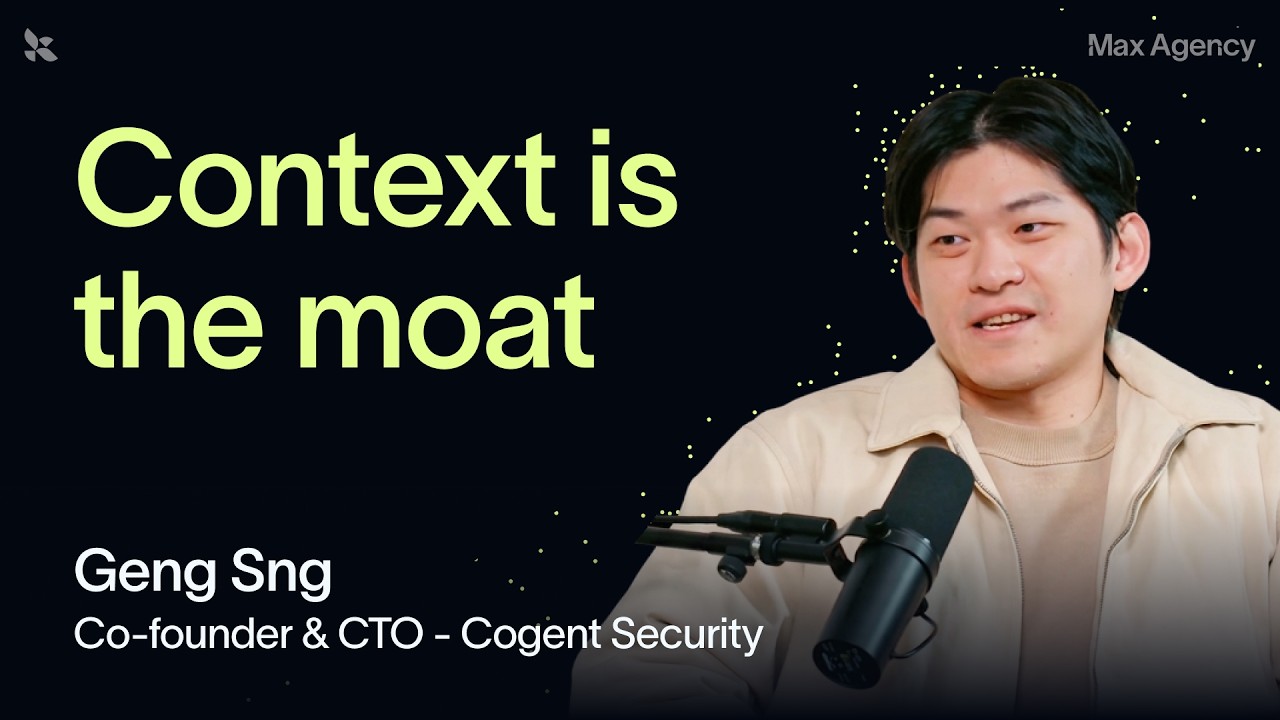
📺 Today’s recommended deep-dive video: https://www.youtube.com/watch?v=D6XWu54oG4g
Closing the Zero-Day Window: The Rise of Autonomous Cyber Defense
Traditional security timelines have been shattered by frontier models capable of finding novel exploits in a matter of minutes. As the window between vulnerability discovery and active exploitation collapses, Cogent is building autonomous agents that can act at machine speed to patch, contain, and remediate threats before human teams can even triage a ticket.
Core Question: How can autonomous agent architectures solve the “defensive gap” where attackers only need to be right once, but defenders must secure every unique “castle” simultaneously?
Highlights
- The Minute-Scale Exploit: Mean time to exploit has shrunk from years to minutes due to frontier models finding zero-days in hours.
- Agentic Data Lakes: Cogent replaces traditional, unscalable graph databases with a “context swarm” that colors high-scale data stored in S3.
- The Trust Ladder: Automation isn’t all-or-nothing; it progresses from read-only recommendations to auto-remediation of low blast radius assets.
- Defensive Scarcity: While offensive exploits are well-documented, defensive security is harder to automate because every enterprise “castle” is built with unique, unmodeled logic.
⏱️ Reading time: approx. 8 minutes · Saves you about 67 minutes vs. watching.
Want to take notes while watching? Click the image below and let AI Notebook capture the key points for you 👇

The New Speed of Cyber Conflict
The Compression of the Exploit Window
The security landscape has shifted from a marathon to a sprint where the runners are no longer human. Just two years ago, a security team had a massive window—roughly 2.5 years—to backlog and triage a vulnerability before it was exploited in the wild, but today that window has effectively vanished.
The attack surface is expanding so rapidly that humans have effectively been priced out of the manual defense game.
This shift is driven by a combination of digital sprawl and the arrival of frontier models like Claude Opus 4.7. These models are now capable of finding zero-day exploits in battle-tested environments, such as Mozilla, within just a few hundred turns of reasoning. When an attacker can generate a novel exploit at the cost of a few API tokens, the defender’s only hope is a system that reacts at the same metabolic rate.

💡 Digging Deeper
Q: Why is finding vulnerabilities no longer the main challenge?
A: Detection tools are plentiful; the bottleneck is the “remediation hell” where patching a single dependency might break an entire production environment.
Q: Can AI find zero-days on its own?
A: Yes, frontier models have proven they can find vulnerabilities in decades-old, pen-tested codebases by iteratively reasoning through 500+ turns.
Q: What is the “Mean Time to Exploit” today?
A: It has compressed from years to minutes, necessitating a shift from human-in-the-loop to autonomous defensive agents.
The Architecture of an “Agent Lake”
Context Swarms and High-Scale Data
Cogent avoids the common pitfall of relying on graph databases, which often fail to scale under the weight of billions of daily security events. Instead, they utilize an “agentic data lake” where raw events are stored cheaply in S3 and processed by a swarm of background agents. These agents act as a “nervous system,” resolving identities and mapping assets across disparate systems like AWS, Jira, and GitHub.
The system builds a dynamic ontology where agents “color” a structural graph with high-confidence inferences about internet exposure and data sensitivity.
Most enterprises struggle with “system ownership” because data is scattered across old AWS tags and stale org charts. Cogent’s agents perform long-running data science tasks—running Spark and Jupyter notebooks—to corroborate who actually owns a piece of code. This cleaned, high-fidelity context is what eventually allows the system to cut through the noise of millions of alerts to find the top 100 risks that truly matter.

💡 Digging Deeper
Q: Why not use a standard Knowledge Graph database?
A: Graph databases struggle with the write-throughput required for billions of events; a data lake with materialized views is faster and more cost-effective.
Q: What is the difference between “Hot” and “Cold” context?
A: Hot context is actively being used in a session or ongoing task, whereas cold context is archived historical metadata that remains searchable but inactive.
Q: How do agents handle “unverifiable” data like system ownership?
A: They enter reasoning loops, asking pointed questions across different data sources and building confidence scores based on corroborating evidence.
Scaling the Trust Ladder
Moving From Read-Only to Auto-Remediation
Building trust is the primary hurdle for any autonomous system operating in a high-stakes enterprise environment. Cogent uses a “trust ladder” approach, starting customers in a read-only mode where the AI simply suggests fixes that humans can approve with a single click. Over time, as the agent proves its accuracy, it moves toward auto-routing tickets and eventually auto-remediation in dev or staging sandboxes.
You cannot expect a bank to let an AI autonomously patch a primary payment processor on day one.
The real challenge isn’t the patch itself, but predicting the production impact of that patch. Cogent’s coding agents spin up isolated sandboxes to validate if an upgrade breaks existing invariants before it ever touches a production server. This allows for a “low blast radius” strategy where a large percentage of the attack surface is protected autonomously, while high-risk systems remain under human supervision.
💡 Digging Deeper
Q: What prevents an agent from “hallucinating” a destructive write action?
A: Cogent uses deep sandbox isolation where agents have read-only permissions by default; write actions must be elevated through a deterministic policy engine outside the box.
Q: How does the “interactive agent” differ from “background agents”?
A: Interactive agents prioritize low latency for human chat, while background agents handle long-running, parallelized data science tasks without speed constraints.
Q: Can the user see what the agent is thinking?
A: Yes, Cogent emphasizes “explainability” by surfacing the agent’s planning phase and tool-use trajectories in a transparent chat interface.
The Defensive Bastion
Why Defensive AI is a Harder Problem
There is a common misconception that since AI can generate exploits (offensive), it can easily fix them (defensive). However, offensive security is a well-defined task with massive amounts of labeled training data available from decades of pen-testing. Defensive security is “customized” for every organization; a patch that works for one company might crash the custom legacy stack of another.
Every enterprise is a unique castle with its own specific guards, schedules, and hidden holes in the walls.
Because defensive data is so scarce and company-specific, Cogent is moving toward post-training open-source models on organizational context. By feeding a model a company’s unique ticketing history, change-control processes, and architectural quirks, they can create an agent that “understands” the local environment better than any generic frontier model could. This localized intelligence layer is what will eventually distinguish a generic “coding assistant” from a true “security defender.”

Key Takeaways
The era of human-speed security is ending. As frontier models lower the barrier for sophisticated cyberattacks, the defense must shift toward autonomous “Agent Lakes” that can resolve identity, context, and risk in real-time. By treating security as a data-scaling problem rather than just a detection problem, organizations can finally move from reactive firefighting to proactive, autonomous shielding.
Success in this new paradigm requires more than just smart models; it requires a robust context layer that captures how organizational decisions are made. By building a “trust ladder” that slowly expands the autonomy of these agents, enterprises can shrink their attack surface and allow their human analysts to focus on high-level strategy while the agents handle the relentless, minute-by-minute battle of the patches.
Q&A
Q1: What is the primary bottleneck in security today?
A: It isn’t finding bugs, but the “remediation bottleneck”—the slow, manual process of patching vulnerabilities without breaking production systems.
Q2: How does Cogent handle the massive scale of enterprise data?
A: They use an “Agentic Data Lake” on S3, where swarms of agents perform ETL and identity resolution across billions of events daily.
Q3: Can these agents actually write code to fix vulnerabilities?
A: Yes, Cogent uses coding agents that work in sandboxed environments to test patches, validate dependencies, and ensure no production impact before deployment.
Q4: How do you interview for “High Agency” in AI builders?
A: By diving five or six levels deep into their past experiences to understand their reasoning, motivations, and how they handled circumstances where tools were nascent or broken.
Q5: Will generic LLMs eventually commoditize the security industry?
A: Offensive security is becoming commoditized, but defensive security remains a “last bastion” because it requires hyper-specific organizational context that generic models lack.
Q6: What is “Agentic RAG” in this context?
A: It is the use of a file system as a high-efficiency way to pass context between agents, allowing them to retrieve and manipulate data within a localized environment.
Q7: How does Cogent price its service given the high compute cost of agents?
A: They stick to the industry standard of “asset-based pricing,” charging based on the number of entities protected, which aligns the cost with the customer’s total attack surface.