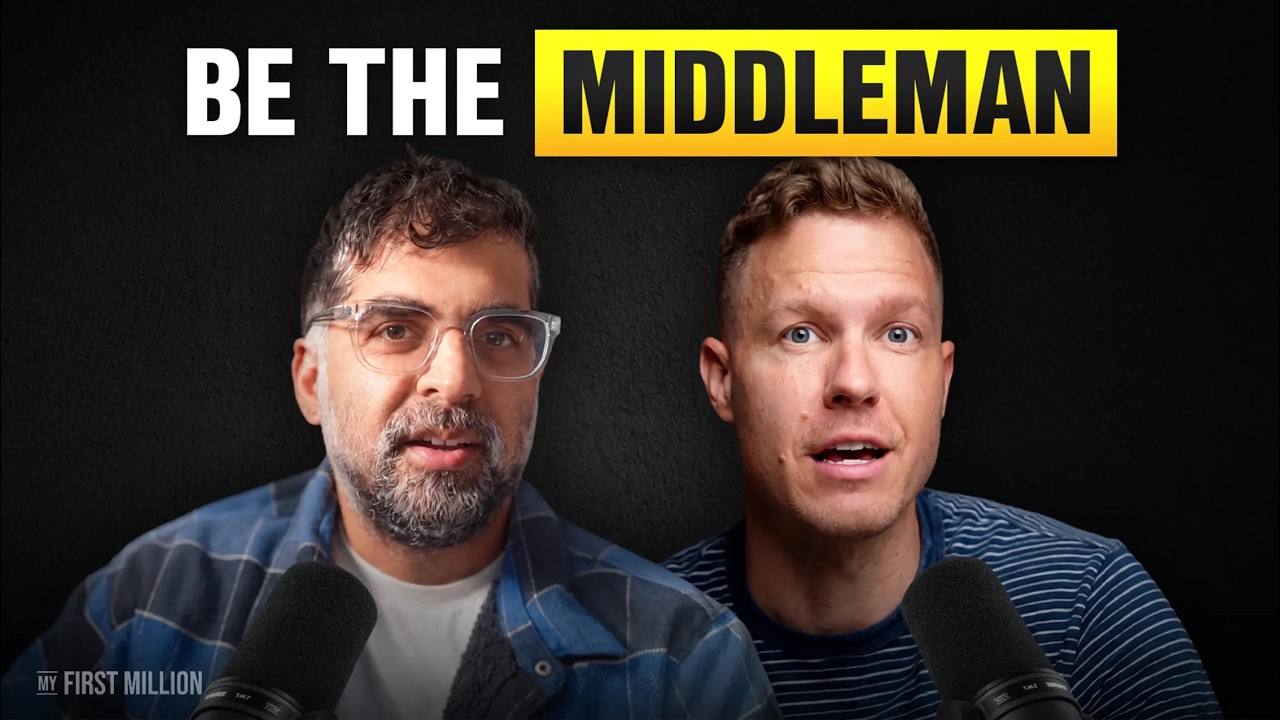
📺 Today’s recommended deep-dive video: https://www.youtube.com/watch?v=hTodVJ81I7Q
The Middleman Empire: Silent Dominance and the Economics of Inevitability
There is a family-owned company that generates more revenue than Nike, Starbucks, and Goldman Sachs combined, yet remains virtually invisible to the public eye. Understanding how they achieved “silent dominance” reveals a blueprint for building wealth that lasts centuries rather than seasons.
Core Question: How do the world’s most successful dynasties leverage physical logistics, family culture, and economic paradoxes to maintain power across generations?
Highlights
- Cargill’s 80/20 reinvestment rule that produced over 20 family billionaires.
- The Jevons Paradox: why making code cheaper will lead to an explosion in demand.
- The stark psychological difference between “Project” entrepreneurs and “Empire” builders.
- Why explicit family meetings and ironclad trusts are essential for multi-generational success.
⏱️ Reading time: approx. 7 minutes · Saves you about 44 minutes vs. watching.
Want to take notes while watching? Click the image below and let AI Notebook capture the key points for you 👇

The Invisible Giant: Cargill’s Middleman Mastery
The 80/20 Rule of Compounding
Cargill operates as the ultimate middleman, sitting at the center of the global food supply chain by owning the infrastructure that connects farmers to consumers. They don’t just trade grain; they own the elevators, the ships, the processing plants, and even the salt on your fries. By controlling the physical logistics of the railroad and the shipyard, they became more valuable than the producers and the buyers combined, proving that being in the middle is a position of extreme power.
They operate under a strict financial rule: 80% of all profits are reinvested back into the business, while only 20% are paid out as dividends to the family.
This “silent dominance” strategy allowed the family to remain private for 160 years. While other billionaires seek the spotlight on CNBC or podcasts, the Cargill heirs prefer “wealth whispering,” maintaining a massive $150 billion revenue stream from a quiet, chateau-style office far from the public eye. Because they are private, they can prioritize 50-year outcomes over next month’s earnings report, a luxury that most public competitors simply cannot afford.

💡 Digging Deeper
Q: Why is being a middleman often seen as a weak position?
A: Usually, middlemen are easily “cut out” if they only provide information, but Cargill owns the physical bottlenecks like grain elevators and shipping ports that cannot be bypassed.
Q: How has the family stayed in control for 160 years?
A: They transitioned to professional CEOs decades ago, allowing the family to remain owners without the risk of an incompetent heir destroying the daily operations.
Q: Is there a “dark side” to this level of dominance?
A: Critics point to child labor accusations in global supply chains and a “spy network” of crop intelligence that is reportedly more accurate than the CIA’s.
Building 100-Year Legacies
The Architecture of Multi-Generational Wealth
Most entrepreneurs are wired for “projects,” seeking the thrill of the start, the grind of the middle, and the finality of a sale. This cycle provides variety and fresh chapters. However, a different breed of founder focuses on laying bricks for an empire designed to outlive them by a century, treating the business as a permanent cathedral rather than a flip.
Building a legacy requires shifting from implicit to explicit culture. Families like the Rockefellers or the Hursts didn’t survive by accident; they utilized ironclad legal trusts and monthly family meetings to instill specific values. Instead of assuming children understand the business, these dynasties run their families like boards of directors, discussing credos, missions, and financial expectations openly to ensure the “saddest child” doesn’t bring down the entire family’s hard-earned achievements.
You can choose to be an author of many books or the architect of a single, massive cathedral that stands for five hundred years.

💡 Digging Deeper
Q: What is a “Family Meeting” in this context?
A: It is a formal, recurring meeting where family members review financial performance, discuss values, and vote on how resources should be spent on new “dreams.”
Q: How do legal trusts prevent family infighting?
A: They often include “no-contest” clauses where any heir who disputes the trust or the board’s decision is immediately stripped of their inheritance.
Q: Can legacy be “forced” on children?
A: No, which is why experts suggest focusing on “identity creation”—reinforcing positive traits in children until those traits become their core identity.
The Jevons Paradox and the AI Boom
Why Code is the New Coal
The Jevons Paradox suggests that as a resource becomes more efficient to use, we actually end up consuming much more of it.
When the steam engine made coal usage more efficient, critics thought coal demand would drop. Instead, the demand exploded because everyone wanted a steam engine. We saw this again with the cotton gin, which inadvertently cemented the economic engine of the American South by making cotton processing 50 times faster.
Today, AI is making the production of code significantly cheaper and faster, leading many to fear a loss of engineering jobs. History tells a different story. Just as the printing press led to an infinite expansion of reading material rather than a contraction of writers, cheap code will likely create a net positive of new industries. We aren’t looking at a world with less work; we are entering an era where intelligence becomes a base unit of measurement, used in ways we cannot yet imagine.

💡 Digging Deeper
Q: If AI makes work easier, why won’t we work less?
A: Humans are like bees; we instinctively fill the space we are given. As work becomes easier, our ambitions scale to match the new capacity.
Q: What is the biggest risk during these technological shifts?
A: The “length of turmoil”—the time it takes for a society to co-invent the surrounding infrastructure (like steel for railroads) to support the new tech.
The Mindset of an “Ice King”
The “Only Way Out is Through” Philosophy
Frederick Tutor, the “Ice King,” didn’t just sell frozen water; he sold the concept of “winter” to people in the tropics who had never seen it. When initial shipments melted or were met with confusion, he didn’t quit. He gave bartenders free ice to create a taste for chilled rum, effectively engineering a demand that didn’t exist. His story proves that innovation often requires teaching the market why they need your solution in the first place.
Many founders fail because they “over-architect” solutions instead of just solving the problem. They spend weeks buying the right running shoes and headphones rather than just hitting the pavement.
Stop trying to find a clever way around the hard work. In most cases, the obvious, boring solution is the only one that actually produces a result.

Key Takeaways
The success of the Cargill family and the historical “Ice Kings” of industry highlights a shared trait: the ability to see value in infrastructure and logistics that others find boring. By owning the “boring” middle—the storage, the transport, and the processing—these entities create a level of “silent dominance” that is nearly impossible to disrupt. This is further bolstered by a reinvestment strategy that prioritizes the health of the empire over the immediate whims of the owners.
Furthermore, the Jevons Paradox reminds us that technological shifts like AI should be viewed through the lens of expanding demand rather than contracting supply. Those who thrive in the coming years will be the ones who stop resisting the “weather” of progress and instead start building the new “grain elevators” of the digital age. Whether you are building a multi-generational dynasty or a high-growth startup, the most effective path forward is usually the most direct one: stop over-planning and start through.
Q&A
Q1: What is the 80/20 rule mentioned in the Cargill story?
A: It is their policy of reinvesting 80% of profits back into the company and only distributing 20% to the family, fueling massive, long-term growth.
Q2: What is the Jevons Paradox?
A: It is an economic principle stating that as a technology makes a resource more efficient, the total consumption of that resource actually increases because demand explodes.
Q3: Why did the “Ice King” Frederick Tutor succeed?
A: He didn’t just sell a product; he engineered demand by giving away free samples of “chilled drinks” to bartenders, creating a new consumer habit.
Q4: What is the difference between a “Project” and an “Empire” mindset?
A: Projects are about starting and selling for a fresh chapter; Empires are about building a permanent foundation intended to last for 100+ years.
Q5: How do successful families maintain culture across generations?
A: They use explicit communication, such as formal family meetings and “family crests,” to declare their values rather than leaving them implied.
Q6: What is the “Only Way Out is Through” advice?
A: It is a reminder to stop over-architecting complex solutions to avoid the hard work and to instead focus on the most direct, obvious solution to the problem.
Q7: How did Cargill become so dominant in the food industry?
A: By building grain elevators right next to railroads, they became the physical middleman that farmers had to use to get their crops to market.