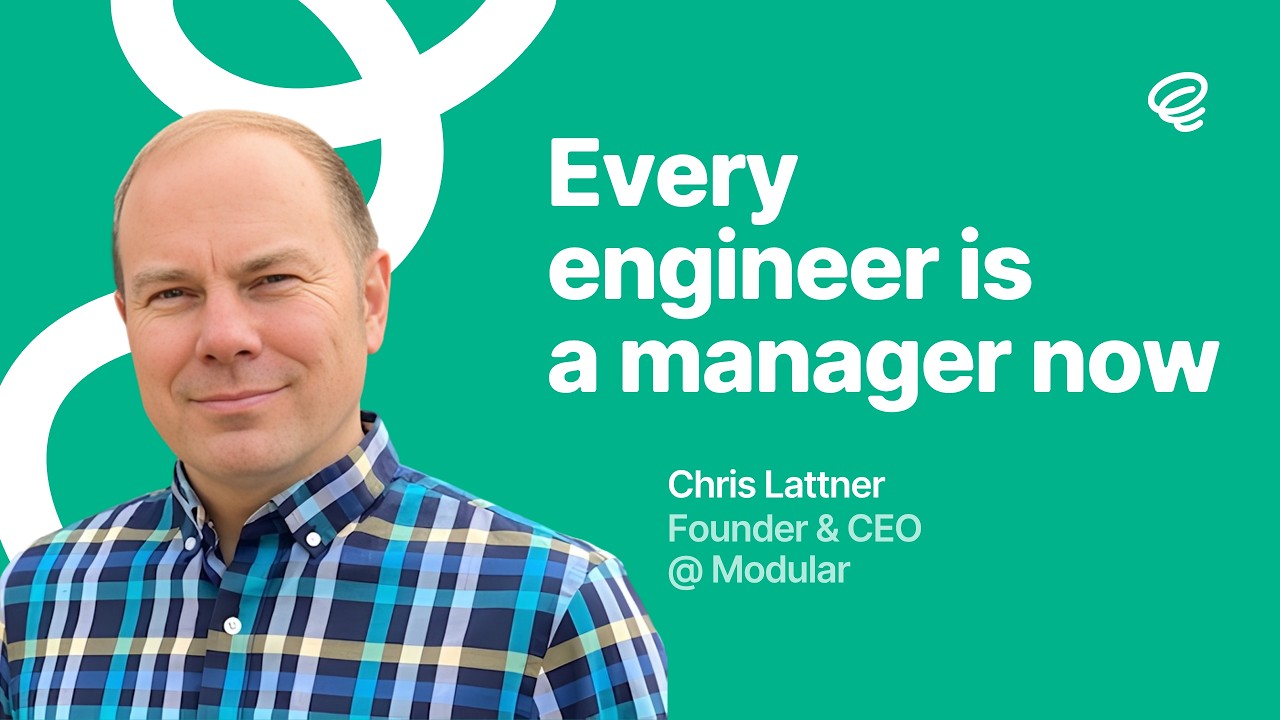
📺 Today’s recommended deep-dive video: https://www.youtube.com/watch?v=PLQs_hHTzSk
Beyond the AI Slop: Chris Lattner on the Future of Computing Infrastructure
AI is currently a high-stakes race where the elite hold all the keys, leaving the rest of the industry struggling with “duct-taped” infrastructure. In this deep dive, the creator of Swift and LLVM reveals how he is rebuilding the software stack to democratize high-performance compute.
Core Question: How can we transform AI from a specialized niche into a portable, high-performance programming paradigm accessible to every engineer?
Highlights
- Modular’s mission to replace aging “dinosaur” tech like CUDA with Mojo, a modern and portable compiler stack.
- Why the rise of “AI slop” threatens the health and mentorship cycles of open-source communities.
- The shift from “coder” to “manager,” where every developer must prioritize architectural intent over raw syntax.
- Why AI serves as an amplifier that exposes—and punishes—poor engineering hygiene like slow CI and technical debt.
⏱️ Reading time: approx. 7 minutes · Saves you about 52 minutes vs. watching.
Want to take notes while watching? Click the image below and let AI Notebook capture the key points for you 👇

Cracking the AI Infrastructure Bottleneck
From “Dinosaur” Tech to Modern Compilers
The current state of AI infrastructure is a chaotic mess of legacy tools held together by duct tape and prayer. While elite research labs and trillion-dollar companies can afford the specialized “wizards” required to navigate these systems, the average developer is essentially locked out of the full potential of modern hardware.
The industry is currently being held back by “dinosaur” technologies like CUDA, which is two decades old and fundamentally rooted in C++ paradigms that predate the modern GPU revolution. Chris Lattner argues that we need a clean-sheet approach to software that treats AI not as a separate, scary niche, but as a standard programming paradigm that can scale across any chip, from NVIDIA to AMD to Apple Silicon.
Modular aims to solve this by providing a unified, high-performance stack that removes the “expert gatekeeping” currently surrounding GPU development.

💡 Digging Deeper
Q: Is AI going to replace traditional software entirely?
A: No; for-loops and structured logic aren’t going anywhere, but AI will become the standard interface for handling the messy boundary between human perception and digital logic.
Q: Why focus on a new language like Mojo?
A: Because syntax isn’t the only problem; we have “missing compilers” that can’t effectively target heterogeneous hardware without sacrificing the ease of Python.
Q: What is the primary goal of the Modular platform?
A: To pull forward innovation by allowing any five-person research team to achieve the same performance as a massive lab without needing a closet full of CUDA experts.
The Engineering Shift: From Coder to Manager
AI as a Productivity Amplifier
Even for elite programmers, AI tools are providing a 10% to 20% boost by automating the “micro-aggressions” of software development. Tasks like updating test cases after an intentional behavior change or performing context-sensitive renames across a massive codebase are now handled instantly, allowing humans to stay in a state of flow.
The real transformation, however, is that every software engineer is now effectively a manager of agents.
Even fresh graduates must adopt “manager thinking,” focusing on what they are trying to achieve and how a system will be maintained over time, rather than just pounding out lines of code. This shift rewards those who can articulate design intent and architectural constraints clearly to their AI assistants.

💡 Digging Deeper
Q: Who benefits most from AI coding tools?
A: While experts get a modest lift, junior engineers and “AI-native” students are seeing massive gains because the tools bridge the gap between their conceptual knowledge and syntax execution.
Q: What is “vibe coding” and why is it dangerous?
A: It is the practice of generating impressive-looking demos that lack the testing, edge-case handling, and architectural integrity required for production-grade software.
The Open Source Crisis and “AI Slop”
Maintainer Burnout in the Age of Agents
Open source is facing a mounting crisis where maintainers are being overrun by low-quality “AI slop” contributions. In a healthy community, maintainers invest in new contributors to help them grow into long-term stewards, but AI has broken this cycle by allowing anyone to submit massive pull requests with almost zero effort.
The reviewer still has to perform the same amount of high-intensity work, but the volume of submissions has exploded, leading to a toxic environment where high-quality human contributors get lost in the noise.
Lattner warns that if we don’t develop new processes to filter this influx, the vibrancy of essential projects like LLVM could be permanently damaged.

💡 Digging Deeper
Q: How is AI changing intellectual property in open source?
A: We are seeing cases where developers use agents to “transcode” proprietary tools into new languages to strip licenses, a practice that current copyright law isn’t prepared to handle.
Q: Will AI eventually write entire kernels from scratch?
A: While possible, Lattner is skeptical; AI excels at “transcoding” existing knowledge (like moving C into Rust) but lacks the novelty required to drive the world forward with truly new ideas.
Engineering Hygiene as a Competitive Advantage
Fast CI and Architecture Docs
AI is an amplifier that punishes teams with significant technical debt or slow feedback loops. If your Continuous Integration (CI) takes hours to run, an AI that allows you to write code ten times faster will only make the bottleneck feel ten times more painful.
The teams that win in the AI era will be those that invest heavily in “boring” basics: fast CI, comprehensive test suites, and living architecture documentation.
Lattner proposes a future where AI doesn’t just write code, but maintains the “connective tissue” of a project by scanning documentation and identifying parts that have fallen out of sync with the actual implementation.

Key Takeaways
Modern software development is moving away from the era of “syntax experts” and toward an era of “architectural stewards.” As AI automates the mechanical aspects of coding—renaming variables, writing tests, and scaffolding modules—the value of a human engineer shifts entirely toward decision-making and long-term maintenance.
High-performance infrastructure must be democratized to prevent a permanent divide between AI “haves” and “have-nots.” By building portable, high-level languages like Mojo that don’t sacrifice hardware performance, the industry can move away from proprietary silos and toward an open, interoperable future where innovation happens everywhere, not just in the largest data centers.
Finally, remember that AI is an amplifier. If you apply it to a mess, you simply get a bigger mess faster. Success in this new paradigm requires more discipline, not less, with a renewed focus on engineering hygiene, fast feedback loops, and principled architectural design.
Q&A
Q1: What is the “elevator pitch” for Modular?
A: Modular is reinventing AI infrastructure to make software portable across all platforms and GPUs, cracking open the bottleneck that currently limits high-performance AI to elite teams.
Q2: How does Mojo differ from Python?
A: Mojo keeps the friendly syntax of Python but adds a modern compiler stack (MLIR) that allows it to be hundreds or even thousands of times faster, capable of running on both CPUs and GPUs.
Q3: Is Lattner worried about AI replacing programmers?
A: No; he views it as a tool that removes the “friction and micro-aggressions” of refactoring, allowing programmers to focus on the thorniest problems that require human judgment.
Q4: What is the biggest danger to open source right now?
A: The “AI slop” problem, where maintainers are overrun by low-effort PRs, potentially cutting off the inflow of genuine new contributors who need mentorship.
Q5: Should companies still hire junior engineers?
A: Yes; Lattner is bullish on juniors because they are AI-native and willing to adapt to new tools faster than seasoned veterans who may be stuck in legacy ways of thinking.
Q6: What does “Every developer is a manager” mean?
A: It means engineers must prioritize defining the “what” and “why” of a project, managing AI agents to handle the “how,” and taking responsibility for the long-term maintainability of the output.
Q7: Why is “fast CI” so important for AI-assisted teams?
A: Because AI compresses the time it takes to write code, which puts immense pressure on every other part of the development lifecycle; slow testing becomes the primary blocker to progress.