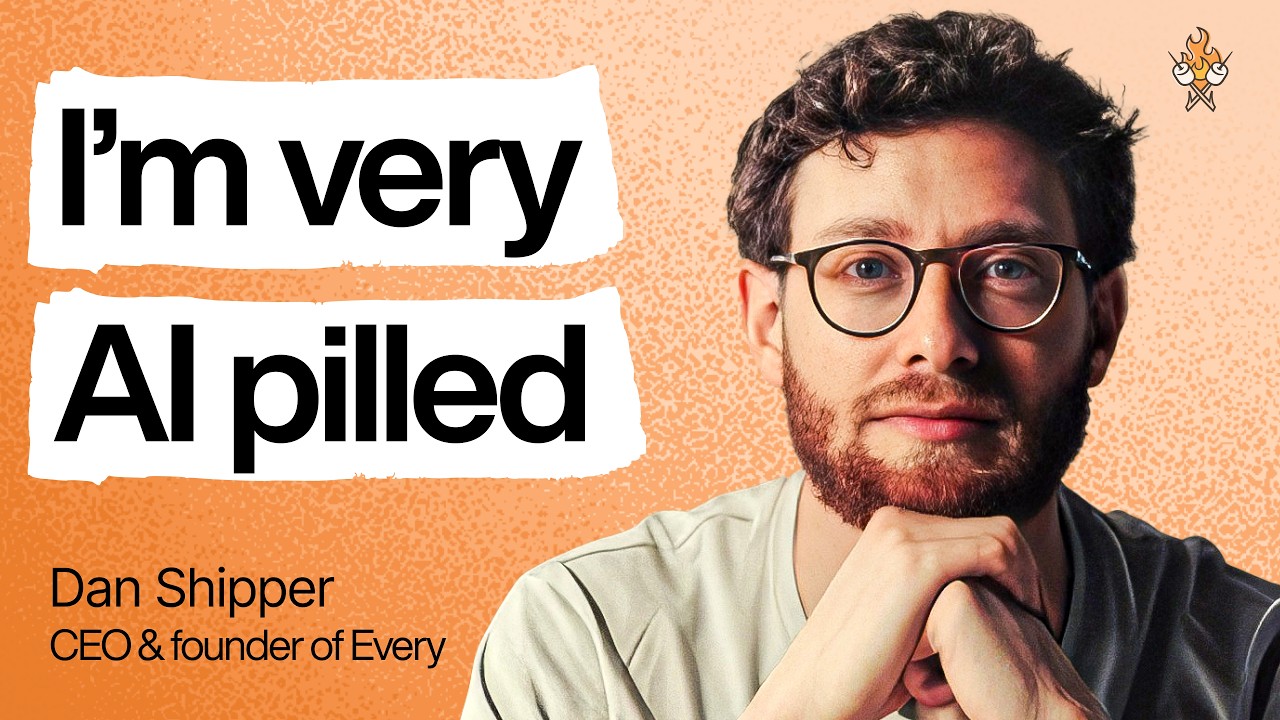
📺 Today’s recommended deep-dive video: https://www.youtube.com/watch?v=4D3hDmGhFhA
The End of the CLI and the Rise of the AI Super-Agent
Dan Shipper, CEO of Every, argues that the predicted AI job apocalypse is a myth and that product managers are about to become more powerful than ever. By living in a “pocket of the future,” he reveals how the next year will shift our focus from chatting with bots to living inside them.
Core Question: How will the integration of AI agents into our daily desktop environments fundamentally reshape SaaS, professional roles, and the definition of human competence?
Highlights
- The CLI era is over; the future of work lives in “harnessed” GUI environments like Codex and Claude Co-work.
- Every AI agent requires a “human who cares” to function, shifting jobs from execution to “forward-deployed engineering.”
- SaaS is not dead; in fact, agents will increase SaaS usage while saving vendor margins as users “bring their own tokens.”
- Product Managers and Designers are the biggest winners, as AI turns “yesterday’s human competence” into a cheap commodity.
⏱️ Reading time: approx. 10 minutes · Saves you about 84 minutes vs. watching.
Want to take notes while watching? Click the image below and let AI Notebook capture the key points for you 👇

The New Operating System for Work
From Chatbots to Desktop Environments
Shipper predicts a massive bifurcation in how we use AI: company-wide “super-agents” for asynchronous tasks and local environment agents that serve as our primary work surface. Instead of visiting a browser to use AI, we are beginning to use AI agents that have browsers built into them, allowing the model to see, research, and execute alongside the human in real-time.
The terminal was a transitionary phase.
While Claude Code gained massive traction among technical users, Shipper notes that we are “speed-running” back to GUIs because they offer better visibility and lower friction for non-programmers. This shift transforms tools like Codex into a surrogate operating system where your email, documents, and research all happen within the agent’s “sight.”

💡 Digging Deeper
Q: Why is the desktop app better than a web-based LLM?
A: A local agent has access to your entire file system, terminal, and specific context that a web-based chat window lacks.
Q: What is the “reach test”?
A: It is an internal metric at Every to see if a tool is successful—do you instinctively “reach” for it first thing in the morning?
Q: Is the CLI dead for everyone?
A: No, but its dominance as the “cool new way” to use AI is fading as unified GUI harnesses like Codex become more sophisticated and user-friendly for all knowledge work.
The SaaS Rebirth and the Super-Agent
Why You Should Buy SaaS Stocks
Despite the “SaaS apocalypse” narrative, Shipper is incredibly bullish on software-as-a-service because agents actually increase the volume of users interacting with these platforms. When an agent uses a tool like Salesforce or GitHub, it can execute a billion requests in seconds, driving demand while potentially lowering costs for the provider.
The “bring your own token” model is the future of software margins.
If users interact with SaaS tools through their own agents (like Codex), they are using their own API credits, which removes the massive AI infrastructure cost from the SaaS vendor’s balance sheet. This allows vendors to focus on building “agent-friendly” interfaces—like clean HTML and robust CLIs—rather than worrying about the high cost of embedding their own LLMs.
💡 Digging Deeper
Q: What is a “Super-Agent”?
A: Instead of every person having a finicky personal bot, companies are moving toward one highly-maintained “Super-Agent” (like Shopify’s River) that everyone queries.
Q: Why did personal agents fail?
A: They require too much “gardening”—most people don’t want to SSH into a server to fix their personal assistant when it breaks.
Q: How does an agent report a bug?
A: An agent-to-agent bug report is superior because it includes exact reproduction steps and even suggested code fixes, creating a “closed loop” of development.
The Rise of the AI-Pilled Generalist
Product Managers as the New Power Users
The most successful people in this new era will be “AI-pilled” PMs and designers who can now execute on their ideas without waiting for a full engineering team. Shipper highlights cases where PMs, using tools like Cursor or Claude Code, ship faster than specialized engineers because they combine deep product sense with the ability to “vibe code” functional prototypes.
AI makes yesterday’s human competence cheap and commoditized.
When a model can handle the rote tasks of writing code or drafting PRDs, the value shifts entirely to the “framing” of the problem and the “vibe check” of the output. This doesn’t eliminate the need for engineers, but it forces them to move into “forward-deployed” roles where they manage systems of agents rather than writing every line of syntax by hand.

💡 Digging Deeper
Q: Will AI replace senior engineers?
A: No, because AI lacks “agency” and “confidence” to rewrite from first principles; current benchmarks show models still struggle to identify when a code base needs a total overhaul vs. a small patch.
Q: Why are designers thriving?
A: Designers can now use AI to turn high-fidelity interactions into actual pull requests, cutting out the “handoff” friction that usually kills creative details.
Q: What is “vibe coding”?
A: It is the process of using natural language and high-level intuition to steer an AI agent through a build, focusing on the “vibe” of the result rather than the underlying code.
Key Takeaways
The transition into an AI-driven workforce is not about the removal of humans, but the elevation of the “human manager.” Shipper’s core philosophy—”Automation is a lie”—reminds us that every automated system requires a human to stand behind it, ensuring the output remains coherent and aligned with the company’s goals. The “job apocalypse” is effectively a “reorganization” where the barrier between technical and non-technical roles dissolves.
To thrive, professionals must “ride the models,” treating every new LLM release as a discovery of new powers rather than a threat to old ones. Whether it is a PM shipping a full app or an editor using an AI co-author, the winners will be those who maintain a sense of “spaciousness and strength” while playing with the technology to find their own moments of joy.
Q&A
Q1: What happens to the “Senior Engineer” role if AI can code at a 60/100 level?
A: Humans shift to a zero-based benchmark. When yesterday’s hard tasks become easy, humans move the goalposts to harder, more complex architectural problems that AI hasn’t seen in its training data yet.
Q2: Should I be worried about reading AI-generated documents at work?
A: Only if they are “slop.” High-quality AI-generated strategy docs, when directed by a human who stands behind every line, are often superior to mediocre human-written ones.
Q3: What is the most underrated skill right now?
A: Curiosity and playfulness. The “edge of AI” isn’t in San Francisco; it’s wherever a real human is experimenting with a model to solve a specific, boring problem.
Q4: Is the SaaS “Super-Agent” just a Slack bot?
A: Currently, yes, because people like keeping work and personal bubbles separate. However, these bots are becoming more integrated into the company’s data warehouse and internal permissions.
Q5: Why did Dan hire more people while becoming more AI-forward?
A: Because AI creates “computer errands” and more pull requests, which ironically requires more humans to review, curate, and manage the increased output.
Q6: What should a PM at a large company do today?
A: Find a way to use Codex or Claude Code on your own time. Turn over every rock and see if the latest model can now solve a problem it couldn’t solve three months ago.
Q7: Will we ever have truly autonomous agents?
A: Likely not in the way people hope. There is a “paradox of automation” where the more we automate, the more work we create for ourselves to ensure those automations stay relevant and high-quality.