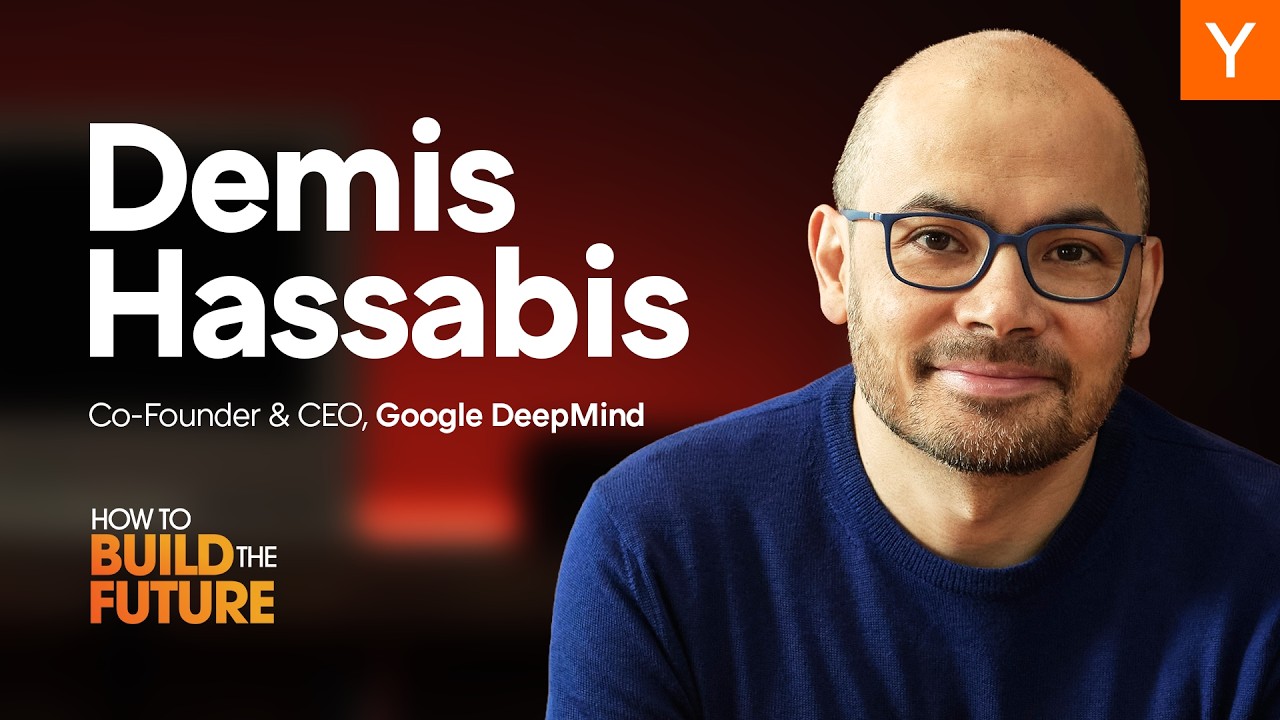
📺 Today’s recommended deep-dive video: https://www.youtube.com/watch?v=JNyuX1zoOgU
Solving Intelligence: Demis Hassabis on the Path to AGI
Google DeepMind CEO Demis Hassabis shares his roadmap for achieving artificial general intelligence, suggesting a timeline as early as 2030. He breaks down the technical hurdles remaining—from continual learning to “soulful” creativity—and explains why AI will be the ultimate tool for scientific discovery.
Core Question: What fundamental architectural shifts are required to move from today’s large-scale pre-training to a system capable of solving the world’s most complex scientific “root node” problems?
Highlights
- AGI is predicted to arrive by 2030, meaning current deep tech startups must plan for AGI to emerge mid-journey.
- Current AI systems are “jagged,” capable of solving gold-medal math problems while failing at basic elementary reasoning.
- True scientific reasoning will be proven when an AI can pass the “Einstein Test”: discovering special relativity using only pre-1905 data.
- Massive combinatorial search spaces and clear objective functions are the key ingredients for AlphaFold-style breakthroughs.
⏱️ Reading time: approx. 7 minutes · Saves you about 34 minutes vs. watching.
Want to take notes while watching? Click the image below and let AI Notebook capture the key points for you 👇

The Missing Pieces of the AGI Puzzle
Beyond the “Duct Tape” of Context Windows
Current AI progress relies heavily on large-scale pre-training and reinforcement learning from human feedback, but these are not the final destination. Hassabis argues that while these components will likely remain part of the final architecture, we are currently “cobbling together” memory and learning with temporary fixes. Using a million-token context window to simulate memory is an expensive and brute-force approach that lacks the grace of biological systems.
True AGI requires a shift toward “continual learning,” where models adapt to new information without forgetting their core weights or requiring massive retraining cycles.
The human brain manages this through consolidation during sleep, specifically REM cycles, to integrate episodic memories into a permanent knowledge base. We need an algorithmic equivalent that moves beyond just “shoving everything into a context window” to a system that understands cost-effective information retrieval.

💡 Digging Deeper
Q: Why is a 10-million token context window not enough?
A: While it seems large, it is essentially “working memory.” If an agent processes live video, 10 million tokens might only cover a few hours, whereas a true agent needs to understand context over months or years.
Q: How “jagged” is current AI intelligence?
A: Systems can solve International Mathematical Olympiad (IMO) problems but still make basic blunders in chess or elementary math because they lack an “introspection” mechanism to monitor their own chain of thought.
Q: What is the “Einstein Test”?
A: It is a benchmark for genuine novelty where a system is given data up to 1901 to see if it can independently hypothesize Special Relativity.
Distillation and the Rise of Agents
The Efficiency Frontier
Google DeepMind is heavily focused on distillation—the process of packing the power of frontier models into smaller, faster versions like the Gemini “Flash” and “Nano” series. Because Google serves billions of users across Search, YouTube, and Maps, there is a massive incentive to drive the cost of inference toward zero while maintaining 90-95% of frontier capability.
These smaller models are not just about cost; they are essential for the future of robotics and edge computing.
Hassabis envisions a world where local, privacy-preserving models handle 99% of your personal data on-device, only delegating to massive “cloud brains” for the most complex reasoning tasks. This orchestration between small, fast edge models and large frontier models will define the next decade of hardware.

💡 Digging Deeper
Q: Can small models ever be as smart as giants?
A: There is likely an information density limit, but Hassabis believes we are currently nowhere near it, suggesting 50B-400B parameter models will eventually match today’s best frontier models.
Q: What is holding back “Agent” technology?
A: The lack of continual learning means agents cannot adapt to your specific personal or professional context in a “fire and forget” manner; they currently require too much human steering.
AI as the Ultimate Scientific Tool
Solving the “Root Node” Problems
The mission of DeepMind has always been two-fold: solve intelligence, then use it to solve everything else. Hassabis views science through the lens of “root nodes”—problems like protein folding which, once solved, unlock entire new branches of biology and medicine. AlphaFold is the prototype for this, used by 3 million researchers to accelerate drug discovery globally.
The secret to an AlphaFold-style breakthrough is finding a problem with a massive combinatorial search space and a clear objective function.
We are roughly 10 years away from a “virtual cell”—a complete digital simulation of a cellular system that researchers can perturb to predict real-world outcomes. This would transform biology from a trial-and-error experimental science into a predictive engineering discipline.

💡 Digging Deeper
Q: Which scientific field will transform most in the next 5 years?
A: Material science and mathematics are ripe for breakthroughs, as they both involve “needles in haystacks” that allow for hill-climbing toward an optimal solution.
Q: What is the “Virtual Cell” bottleneck?
A: A lack of data. We need ways to image live cells at nanometer resolution without killing them to provide the “vision” data necessary for AI training.
Key Takeaways
Building at the frontier requires a focus on “deep tech” areas that are defensible against the rapidly moving baseline of foundation models. Hassabis advises founders to look for interdisciplinary sweet spots where the world of atoms meets the world of bits, as these fields require a level of specialized expertise that a general-purpose LLM cannot easily replicate.
The most important strategic shift for any tech builder today is the realization that AGI is likely to emerge in the middle of a ten-year development cycle.
Startups should not just build for today’s capabilities but “intercept” the trajectory of AI. By the time a deep tech project matures, it will be able to leverage agentic swarms and zero-cost inference to solve problems that are currently considered intractable.
Q&A
Q1: What are the three unsolved problems required for AGI?
A: Continual learning, long-term reasoning, and more sophisticated episodic memory.
Q2: Will AI ever replace human creativity in science?
A: Not entirely. While AI can find “Move 37” in Go, it hasn’t yet shown the ability to invent a game as beautiful and complex as Go from scratch. Humans still provide the “soul” and the high-level “why.”
Q3: How does DeepMind view the role of open source?
A: They are proponents of open science, as seen with AlphaFold. For smaller “Nano” models meant for Android or robotics, open-weight releases like Gemma are strategic because they encourage a “Western stack” of open-source development.
Q4: Is reinforcement learning (RL) still relevant in the age of LLMs?
A: Absolutely. Hassabis believes RL and search (like Monte Carlo Tree Search used in AlphaGo) are being “re-looked at” to give today’s foundation models better thinking and planning capabilities.
Q5: How will AGI impact the job of an engineer?
A: We are entering an era of “1,000x productivity.” An individual engineer using AI tools today can iterate as fast as a whole team did in the early 2000s, but they must still bring “taste” and “craft” to the process.
Q6: What is Isomorphic Labs’ goal?
A: To take the success of AlphaFold and apply it to the entire drug discovery pipeline, treating biochemistry as a computational search problem.
Q7: What advice does Hassabis have for his 25-year-old self?
A: Hard problems are often no more difficult to solve than “shallow” ones, but their impact is significantly higher, so you should always aim for the most consequential work possible.