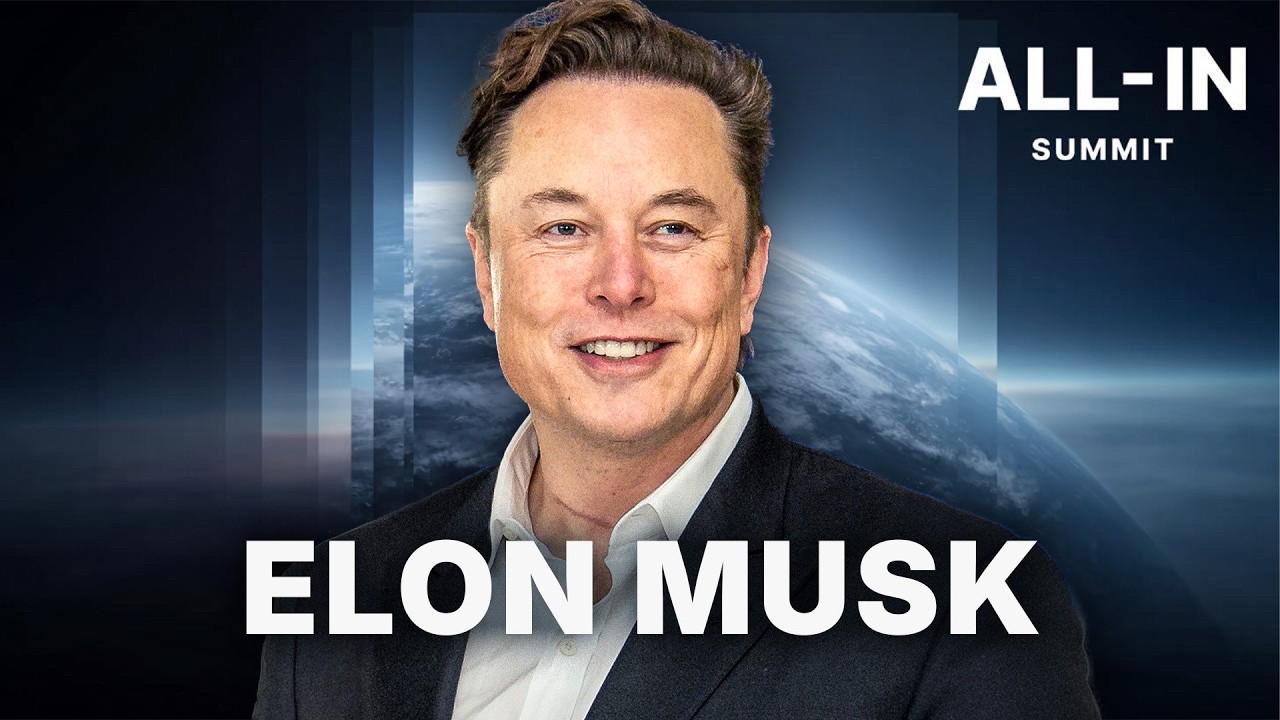
📺 Today’s recommended deep-dive video: https://www.youtube.com/watch?v=qeZqZBRA-6Q
The Master Plan for Consciousness: Robots, Rockets, and the Revival of Curiosity
Elon Musk details his vision for a future where humanoid robots are ubiquitous, AI surpasses human intelligence within years, and Mars becomes a self-sustaining home for consciousness. By focusing on physics first principles, he aims to solve the hardest engineering problems humanity has ever faced while battling civilizational decline.
Core Question: Can humanity scale its technology and intelligence to reach the stars before internal social and demographic crises take hold?
Highlights
- Optimus version 3 aims for human-level dexterity and a target production cost of $20,000.
- The upcoming AI5 chip will offer a 40x performance leap over current Tesla hardware for specific AI operations.
- Starship is projected to demonstrate full reusability and a 100-ton payload capacity by next year.
- A self-sustaining Martian city is potentially achievable within 25 to 30 years through exponential tonnage increases.
⏱️ Reading time: approx. 7 minutes · Saves you about 38 minutes vs. watching.
Want to take notes while watching? Click the image below and let AI Notebook capture the key points for you 👇

The Robotic Frontier and the Dexterity Challenge
Engineering the Human Form
Achieving human-level dexterity is the single hardest mechanical challenge for the Optimus project because the existing global supply chain simply lacks the necessary high-precision actuators. Musk argues that the human hand, with its 28 degrees of freedom and forearm-driven tendon system, is a masterstroke of evolution that must be replicated to make a robot truly generalized and “backwards compatible” with a world built for people.
Tesla is currently finalizing the design for Optimus version 3, which moves beyond simple movements toward complex tasks like threading needles or playing instruments.
Because no external vendor can provide the required motors or gearboxes, Tesla has been forced to design every electronic and mechanical component from scratch using physics first principles. This level of vertical integration is what Musk believes will eventually drive the marginal cost of production down to the $20,000 range once they hit a million units per year. He treats the robot not as a luxury item, but as a high-volume industrial product that requires a completely new supply chain to exist.

💡 Digging Deeper
Q: Why use the human form factor instead of something more specialized?
A: The world is built for humans; a humanoid form is “backwards compatible” with all existing tools and infrastructure.
Q: What is the most expensive part of the robot?
A: The AI chip is expected to be the most costly component, potentially representing $5,000 to $6,000 of the total bill of materials.
Q: How does Optimus differ from other robotics companies?
A: Musk claims others lack the combination of high-volume manufacturing capability, human-level hand dexterity, and a real-world AI mind.
Silicon Leaps and Orbital Reusability
The Road to AI5 and Sentient Cars
Tesla’s silicon strategy is bifurcating into massive training clusters and high-efficiency inference chips that live inside the vehicles. The transition from AI4 to AI5 represents a staggering 40x improvement in specific operations like Softmax, largely because the hardware and software teams are co-designing the silicon to remove very specific architectural bottlenecks.
By the end of this year, software updates are expected to make Tesla vehicles feel “sentient” through a massive increase in parameter counts and refined reinforcement learning.

Starship and the Heat Shield Hurdle
SpaceX is on the verge of making the world’s first fully reusable orbital rocket, with a goal to catch both the booster and the ship by next year. While the Raptor 3 engines provide the necessary thrust for 100-ton payloads, the primary technical “showstopper” remains the heat shield.
Unlike the Space Shuttle, which required months of refurbishment between flights, Starship needs a tile system that can survive the plasma of reentry without any individual inspections. This is a material science problem of the highest order, requiring tiles that are lightweight, durable against rain, and capable of withstanding extreme thermal cycles repeatedly.
💡 Digging Deeper
Q: How does Starlink direct-to-cell work?
A: SpaceX acquired specific spectrum to allow satellites to communicate with modified phone chipsets, enabling video streaming anywhere on Earth within two years.
Q: What is the significance of the Raptor 3 engine?
A: It powers the “Version 3” Starship, which Musk describes as a radical redesign capable of delivering 100 tons to orbit with full reusability.
Civilizational Decline vs. The Martian Goal
The Philosophy of Curiosity
Musk views the current state of Western civilization with growing alarm, citing declining birth rates and a lack of cultural optimism as “indistinguishable from suicide.” He posits that the decline of traditional religion has left a vacuum filled by “dystopian de facto religions” that are inherently self-destructive.
To counter this, he proposes a “philosophy of curiosity”—a drive to expand the scope and scale of consciousness to better understand the questions the universe is asking.
Establishing a self-sustaining city on Mars is the ultimate insurance policy for this consciousness. The “key test” for Martian success is not the first landing, but whether the colony can survive if resupply ships from Earth stop coming for any reason.
Musk estimates that through exponential increases in tonnage during the two-year planetary alignment windows, Mars could become self-sustaining in roughly 25 to 30 years. This timeline is a race against what he perceives as a potential “descending arc” of terrestrial civilization.

Key Takeaways
The future of technology is moving toward a total convergence of high-end silicon and mechanical autonomy. Between the 40x leaps in AI chip performance and the vertical integration of humanoid robotics, the traditional boundaries between software and the physical world are dissolving. Musk’s focus on the human hand as the ultimate engineering challenge highlights a shift from “digital AI” to “embodied AI” that can manipulate the world as effectively as a person.
Simultaneously, the quest for multi-planetary life serves as a hedge against civilizational fragility. The engineering milestones of Starship—specifically full reusability and massive payload capacity—are the prerequisites for making the Martian dream a logistical reality. Without a drastic reduction in the cost per ton to orbit, consciousness remains “single-planet dependent” and vulnerable to extinction events.
Ultimately, these technical pursuits are fueled by a broader philosophical concern regarding the “suicide of the West.” By advocating for higher birth rates and a renewed sense of wonder about the stars, Musk is attempting to spark a cultural shift toward optimism. He believes that only a civilization excited about its future will have the drive to build the tools necessary to survive it.
Q&A
Q1: What makes the Optimus hand so difficult to build?
A: It requires 27 to 28 degrees of freedom and complex tendon systems. Most of the “muscles” reside in the forearm, making it a sophisticated puppet-like mechanism that current supply chains cannot produce.
Q2: When will AI be smarter than a human?
A: Musk predicts AI will be smarter than any single human at any task by next year, and likely smarter than the sum of all humans by 2030.
Q3: Is SpaceX planning a Starlink phone?
A: While they aren’t building a handset yet, they are working with manufacturers to add specific frequencies to phones so they can connect directly to satellites for high-bandwidth data within two years.
Q4: What is “Gropedia”?
A: It is a proposed project using xAI’s inference compute to rewrite the corpus of human knowledge (like Wikipedia) to remove bias, correct falsehoods, and add missing context.
Q5: How many Mars transfer windows are needed for a self-sustaining city?
A: Musk estimates between 10 to 15 transfer windows (which occur every two years) to achieve the necessary tonnage for a self-sufficient civilization.
Q6: Why is the heat shield the biggest “showstopper” for Starship?
A: Because a fully reusable rocket cannot afford the months of manual tile repair that the Space Shuttle required; the tiles must be resilient enough to fly repeatedly with zero refurbishment.
Q7: How does AI5 improve safety in Tesla cars?
A: The massive increase in compute and memory allows for higher parameter counts and better real-world reasoning, which Musk believes will eventually make self-driving 10x safer than a human driver.