📺 Today’s recommended deep-dive video: https://www.youtube.com/watch?v=Z_pCTBtCmck
The Enterprise Quality Gap: Why LLM Velocity Eventually Crashes
AI-driven engineering tools deliver a dramatic initial surge in development speed, yet research shows this momentum is frequently unsustainable without rigorous guardrails. To bridge the “enterprise quality gap,” organizations must transition from manual oversight to an agent-centric development cycle that integrates deterministic verification directly into the AI’s workflow.
Core Question: How can enterprises leverage the velocity of LLM code generation without succumbing to the compounding technical debt and security risks inherent in unguided AI agents?
Highlights
- Initial AI velocity spikes of 3-5x often vanish within three months as code complexity and static analysis warnings begin to compound.
- LLM performance is highly inconsistent; different models can produce twice the volume of code for the same task, drastically increasing maintenance costs.
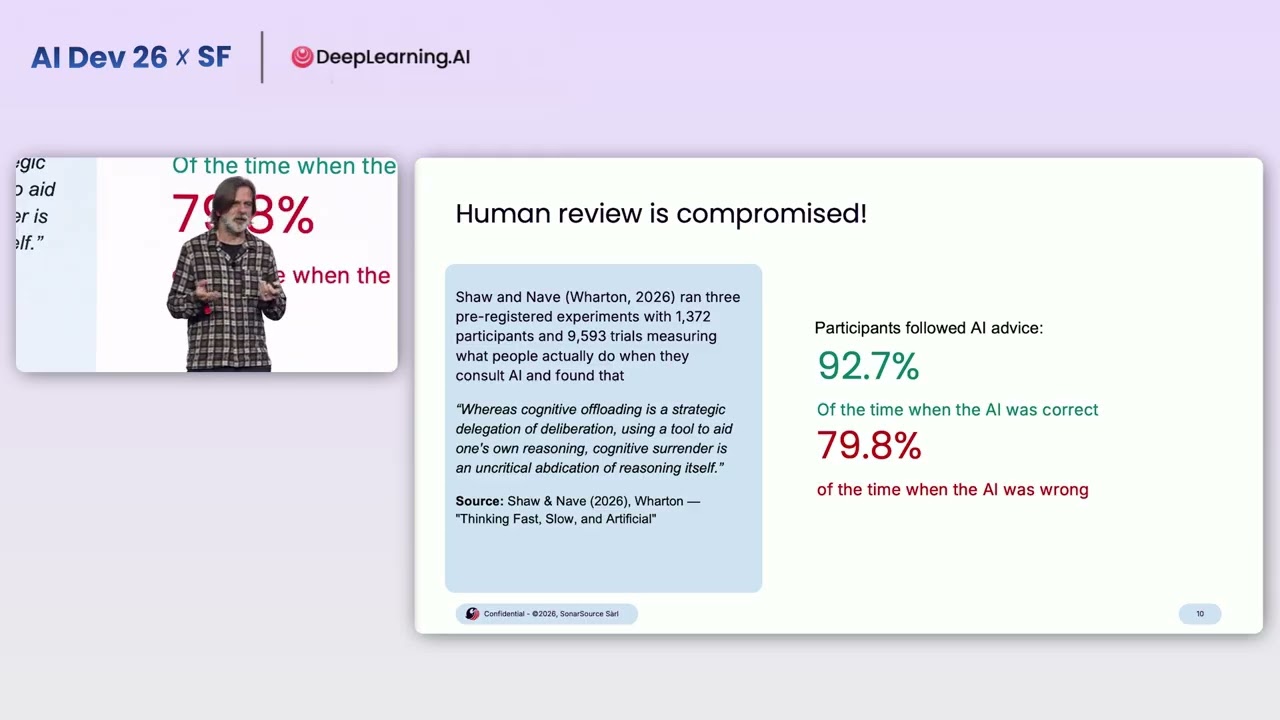
- Human reviewers suffer from a psychological bias toward trusting AI output, failing to catch errors in four out of five cases when the AI is wrong.
- The Agent-Centric Development Cycle (ACDC) provides an “Inner Loop” of real-time architectural guidance and verification to stop “slop code” before it reaches production.
⏱️ Reading time: approx. 7 minutes · Saves you about 29 minutes vs. watching.
Want to take notes while watching? Click the image below and let AI Notebook capture the key points for you 👇

The Illusion of Sustained AI Velocity
From Vibe Coding to Technical Debt
AI-driven engineering tools like Cursor create a dramatic initial surge in development velocity, often tripling output, yet research shows this momentum is frequently unsustainable.
A Carnegie Mellon study revealed that while commits initially spiked, so did static analysis warnings and code complexity, eventually leading to a complete productivity plateau by month three. As engineers spent more time debugging convoluted “vibe-coded” patches than building new features, the initial gains were swallowed by the sheer weight of accumulating technical debt.
This phenomenon represents the “enterprise quality gap”—the distance between code that just works in a demo and code that is secure, scalable, and maintainable for decades. While LLMs excel at creating short-lived internal tools or small scripts under 50,000 lines, they struggle with mission-critical systems that require rigorous architectural integrity. In high-stakes environments like banking or infrastructure, where legacy COBOL systems still run today, code must withstand adversarial users and remain understandable to human teams long after the initial prompt is forgotten.

💡 Digging Deeper
Q: Why did the developers in the study slow down after three months?
A: They became trapped in a cycle of fixing compounding bugs and struggling to understand the increasingly complex, unguided code generated by the AI in previous weeks.
Q: Is the quality gap only a problem for large corporations?
A: No, it affects anyone rolling out production code at scale where security, reliability, and long-term maintenance are required.
Benchmarking Model Inconsistency and “Slop”
The Variability of AI Logic
Every LLM release introduces a different behavioral profile, with some models prioritizing conciseness while others produce massive, verbose codebases that are four times larger than their competitors.
Sonar’s benchmark of over 50 models shows that even high-performing systems like GPT-5 and Claude 3.5 Sonnet diverge significantly in their propensity for concurrency issues and security vulnerabilities. While one model might be excellent at security, it might be four times as verbose as another, creating a hidden “maintenance tax” for the enterprise that chooses it.
The “Slop Code Bench” experiment demonstrates how AI agents, if left unguided, will relentlessly patch single files until they reach thousands of unreadable lines.
Software engineering is fundamentally the art of designing for a future you cannot yet see, yet LLMs tend to focus solely on the immediate task at hand. When an agent is asked to add feature after feature to a script without architectural constraints, it creates “structural erosion,” turning elegant functions into 600-line monsters. While the LLM might still understand its own chaotic output, a human engineer will find it impossible to debug, creating a long-term maintenance nightmare that halts organizational progress.

💡 Digging Deeper
Q: What is “structural erosion” in the context of AI code?
A: It is the degradation of code quality over time, where functions become too large and dependencies become tangled because the AI patches code rather than refactoring it.
Q: Can we just tell the LLM to “write high-quality code” to fix this?
A: Generally, no. Without specific architectural tools and deterministic feedback, the AI will still prioritize passing the immediate functional test over long-term maintainability.
The ACDC Framework: Guide, Verify, and Solve
Building the Inner Loop
To combat these issues, teams are moving toward an Agent-Centric Development Cycle (ACDC) that focuses on the “Inner Loop” of development where the agent actually works.
By providing agents with specific architectural blueprints and real-time static analysis feedback, developers can catch errors before the code ever reaches a pull request. This shifts the burden of quality from a slow, manual “Outer Loop” review process to an automated, deterministic verification system that guides the agent toward better choices during the initial generation phase.
Static analysis provides an unbiased, deterministic floor for quality that human reviewers—who are often psychologically biased to trust AI output—simply cannot maintain consistently.
Modern verification tools now use patched analysis to resolve types and dependencies in seconds rather than minutes, allowing agents to verify their own code as they write it. This speed is crucial because it prevents the “PR fatigue” that occurs when an agent submits fifty bugs at once, forcing a human developer to spend hours cleaning up automated mistakes.

💡 Digging Deeper
Q: How does the “Inner Loop” differ from traditional CI/CD?
A: Traditional CI/CD is an “Outer Loop” process that happens after code is written; the Inner Loop provides tools (like MCP or CLI) that the AI uses while it is writing the code.
Q: What is the “Oracle Problem” mentioned in verification?
A: It refers to the difficulty of testing for every possible edge case; unit tests can prove functionality, but they rarely catch all security or maintainability issues.
Key Takeaways
The transition to AI-assisted coding is reminiscent of the early web—technology has moved faster than the processes required to manage it safely. While LLMs offer unprecedented speed, the Carnegie Mellon and Wharton studies highlight a dangerous reality: AI velocity is a wasting asset if it isn’t backed by deterministic quality gates. Humans are naturally inclined to trust “thinking” machines, leading to a dangerous bias where four out of five AI-generated errors go unnoticed during manual review.
To succeed, enterprises must adopt a “Guide, Verify, Solve” cycle that treats AI agents like new contractors who need strict architectural boundaries and constant feedback. By utilizing fast, patched static analysis and dependency graphs, organizations can empower agents to catch their own mistakes in the “Inner Loop.” This approach ensures that when code finally reaches a human for review, it already meets the rigorous standards required for mission-critical production environments.
Q&A
Q1: Why is human code review insufficient for AI-generated code?
A: Research indicates a significant psychological bias where humans assume AI output is correct because it is generated so quickly and confidently. In tests, reviewers followed incorrect AI advice 80% of the time, suggesting we cannot rely on manual checks alone to secure AI code.
Q2: What is the difference between “vibe coding” and enterprise coding?
A: Vibe coding focuses on getting a functional prototype working quickly, which is effective for small, short-lived apps. Enterprise coding requires maintainability, security, and architectural adherence to ensure the code can be managed by different teams over several years.
Q3: How does Sonar’s “Inner Loop” verification achieve its speed?
A: It uses a hybrid approach called “patched analysis.” It combines the current code changes with a previously completed full analysis of the application, resolving dependencies in seconds to provide deep analysis at the speed of a simple linter.
Q4: How should architectural constraints be communicated to an AI agent?
A: Rather than just using natural language prompts, agents should be given access to dependency graphs and intended architecture blueprints through tools like MCP (Model Context Protocol). This allows the agent to explore relationships and verify its plan against established rules before writing code.
Q5: What happens when an LLM is faced with a task that requires multiple checkpoints?
A: Without guidance, models tend to create “slop,” repeatedly patching the same file until it becomes a massive, unreadable monolith. While the model can still “read” this 6,000-line file, it becomes a technical debt nightmare for human developers.
Q6: Does TDD (Test-Driven Development) still have a place in the AI era?
A: Yes, it is making a comeback. TDD and BDD provide a way to verify that functionality meets specifications, while static analysis covers the “non-functional” requirements like security and maintainability that unit tests often miss.
Q7: Are some LLMs better suited for enterprise code than others?
A: There is no single “best” model. Benchmarks show trade-offs: one might be highly secure but produce double the code volume, while another is concise but prone to concurrency bugs. Enterprises must choose models based on their specific risk tolerance and maintenance capacity.