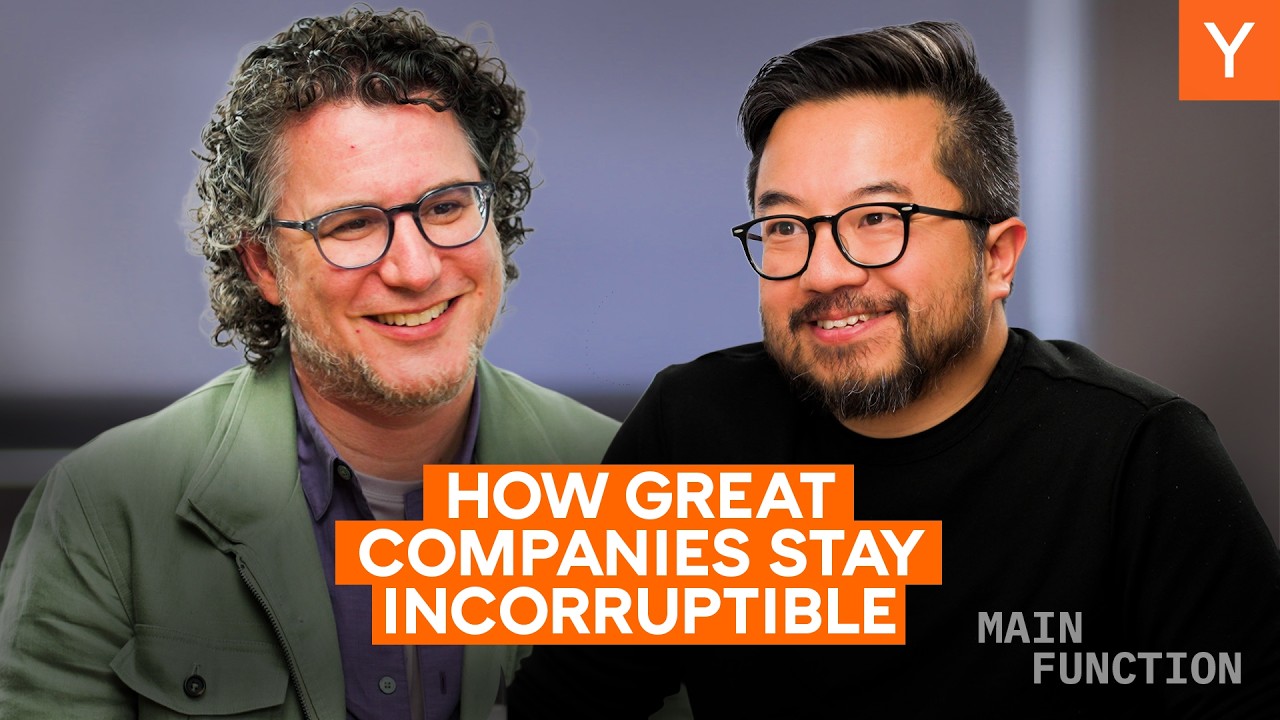
📺 Today’s recommended deep-dive video: https://www.youtube.com/watch?v=7VKliOQXQ9M
Beyond the Exit: Eric Ries on Building Incorruptible Companies
For decades, founders have been taught that maximizing shareholder value is the “natural law” of capitalism, yet this “best practice” often destroys the very mission that made the company great. Eric Ries explains why the current corporate playbook is fundamentally broken and how a new generation of builders is reclaiming control through structural governance.
Core Question: How can founders protect their company’s soul from being sacrificed for short-term profits as they scale?
Highlights
- The “shareholder primacy” model is not an ancient law, but a 1980s invention that functions as a value-destroying normative consensus.
- Founder control is a temporary shield; true longevity requires a “governance fortress” that outlives the individual creator.
- The Public Benefit Corporation (PBC) is a low-effort, high-impact tool that restores a company’s legal right to have a specific purpose.
- Industrial foundations and purpose trusts, used by companies like Novo Nordisk and Anthropic, offer a “third way” between investor and founder control.
⏱️ Reading time: approx. 8 minutes · Saves you about 42 minutes vs. watching.
Want to take notes while watching? Click the image below and let AI Notebook capture the key points for you 👇

The Myth of Shareholder Primacy
Why “Best Practices” Are Killing Startups
We are currently living in an era defined by temporary organizations led by temporary managers on behalf of temporary investors. This creates a systemic erosion of trust where the average holding time of stocks has plummeted and the lifespan of companies has dwindled to a fraction of what it once was.
Success will not protect you; in fact, the more valuable your company becomes, the more it transforms into a lucrative target for those who wish to extract value rather than create it.
Most founders are remarkably naive about the legal documents they sign, assuming that boilerplate Delaware C Corp language is a neutral framework for growth. In reality, these documents often mandate that the company be treated as a mere financial instrument for investment returns rather than a mission-driven entity capable of human flourishing. If your charter says you must maximize shareholder value at any cost, you have essentially signed a one-way ticket to a “wake” where your mission is the guest of honor.

💡 Digging Deeper
Q: Is shareholder primacy actually the law?
A: It is a “normative consensus.” While not a statute passed by a legislature, courts have interpreted “any lawful activity” in charters to mean maximizing returns, effectively enforcing it as law.
Q: Why isn’t founder control (super-voting shares) enough?
A: Founder control is often defeated by “hubris syndrome,” death, or intense investor pressure during a stock dip, as seen in the case of Jeff Lawson at Twilio.
Q: What is the “Builder’s Intuition”?
A: The belief that the best way to make money is to create more value than you capture—building something people actually want.
The Legend of the Governance Fortress
Lessons from Sol Price and the Birth of Costco
The history of modern retail provides a perfect “AB test” for governance through the story of Sol Price, the founder of FedMart. Price believed in a strict fiduciary hierarchy: customers first, employees second, and shareholders third. He viewed himself as a fiduciary to the customer, even going as far as placing signs in his stores telling customers where they could find products cheaper at competitors.
Trust is an asset that accrues interest over decades, but it can be liquidated in a single quarter by a board obsessed with “Kroger-style” best practices.
When Sol Price was eventually locked out of his own office by a board that wanted higher prices and lower wages, FedMart went bankrupt within seven years. However, Sol started over with Price Club, which eventually merged with a company founded by a loyal ex-FedMart employee to become Costco. Today, Costco remains successful because it is protected by a governance ethos that prioritizes the mission over extractive pressures, proving that “bad” governance ratings from analysts often correlate with legendary long-term performance.

💡 Digging Deeper
Q: Why do independent directors often fail to protect the mission?
A: Despite the name, “independent” directors are often recommended by venture firms and have a financial incentive to be seen as pro-investor to secure future board seats.
Q: What is the “Kroger Practice” vs. “Costco Practice”?
A: It’s a mental shorthand: “Best practices” often mirror Kroger’s average performance, whereas “bad governance” (in the eyes of analysts) often protects a company’s “secret sauce,” like Costco’s.
Q: How did Sol Price define his duty?
A: He viewed himself as a lawyer for the customer, putting the client’s interests before his own or his investors’ short-term gains.
Structural Integrity: The Two-Tiered Solution
How Novo Nordisk and Anthropic Built for the Century
To build a company that lasts 100 years, you need structural solutions that do not depend on the goodwill of a single individual. The “Industrial Foundation” model, used by Danish giant Novo Nordisk, involves a non-profit foundation holding a controlling stake in a for-profit subsidiary. This structure saved the company from a disastrous merger in the early 2000s that would have killed the research program that eventually produced the multi-billion dollar GLP-1 (Ozempic/Wegovy) drugs.
Foundations allow for “strategic patience,” enabling a company to fund research for 13 years without a single piece of evidence that it will work.
A modern evolution of this is the “Perpetual Purpose Trust,” a structure Eric Ries helped implement at the AI lab Anthropic. By creating a Long-Term Benefit Trust with the power to appoint directors, Anthropic has insulated itself from the “paperclip maximizer” pressures of the AI arms race. This structural strength allows them to make courageous decisions—like turning down lucrative contracts that conflict with AI safety—which paradoxically increases their talent advantage and market valuation.

💡 Digging Deeper
Q: What is a Public Benefit Corporation (PBC)?
A: It is a legal filing that restores “purposeful incorporation,” allowing a board to defend decisions based on a specific mission rather than just profit.
Q: How much more likely are foundation-owned companies to survive?
A: Research shows they are six times more likely to reach their 50th anniversary compared to traditional investor-controlled companies.
Q: Can a PBC shield a founder from being fired?
A: Not directly, but it acts as a legal shield for the board, allowing them to resist investor lawsuits if they choose to prioritize the mission over a quick exit.
Key Takeaways
Building an “uncorruptable” company requires moving beyond the false choice of investor control versus founder control. The current venture capital ecosystem is built on a 10-year cycle that is increasingly at odds with the 20-year timeline required for modern “overnight” successes. Founders must reclaim their “builder’s intuition” and recognize that the legal architecture of their company is just as important as the software architecture of their product.
To achieve longevity, a company must marry a high-minded Ethos with Structural Integrity. This means choosing a Public Benefit Corporation status early, carefully selecting board members who are aligned with the mission rather than just the cap table, and considering advanced structures like purpose trusts. As Eric Ries emphasizes, “Ethos plus integrity equals incorruptible.” By setting these checks and balances early, founders can create organizations that outlive them and continue to serve the public good.
Q&A
Q1: Why is the Delaware C Corp structure considered “extractive”?
A: The standard boilerplate for a Delaware C Corp often defaults to “shareholder primacy,” which legally pressures directors to prioritize short-term financial returns over the long-term mission or other stakeholders like customers and employees.
Q2: How does a Public Benefit Corporation (PBC) differ from a B Corp?
A: A PBC is a legal entity type in Delaware (a “how you are incorporated”), whereas a B Corp is a private certification (like Fair Trade) from a third party. A PBC gives you legal protection for your mission; a B Corp is more of a marketing and standards badge.
Q3: What happened to Polaroid after they fired Edwin Land?
A: Polaroid was once an R&D powerhouse. After the board fired its founder for making “mistakes” in his pursuit of innovation, the company ceased to invent significant new technologies and eventually became an extractive shell of its former self.
Q4: Is founder control a mental health risk?
A: Yes. Eric Ries notes that “emperor for life” structures can lead to “hubris syndrome,” making founders more selfish, less compassionate, and increasingly paranoid about losing their power.
Q5: What is the main benefit of the Anthropic Long-Term Benefit Trust?
A: It provides a “checks and balances” system where outside trustees, who have no financial stake in the company, ensure the board of directors remains faithful to the mission of AI safety.
Q6: Can I convert my startup to a PBC if I only have SAFEs?
A: Yes. If you haven’t taken priced equity yet, converting to a PBC is a simple two-page legal filing that doesn’t typically require permission from SAFE holders, making it a “no-brainer” for early-stage founders.
Q7: Why didn’t my lawyer tell me about these alternative structures?
A: Most lawyers and advisors are incentivized to follow the “normative consensus” of standard best practices. They often view non-standard governance as a risk to future fundraising, even if it’s better for the company’s long-term health.