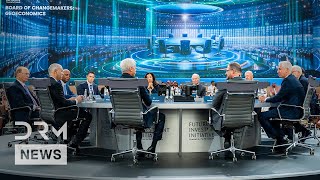
📺 Today’s recommended deep-dive video: https://www.youtube.com/watch?v=LITFYkdIRW4
The Board of Change: Global Titans on the Future of Capital, AI, and Geopolitics
As the global economy faces a $38 trillion US debt clock and the rapid onset of “agentic” AI, the world’s most powerful financial leaders are rewriting the rules of investment. From the trading floors of New York to the desert hubs of Saudi Arabia, this panel explores where the smart money is moving and why “growth is the only exit strategy.”
Core Question: How are industry leaders balancing the massive capital requirements of the AI revolution against the looming pressures of global debt and shifting geopolitical alliances?
Highlights
- AI infrastructure has hit a “power bottleneck,” making energy production and grid upgrades the most critical investment sectors of the next decade.
- The US debt crisis is solvable not through taxation, but by unlocking private capital to push GDP growth from 2% to 3%.
- Saudi Arabia is successfully transitioning from a capital source to a global investment destination through sweeping legal and cultural reforms.
- Corporate culture is shifting back to “engineering-focused” roots, with leaders like Jamie Dimon and Lip-Bu Tan prioritizing in-person collaboration over remote work.
⏱️ Reading time: approx. 9 minutes · Saves you about 31 minutes vs. watching.
Want to take notes while watching? Click the image below and let AI Notebook capture the key points for you 👇

The Infrastructure of Intelligence: AI and the Energy Gap
Power as the New Global Currency
The conversation around Artificial Intelligence has shifted from software capabilities to the raw physical requirements of the “AI complex.” Stephen Schwarzman of Blackstone noted that the US electric grid remained stagnant for nearly 20 years, but the sudden demand from data centers is forcing a projected 4% to 5% annual growth in power needs. This creates an acute shortage where the mandated 15% surplus reserve is rapidly disappearing, turning power generation into a high-return asset class.
The investment scale is unprecedented.
Blackstone, now the world’s largest owner and developer of data centers, views the intersection of AI and energy as the single most interesting investment area globally. Without massive private capital injection into gas turbines and renewable grids, the AI revolution risks stalling due to physical constraints.
Cristiano Amon of Qualcomm expanded this view, arguing that AI is not just a data center phenomenon but a total transformation of the human-computer interface. He predicts that within 12 to 24 months, “agentic” experiences—where devices understand human intent—will become standard across phones, PCs, and cars. This shift requires a decentralized computing model that balances cloud power with on-device processing.

💡 Digging Deeper
Q: Is AI a bubble or a fundamental shift?
A: It is a new form of computing and software that will change every industrial machine and consumer device, comparable to the birth of the internet.
Q: Why is power the primary concern for Blackstone?
A: The US grid is ill-prepared for the 4-5% growth demand; without a solution to energy adequacy, the data center expansion cannot be sustained.
Q: What is “Agentic AI”?
A: A shift in the human-computer interface where AI agents understand what we see, say, and write to proactively assist in the enterprise and consumer space.
The $38 Trillion Question: Debt, Growth, and Policy
Outrunning the Liability Side
The looming $38 trillion US national debt is a “crisis of consumption,” according to Larry Fink, yet one that can be managed through aggressive growth policies. Fink and Bill Ackman argue that while the liability side of the government balance sheet is daunting, the asset side—including the government’s 21% stake in corporate earnings through taxes—is equally massive. The key is to unlock “fear-based” savings from money market funds and move them into productive private investments.
Growth is the only viable exit.
If the US can move from 2% to 3% GDP growth through deregulation and private capital deployment, the debt-to-GDP ratio will naturally decline. However, the dependency on selling 30% of US Treasuries to foreign investors remains a structural vulnerability that requires a stable dollar and high global confidence.
David Solomon of Goldman Sachs noted that while the IPO and M&A markets are accelerating, the regulatory environment remains a primary headwind. He observed that for years, the answer to strategic “can we?” questions was a flat “no,” but the tide is turning toward “maybe” or “yes.” This regulatory softening is essential for the scale-driven mergers required to compete in a high-interest-rate environment.

💡 Digging Deeper
Q: Why is deregulation considered “free”?
A: Unlike stimulus spending, removing regulatory burdens costs the taxpayer nothing while immediately lowering the cost of doing business and accelerating project timelines.
Q: Should investors be worried about the declining value of the dollar?
A: Most panelists view recent dollar fluctuations as a short-term correction; the US still holds the “best hand” in technology innovation and capital formation.
Q: What are “assets of fear”?
A: Gold and crypto are described as hedges against the debasement of currency and global insecurity, though Jamie Dimon remains a skeptic of crypto’s intrinsic value.
New Frontiers: Saudi Arabia and the African Opportunity
From Capital Source to Destination
Lubna Olayan highlighted a fundamental shift in Saudi Arabia’s economic identity, moving from being a mere exporter of capital to a premier destination for it. The new investment law that took effect this year is a game-changer, placing foreign investors on equal footing with Saudi nationals regarding real estate ownership and capital repatriation. This legal clarity is fueling a boom in data centers, healthcare, and renewable energy.
Ease of business has finally met massive liquidity.
Patrice Motsepe provided a similar outlook for Africa, urging global investors to stop underestimating the continent’s internal capital. While Africa only attracts 1% of global private equity, Motsepe argues that competitive returns are being generated in gold and minerals, provided countries maintain globally competitive and safe investment environments.
HSBC’s Georges Elhedery emphasized that “national assets” are being redefined. In the past, this meant land and oil; today, it includes code, chips, and data. Navigating these national requirements is the new challenge for global banks, yet the underlying trade flows and supply chain connectivity remain robust for those who can maintain local trust.

Key Takeaways
The overarching theme of the FII panel is one of cautious optimism anchored in physical reality. While the digital world is obsessed with the potential of AI, the financial world is currently obsessed with the “plumbing”—the power grids, the data center shells, and the semiconductor foundries like Intel that must be rebuilt to ensure supply chain resilience. The pivot from a “layers of management” culture to an “engineering-focused” culture, as seen in the Intel turnaround, reflects a broader corporate trend toward efficiency and tangible output.
Furthermore, the consensus on US debt suggests that while the numbers are staggering, the American “asset side” remains the world’s most attractive bet. By transitioning from a savings-heavy economy to an investment-heavy one, and by leveraging the GCC as a “one-stop destination” for global capital, the leaders believe the world can grow its way out of current fiscal imbalances. The “fear” assets like gold and crypto will continue to exist as insurance, but the real wealth generation is expected to come from the massive infrastructure projects defining the next decade.
Q&A
Q1: What is the biggest obstacle to the M&A and IPO market recovery?
A: Historically, it was a restrictive regulatory environment and a mismatch in valuations from the 2021 peak. As companies “grow into” these valuations and regulators become more open to scale, activity is accelerating for 2025 and 2026.
Q2: Why is Jamie Dimon so insistent on the “Return to Office”?
A: He argues that the “apprentice system” of banking—learning how to handle mistakes or sales calls—cannot happen over Zoom. He also cites the deterioration of social lives and the lack of “accidental collaboration” in remote settings.
Q3: What makes the current investment climate in Saudi Arabia different from a decade ago?
A: The primary difference is a new legal framework that offers foreign investors equal rights to Saudi citizens, alongside improved lifestyle options and easier visa processes that make it a viable place for global talent to live and work.
Q4: Is the US government’s 10% stake in Intel a new model for industry?
A: Lip-Bu Tan suggests that for critical infrastructure like semiconductors, government partnership is essential for resilient supply chains, mirroring successful models in Taiwan (TSMC) and Singapore.
Q5: Why is gold reaching record highs over $4,000 an ounce?
A: Gold remains a “reliable source of wealth” and an “asset of fear.” Central banks and private investors move to gold when they are concerned about currency debasement or global physical insecurity.
Q6: How can the US solve its power shortage for AI?
A: The solution involves unlocking private capital to build gas turbines and expand the grid. The current 15% reserve is insufficient for the 4-5% growth rate required by the data center boom.
Q7: Is Africa a viable private equity market?
A: Yes, though it currently only receives 1% of global PE dollars. The key for African nations is to remain globally competitive, ensuring investments are safe and returns are high enough to attract capital from London and New York.