📺 Today’s recommended deep-dive video: https://www.youtube.com/watch?v=fbRCIQsndHA
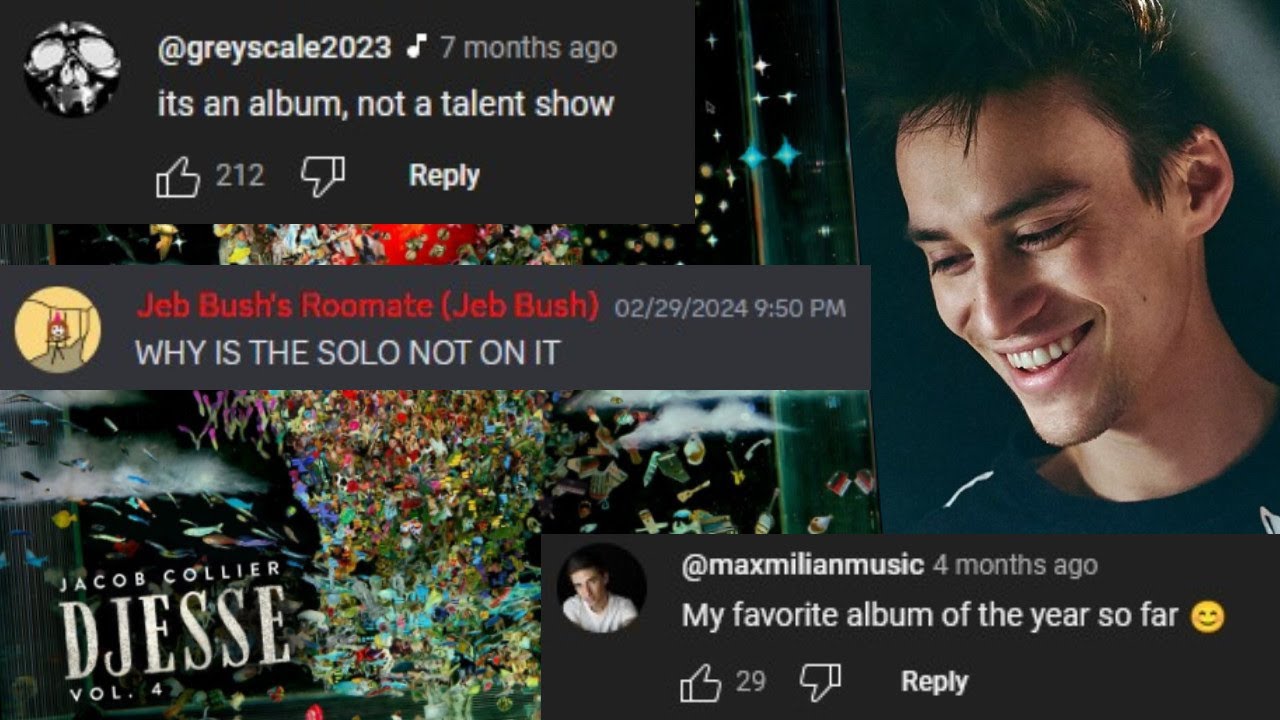
The Jacob Collier Paradox: Why Jesse Vol. 4 Left Old Fans in the Cold
For years, Jacob Collier was the wunderkind of microtonal harmony and maximalist wonder, a “musician’s musician” who seemed to invent new colors in sound. But with the release of Jesse Vol. 4, many long-time fans feel the wizard has traded his magic for a safe, pop-centric sound that prioritizes accessibility over the daring complexity that made him a star.
Core Question: Why did the final chapter of Collier’s four-album epic fail to resonate with the fanbase that supported his rise?
Highlights
- The shift from “intentional maximalism” to a more disjointed, pop-oriented structure.
- A critique of high-profile collaborations that feel “opportunistic” rather than musically essential.
- Why “Witness Me” represents the ultimate disappointment for fans of Collier’s harmonic depth.
- Collier’s philosophical transition from making music “for himself” to making it “for others.”
⏱️ Reading time: approx. 8 minutes · Saves you about 36 minutes vs. watching.
Want to take notes while watching? Click the image below and let AI Notebook capture the key points for you 👇

The Evolution of a Prodigy
From the Bedroom to the World Stage
Jacob Collier didn’t just enter the music scene; he exploded into it, redefining what a single person could achieve within the four walls of a home studio.
Early fans joined during the In My Room era, drawn to a musician who played every instrument with unnatural command and shared his secrets through nerdy music theory live streams. He wasn’t just a performer; he was a teacher who made “super ultra hyper mega-metallidian” scales feel like a playground. To those young jazz musicians and theory geeks, discovering Jacob was like seeing a new color for the first time.
As the Jesse project began in 2018, Collier promised a four-volume journey through different “times of day,” moving from orchestral grandeur to acoustic intimacy and electronic funk. Volumes 1 and 2 largely delivered on this promise, offering listeners a dense, rewarding experience that often required five or ten listens to fully grasp. It was “intentional maximalism”—the sense that every one of those thousand tracks served a specific emotional purpose.

💡 Digging Deeper
Q: Why was the “In My Room” era so influential?
A: It showcased a “musician’s musician” who was completely transparent about his process, combining virtuosity with a willingness to break every traditional rule of harmony.
Q: What is “intentional maximalism”?
A: It is Collier’s philosophy that “less is only more when you know what more is,” using dense arrangements to achieve specific, high-level emotional peaks.
Q: How did the “Jesse” schedule change over time?
A: Initially ambitious, the albums ended up being released over several years, with a significant four-year gap between Volume 3 and Volume 4.
The Volume 4 Breakdown
When Maximalism Becomes Clutter
Jesse Vol. 4 was meant to be the culmination of the previous three worlds, but for many, it feels like different soundscapes placed next to each other rather than being thoughtfully combined.
The album often struggles to find its identity. In tracks like “100,000 Voices,” we see a microcosm of the problem: a cool central riff and a heavy “djent” section that feel disjointed. Putting different sound worlds in the same room is not the same thing as effectively blending them into a new language.
The disappointment reaches a fever pitch with “Witness Me,” a track the author describes as a “commitment to the mundane.” Despite the star power of Shawn Mendes and Kirk Franklin, the song lacks the harmonic daring that made Collier famous. It opts instead for an inoffensive, “workplace safety training video” beat that feels staggeringly safe. For a fan used to microtonal modulations, this feels like a wizard hiding his wand to fit in with a pop crowd.
However, the album isn’t without its triumphs, such as “Bridge Over Troubled Water,” which offers the high-level arrangement fans crave. It’s a rare moment of the “old Jacob” appearing in the new landscape.

💡 Digging Deeper
Q: What is the main criticism of “Witness Me”?
A: It is described as “vapid” and “safe,” failing to deliver any of the harmonic or rhythmic interest expected from a Collier production.
Q: Which track is considered the “best” on the album?
A: “Bridge Over Troubled Water” is cited as a return to intentional maximalism with incredible vocal performances and harmonic depth.
Q: How does the author view the “Box of Stars” tracks?
A: Part 1 is seen as a “TikTok-ified” mess, while Part 2 is praised as a “Captain America: Civil War” style climax that rewards long-time fans with references to previous songs.
A Shift in Philosophy
The Relinquishing of Control
Collier’s recent philosophy suggests he now views his voice as “the voice of others,” prioritizing the collective experience of his live audience over the solitary perfection of the record.
This change is most evident in his “audience choirs,” where he conducts thousands of fans in harmony. While beautiful as a live experience, this “world-as-an-instrument” approach has seemingly diluted the specific creative DNA that made his early recordings so potent. When he was in full control in his room, the results were groundbreaking; when he relinquishes control to pop stars, the results can feel diluted.
The collaborations on this record feel “opportunistic” compared to the niche, purposeful features of Volume 2. Earlier collaborators like Leon Lavas or Becca Stevens brought something Jacob couldn’t do himself; the new pop stars seem to bring visibility, but at the cost of the music’s complexity. Jacob has moved from making music for himself to making music for the world, and in that transition, the “musician’s musician” has become a “global entertainer.”

💡 Digging Deeper
Q: How has Collier’s touring affected his recording style?
A: He now views the live performance as the “real” music, with the records acting as a “shadow” or a vehicle to get people to the show.
Q: Why do pop collaborations bother some fans?
A: Because they often lead to “safe” arrangements that don’t push the boundaries of rhythm or harmony in the way Collier’s solo work does.
Q: Is the “old Jacob” ever coming back?
A: The author suggests probably not, noting that as artists grow, they often move toward broader communication rather than insular complexity.
Key Takeaways
The disappointment felt by long-time fans of Jacob Collier regarding Jesse Vol. 4 isn’t necessarily because the music is “bad” in an objective sense. Instead, it’s a failure to meet the specific value system of unbridled rhythm and harmony that Collier himself established. For those who fell in love with a musician who broke all the rules, seeing him follow the rules of pop music feels like a retreat.
Collier’s transition from a solo “wizard” to a global conductor has shifted his focus toward accessibility and live connection. While this has allowed him to reach a massive new audience, it has left his original, theory-obsessed fanbase feeling “strung along” by a project that took years to deliver a relatively safe conclusion.
Ultimately, Jesse Vol. 4 serves as a reminder that an artist’s growth is rarely linear and often moves away from what made them famous in the first place. If fans want the complexity of the In My Room era, they may have to look to the next generation of musicians—or create it themselves.
Q&A
Q1: Is Jesse Vol. 4 a pop album?
A: Yes, it is widely considered Jacob’s most pop-centric record, though the author argues Vol. 3 was more successful at being “poppy” without losing its soul.
Q2: What was the “Witness Me” controversy?
A: The author finds the track “offensive” because it is so safe and mundane, lacking any of the musical signatures that define Jacob Collier.
Q3: Did the long wait for the album contribute to the disappointment?
A: Absolutely. Being “strung along” for years with promises of “Volume 4 soon” raised expectations to a level the final product couldn’t meet.
Q4: How does the author rank the Jesse volumes?
A: Volumes 1 and 2 are generally held in much higher regard than 3 and 4, which are seen as a step down in harmonic daring.
Q5: What is the “voice of others” philosophy?
A: It is Collier’s idea that his purpose is to empower others to use their voices, often seen in his live audience conducting, which he prioritizes over his own solo vision.
Q6: Are there any “Jacob-style” tracks on the new album?
A: “Bridge Over Troubled Water” and “World O World” are cited as tracks that still deliver the high-level arrangement and mature writing fans expect.
Q7: Is the critic suggesting Jacob Collier has lost his talent?
A: No, the critic acknowledges Jacob is still a “musical wizard” but argues he has chosen to stop using his most interesting tools in favor of broad appeal.