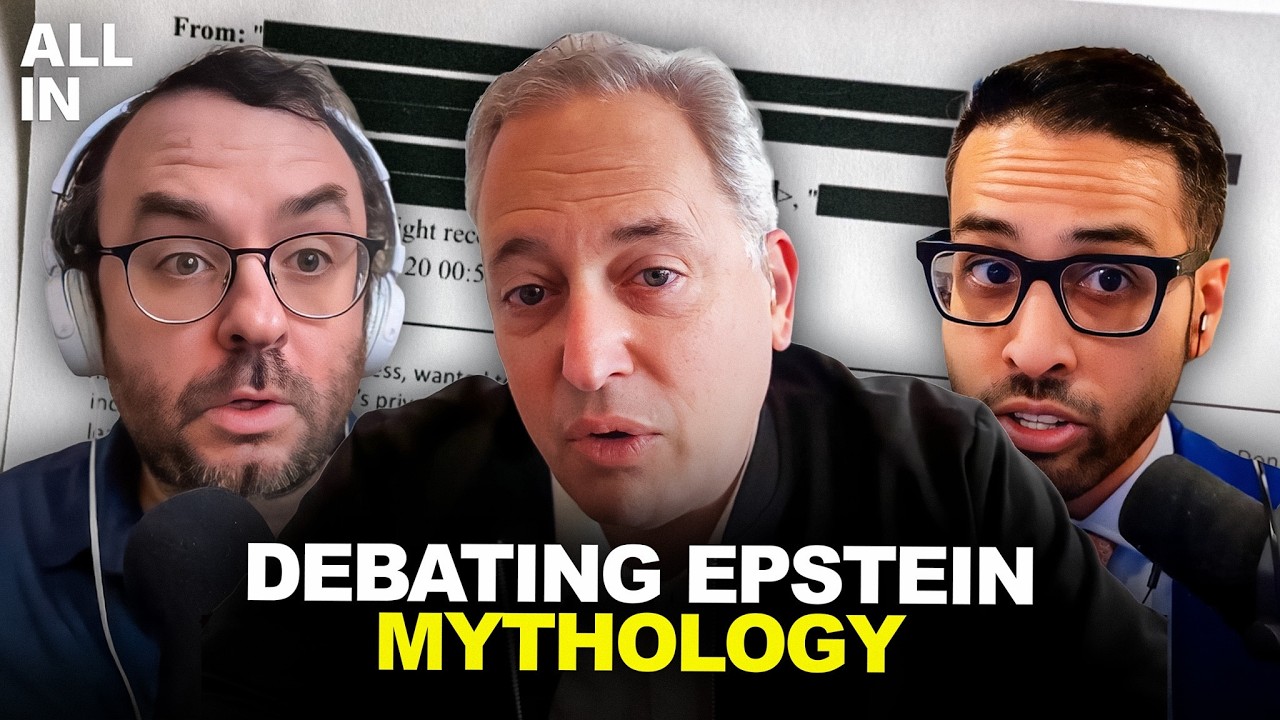
📺 Today’s recommended deep-dive video: https://www.youtube.com/watch?v=CQq3Ocm98sY
The Epstein Files: Intelligence Assets, Moral Panic, or Tech Elitism?
For years, the Jeffrey Epstein saga has been shrouded in a volatile mix of verified crimes and sensationalist lore that threatens to topple governments. This deep dive brings together three conflicting perspectives—from intelligence asset theories to “moral panic” skepticism—to uncover what the newly released files actually reveal about the world’s most infamous network.
Core Question: Is the Jeffrey Epstein story a clear-cut case of global sex trafficking, or a carefully constructed mythology fueled by financial incentives and political weaponization?
Highlights
- Sagar Enjeti argues Epstein was a master money launderer and financial “Zelig” utilized by multiple global intelligence agencies.
- Michael Tracy challenges the “thousand victims” narrative, citing a lack of evidentiary standards and a $500 million “settlement industry.”
- AI analysis by Kevin Bass exposes massive discrepancies between LinkedIn founder Reed Hoffman’s public denials and his hundreds of private contacts with Epstein.
- The “Epstein Mythology” is explored as a modern-day Salem Witch Trial where mere association is weaponized for partisan advantage.
⏱️ Reading time: approx. 8 minutes · Saves you about 99 minutes vs. watching.
Want to take notes while watching? Click the image below and let AI Notebook capture the key points for you 👇

The Global Elite and the Intelligence Nexus
Money Laundering as a “Raison d’Être”
Sagar Enjeti posits that Epstein wasn’t just a predator, but a sophisticated financial asset whose real power stemmed from his ability to move money surreptitiously across borders using emerging technologies like Bitcoin as early as 2011.
By positioning himself within high-stakes networks like the Iran-Contra affair and the Israeli intelligence sphere, Epstein became a “Zelig” figure. His value to the global elite was his discretion in tax evasion and money laundering, providing a shield for a specific “Epstein class” to operate entirely above the traditional legal framework.
The arrest of Prince Andrew on trade secret charges rather than sex crimes suggests the legal system is still grappling with the peripheral damage of these associations. Enjeti argues that while the public focuses on the salacious details of the island, the real story lies in the “black market” financial strategies that made Epstein indispensable to billionaires like Leslie Wexner and intelligence agencies globally, allowing his moral transgressions to be tolerated for decades as a secondary concern.

💡 Digging Deeper
Q: Why was Epstein interested in Bitcoin in 2011?
A: He was a “master money launderer” who sought surreptitious ways to move money across the globe before the technology was mainstream.
Q: What is the significance of the “false Austrian passport”?
A: Austria was considered a capital of spies; Enjeti argues this points to Epstein’s early involvement in international arms smuggling and intelligence circles.
Q: How did Leslie Wexner describe his relationship with Epstein?
A: Wexner claimed he was “conned” by Epstein, despite granting him power of attorney and transferring significant real estate assets to him over decades.
The Architecture of a Modern Witch Hunt
The “Epstein Mythology” and Financial Incentives
Michael Tracy contends that much of what we call the “Epstein Story” is actually a collection of unverified myths fueled by a billion-dollar legal industry that lacks basic evidentiary rigor.
Tracy highlights a systemic lack of standards, pointing out that many high-profile “survivors” only came forward after massive settlement funds were established by JP Morgan and Deutsche Bank. He argues that the “thousand victims” figure is a statistical fabrication used by politicians to drum up moral outrage, ignoring that many claimants were adults who had consensual, if transactional, relationships with Epstein.
This “mythology” has transformed into a partisan battering ram where mere association equals a conviction in the court of public opinion. By treating every email as proof of a global pedophile ring, the media has allegedly abandoned its duty to distinguish between documented criminal activity and sociological hysteria reminiscent of the 1980’s “Satanic Panic.”
💡 Digging Deeper
Q: What does Tracy mean by “The Epstein Industry”?
A: He refers to the roughly $500 million in settlement funds from the Epstein estate and major banks that incentivized a flood of claims.
Q: Did Bill Clinton actually visit Epstein’s island?
A: According to Tracy, while Clinton flew on Epstein’s jet, there is no verified evidence or flight log proving he ever set foot on the island.
Q: Why did Michael Tracy bring up the “Salem Witch Trials”?
A: To illustrate how mass hysteria can lead the public to believe in “grotesque child sacrifice” narratives without a single shred of forensic proof.
The Reed Hoffman Files
AI Analysis vs. Public Denials
AI analysis of the newly released files reveals a startling discrepancy between tech mogul Reed Hoffman’s public denials and his extensive private interactions with Epstein.
While Hoffman claimed his meetings were strictly for MIT fundraising and mediated by Joey Ito, the data tells a different story of independent contact and repeated visits. This suggests a pattern of “reputation management” where tech elites aggressively distance themselves from past associates once they become radioactive, often by pointing fingers at political rivals to distract from their own records.
Kevin Bass’s research highlights roughly 400 points of contact between the LinkedIn founder and Epstein, including multiple overnight stays and shared business interests. This exposes a broader trend in Silicon Valley where access to “financial wizards” often blinded leaders to obvious red flags. The irony of Hoffman bonding with Epstein over a book titled Deception is a case study in how the elite protect their own while weaponizing the same scandals against outsiders.

💡 Digging Deeper
Q: How many times did Reed Hoffman actually meet with Epstein?
A: While Hoffman minimized the count, the files show at least 42 documented meetings and roughly 20 absolutely confirmed in-person sessions.
Q: Did Hoffman visit the island?
A: Yes, records indicate at least one stay of two nights, with evidence suggesting potential second and third visits.
Q: What was the “Deception” book about?
A: It is a book that reportedly justifies the use of deception in specific contexts, which the guests found ironically appropriate given the situation.
Key Takeaways
The Jeffrey Epstein saga is less a single narrative and more a mirror reflecting the anxieties and biases of the modern age. For some, it is the ultimate proof of a corrupt ruling class and a “global pedophile ring” operating with the protection of intelligence agencies like the CIA and Mossad. For others, it is a cautionary tale about how easily the media and legal systems can be co-opted by “mythology” when hundreds of millions of dollars in settlement money are on the line.
The data reveals that many “common knowledge” facts—such as the “Lolita Express” nickname being coined by Epstein himself or thousands of verified victims—are actually media inventions or unverified claims. However, the files also prove that members of the tech and political elite, such as Reed Hoffman, were far more integrated into Epstein’s daily life than they ever admitted to the public.
Moving forward, the challenge lies in separating the genuine victims of a documented sexual predator from the “algorithmic slop” of internet conspiracies. Whether Epstein was a spy, a simple con man, or a prolific predator, his true legacy is the permanent erosion of trust in the institutions that allowed him to flourish for decades.
Q&A
Q1: Why did the Southern District of New York re-indict Epstein in 2019 if the non-prosecution agreement was still valid?
A1: Prosecutors used a “cockamamie rationale” to circumvent the 2007 deal by claiming they found new victims in New York to establish an interstate nexus.
Q2: Was Jeffrey Epstein actually a billionaire?
A2: At the time of his arrest, his disclosed net worth was approximately $650 million, though his influence over the multi-billion dollar fortunes of clients like Leslie Wexner made his reach much greater.
Q3: What is the “Man Act” in the context of this case?
A3: Sagar Enjeti argues that flying adult women across borders for the express purpose of sex is a federal crime under the Man Act, regardless of whether the participants were minors.
Q4: Why are the Epstein files still partially redacted?
A4: Current legislation includes “victim identifying” carve-outs that allow the DOJ to withhold information that could tangentially identify any of the hundreds of claimants.
Q5: Who was Jean-Luc Brunel?
A5: A modeling mogul and Epstein associate who was arrested in France; he reportedly committed suicide in prison before he could be fully prosecuted.
Q6: Did Epstein have surveillance cameras in his homes?
A6: While accusers like Maria Farmer claim he had rooms wired for blackmail, Michael Tracy argues there is no verified forensic evidence of a “vast blackmail operation” involving these tapes.
Q7: How did Epstein start his career?
A7: He was a math teacher at the Dalton School before being recruited to Bear Stearns, where he rose to partner level by innovating high-stakes tax and wealth structuring maneuvers for the ultra-wealthy.