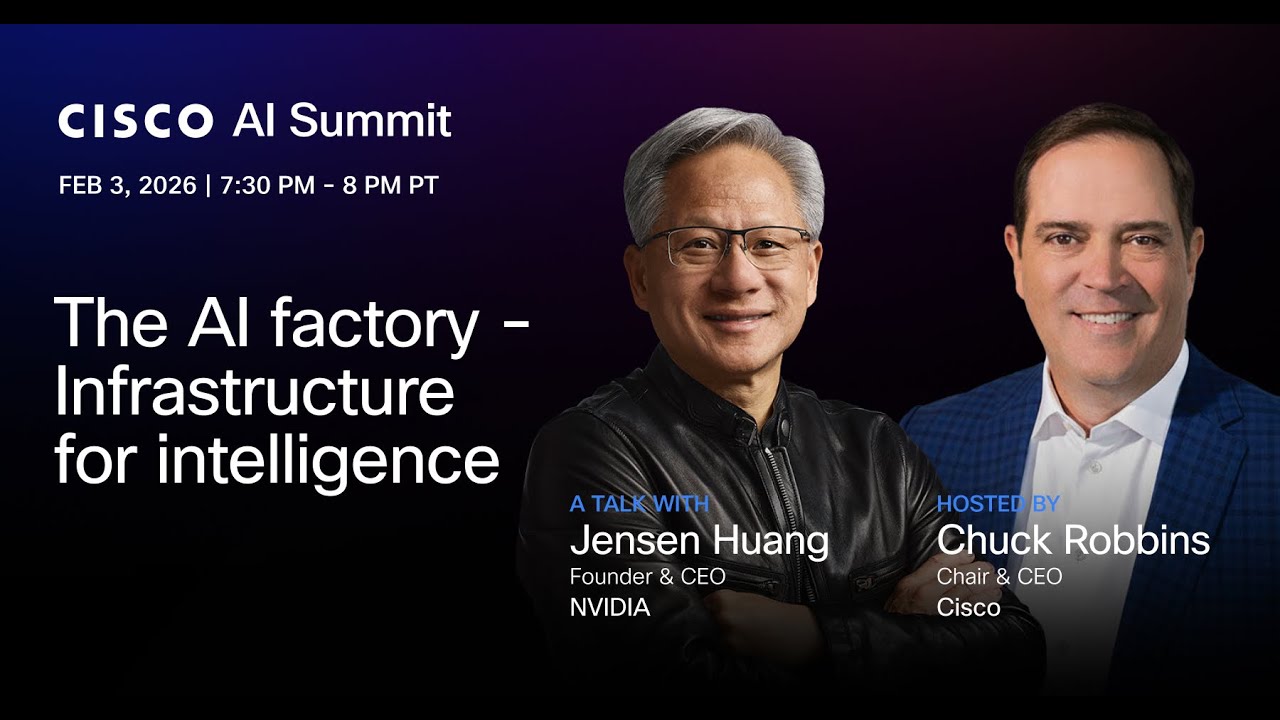
📺 Today’s recommended deep-dive video: https://www.youtube.com/watch?v=6fbyiPRhMSs
The Intelligence Abundance: Jensen Huang on Reinventing 60 Years of Computing
In a candid late-night conversation, NVIDIA’s Jensen Huang and Cisco’s Chuck Robbins explore the seismic shift from explicit programming to “agentic” AI. As we move from a world of pre-recorded software to generative, contextual intelligence, the definition of a technology company is being rewritten.
Core Question: How should enterprises navigate the transition from general-purpose computing to the era of AI factories and digital labor?
Highlights
- The shift from explicit programming (writing code) to implicit programming (communicating intent).
- Why “letting a thousand flowers bloom” is a better initial AI strategy than seeking immediate ROI.
- The transition from digital tools (SaaS) to digital labor (AI agents and chauffeurs).
- Why a company’s questions are more valuable intellectual property than its answers.
⏱️ Reading time: approx. 8 minutes · Saves you about 44 minutes vs. watching.
Want to take notes while watching? Click the image below and let AI Notebook capture the key points for you 👇

From Coding to Intent: The New Computing Stack
The End of Explicit Programming
For the first time in sixty years, the entire computing stack is being reinvented from the ground up. In the old world, humans wrote explicit programs using languages like C++ or COBOL to process variables through rigid APIs. Today, we are moving toward implicit programming, where you simply tell the computer your intent and it figures out the strategy to solve the problem.
This transition marks the evolution from general-purpose calculation to true artificial intelligence. While early chatbots were interesting curiosities based on memorization, modern “agentic AI” involves reasoning, planning, and tool use. It is no longer just about generating words; it is about breaking down complex tasks into solvable elements and using research or memory to execute a plan autonomously.
The shift is fundamental because it moves software from being a pre-recorded artifact to a generative, dynamic experience.

💡 Digging Deeper
Q: Why wasn’t enterprise AI ready three years ago? A: Because we were still in the era of perception and retrieval; we hadn’t yet mastered the reasoning and planning layers required for autonomous agents.
Q: What is the role of networking in this new stack? A: AI requires a massive shift in infrastructure where networking, security, and storage are integrated into a single “control plane” to manage the sheer volume of data.
Q: Is the CD-ROM era officially dead? A: Yes, software is no longer a static file you “retrieve”; it is a live, contextual response generated in real-time based on specific user prompts.
The Innovation Strategy: Let a Thousand Flowers Bloom
Prioritizing Exploration Over ROI
Many companies fail to innovate because they demand a rigid, demonstrable ROI before they even begin experimenting with new technology. Jensen argues that this is an illusion of control that actually stifles progress. In the early stages of a platform shift, you shouldn’t ask “why” before saying “yes”; you should say “yes” first and then figure out the “why” through active experimentation.
NVIDIA’s internal strategy is to allow an almost “out of control” number of AI projects to flourish simultaneously across the company. This isn’t chaos; it’s an admission that you cannot know which “arrow” to put all your wood behind until you’ve tested a thousand different bows. You eventually curate the garden, but if you prune too early, you risk killing the very innovation that will define your future.
The goal is to apply “AI sensibility” to the most impactful work your company performs.

💡 Digging Deeper
Q: When should a company start curating its AI projects? A: Only after the technology has been applied to the “essence” of the company—its most important engineering or business problems.
Q: How does AI change the concept of Moore’s Law? A: Moore’s Law was a 100x increase over ten years, but AI is delivering a million-fold increase in capability over the same period.
Q: Should I worry about being the first to use AI? A: You don’t have to be the first, but you absolutely cannot afford to be the last.
Domain Expertise: The Ultimate Superpower
Turning Intent into Labor
The IT industry has spent decades selling “screwdrivers and hammers” in the form of software tools. We are now entering an era where we can create digital labor, such as a “digital chauffeur” for a car or a “digital engineer” for chip design. This expands the addressable market from the $1 trillion IT sector to the $100 trillion global economy by automating actual work rather than just providing tools.
This shift levels the playing field for those who aren’t traditional software engineers. Because “coding is just typing,” and typing is a commodity, the real value lies in domain expertise—the ability to understand what a customer needs and what problems are worth solving. If you can describe a problem clearly in your native language, you can now “program” a computer to solve it.
Every company has the opportunity to become a “technology-first” company by dealing in electrons rather than atoms.

💡 Digging Deeper
Q: Will AI replace software companies? A: No; AIs will use existing software tools (calculators, ERPs, CAD) rather than reinventing them, because those tools provide the “explicit” accuracy AI lacks.
Q: What is the most valuable skill in the AI era? A: Domain expertise and the ability to define clear “intent,” as the execution (coding) is now handled by the model.
Q: Is “physical AI” the next frontier? A: Yes, creating AIs that understand causality, gravity, and the physical world—like a child understands a domino—is the next great challenge.
Sovereignty and the “AI in the Loop” Model
The Privacy of Questions
There is a growing debate about whether companies should build their own AI infrastructure or simply rent it from the cloud. Jensen suggests that the most valuable intellectual property a company owns isn’t actually its answers, but its questions. The things you are curious about and the uncertainties you discuss internally reveal your strategic direction, and that information should often stay on-prem.
Just as you wouldn’t want your private conversations with a therapist uploaded to a public server, companies shouldn’t necessarily share their internal dialogues with a public cloud provider. Building local “sovereign AI” allows a company to capture its own life experience and institutional knowledge. This creates a permanent, growing repository of expertise that stays within the organization’s walls.
We are moving away from the “human in the loop” concept toward “AI in the loop.”

💡 Digging Deeper
Q: Why is “human in the loop” the wrong idea? A: Because every company should have AI capturing its knowledge so that it never has to start from zero when an employee leaves.
Q: Should companies build their own computers? A: Yes; having a tactile understanding of the components and “lifting the hood” is vital for the most important technology of our future.
Q: What role does security play here? A: Security must be reinvented to protect the “intent” and the “questions” of the enterprise, not just the data files.
Key Takeaways
We are exiting the era of “retrieval-based” computing, where we simply fetched pre-recorded files, and entering an era of “generative” computing. In this new world, every interaction is a unique, real-time synthesis of context and intelligence. This allows companies to move at the speed of light, effectively treating complexity as if it has “zero mass” and “zero gravity.”
The ultimate advantage belongs to those who embrace their domain expertise. You are no longer limited by the number of software engineers you can hire, because the barrier between human thought and machine execution has collapsed. By applying “infinite” computing power to your hardest problems, you can transform your business from a traditional service provider into a high-value technology powerhouse.
Q&A
Q1: What exactly is an “AI Factory”?
A1: An AI Factory is a data center infrastructure specifically designed to produce “intelligence” rather than just store data, using a reinvented stack of processing, networking, and security.
Q2: How does Jensen view the current pressure on software company stocks?
A2: He finds it illogical; AI won’t replace tools like SAP or ServiceNow. Instead, AI will become a “user” of those tools, making them more valuable by increasing their utilization.
Q3: Is it better to “rent” AI from the cloud or “own” it on-prem?
A3: A hybrid approach is best. Use the cloud for scale, but keep your most sensitive “questions” and proprietary IP on-prem for security and sovereignty.
Q4: Why does Jensen emphasize “lifting the hood”?
A4: He believes that because AI is the most important technology of the future, leaders must have a tactile understanding of how it works—like changing the oil in a car—to truly master it.
Q5: What is “Agentic AI”?
A5: It is AI that goes beyond simple text generation to include reasoning, planning, and the ability to use external tools to solve complex, multi-step problems.
Q6: What does “coding is a commodity” mean for the workforce?
A6: It means the value shift is moving from the “how” (writing code) to the “what” and “why” (domain expertise and identifying the right problems to solve).
Q7: How should a CEO view AI’s impact on their company?
A7: They should treat AI as “augmented labor” that can perform tasks at the speed of light, potentially increasing the company’s value by orders of magnitude.