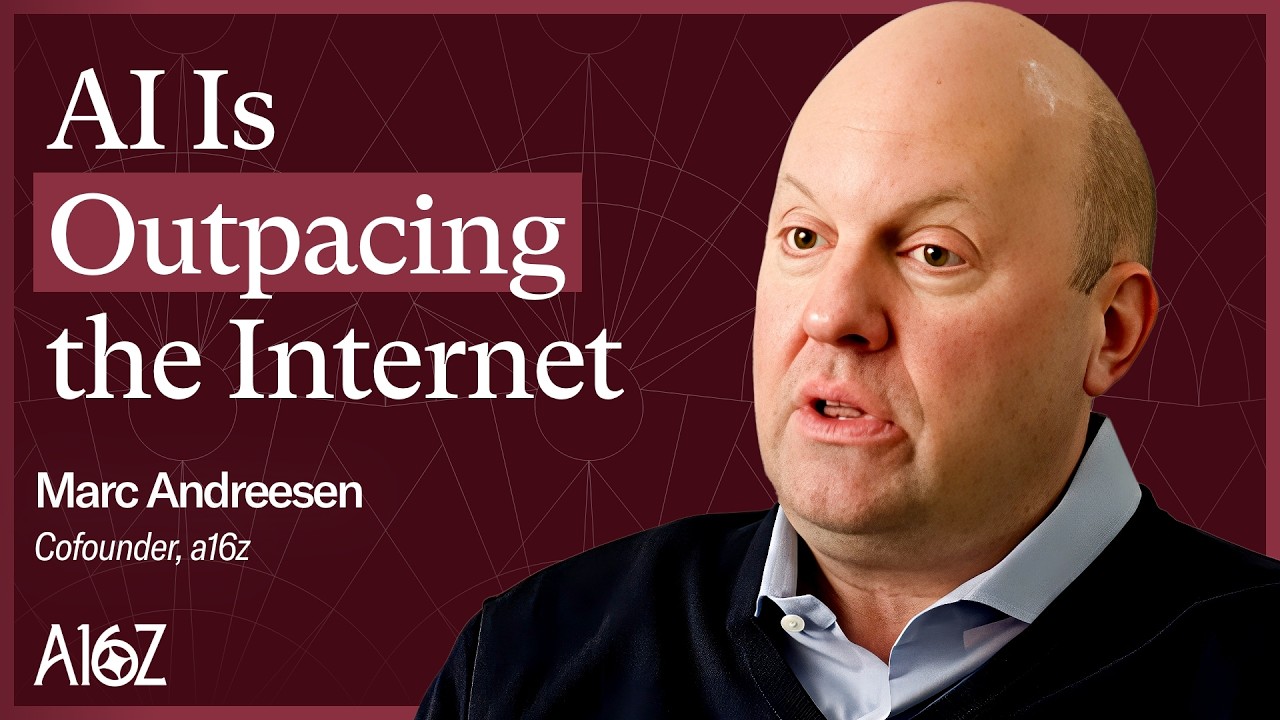
📺 Today’s recommended deep-dive video: https://www.youtube.com/watch?v=xRh2sVcNXQ8
Tokens by the Drink: Navigating the Trillion-Dollar AI Frontier
Marc Andreessen breaks down why AI isn’t just a new feature, but an 80-year-old dream finally meeting reality. He explores the economic shift from “adding machines” to “god models” and explains why the current geopolitical race is a two-horse competition that the West cannot afford to lose.
Core Question: How will the interplay between massive “god models,” small local models, and global regulation shape the next decade of technological dominance?
Highlights
- AI represents an 80-year shift from hyper-literal “calculating machines” to cognitive neural networks modeled on the human brain.
- The “tokens by the drink” model is revolutionizing software economics, allowing startups to access world-class intelligence with zero fixed costs.
- The geopolitical AI race is primarily a US vs. China competition, with open-source software serving as a critical but controversial battleground.
- Fragmented state-level regulation, like California’s SB 1047, poses a “suicidal” risk to American innovation and the open-source ecosystem.
⏱️ Reading time: approx. 9 minutes · Saves you about 72 minutes vs. watching.
Want to take notes while watching? Click the image below and let AI Notebook capture the key points for you 👇

The 80-Year Pivot: From Calculators to Cognition
The Path Not Taken
AI is the biggest technological shift of our lifetime, a fundamental architecture change far larger than the arrival of the internet or the microprocessor. It is the big one—the steam engine or electricity of our era.
Since the 1930s, computer science followed the path of “adding machines”—hyper-literal calculators that executed math but couldn’t understand human speech. This was the model that built the wealth of the last 80 years, from mainframes to smartphones. However, the alternative theory of neural networks modeled on human cognition existed in parallel since 1943, waiting for the hardware and data to catch up to the dream.
We are finally seeing that 80-year-old “path not taken” materialize through the sudden crystallization of large language models. This isn’t a new trend; it is the fulfillment of the original promise of computing that pioneers envisioned decades ago. Now, Silicon Valley is recycling talent and capital to build an entirely new infrastructure around this cognitive model.

💡 Digging Deeper
Q: Why did it take 80 years for neural networks to win?
A: The industry settled on “calculating machines” because they were commercially viable for bookkeeping and math, while neural networks suffered from decades of excessive optimism followed by “AI winters” where the hardware simply wasn’t powerful enough.
Q: Is AI just another “internet moment”?
A: No, it’s bigger. The internet required a massive physical lift—laying fiber and building towers—that took decades. AI can be “downloaded” instantly by the 5 billion people already on mobile broadband, leading to an unprecedented rate of proliferation.
Q: What is the significance of the “revealed preferences” of AI users?
A: While polls suggest voters are panicked about AI killing jobs, their actual behavior shows they are aggressively using it to solve medical issues, draft emails, and navigate relationships. People love the technology they claim to fear.
The Economics of Intelligence: Tokens and Tiers
The “Tokens by the Drink” Revolution
Startups no longer face massive fixed costs to build intelligent applications because they can buy “intelligence tokens” from providers like OpenAI or Anthropic. This usage-based model is a gift to the ecosystem, allowing developers to scale precisely with demand while the per-unit cost of AI drops faster than Moore’s Law.
The cloud wars between AWS, Azure, and Google have effectively commoditized world-class R&D for the masses. Instead of keeping their magic captive, these giants are serving it up via API, sparking a creative explosion in “application” companies.
We are seeing a hyper-deflation of intelligence costs. While the big labs are spending billions on “god models,” the efficiency of these models is being shrunk down into small, local versions at a staggering pace. This creates a ladder where the top is always getting smarter, but the “volume” market belongs to the smaller, cheaper models that run on everything from MacBooks to embedded chips.

💡 Digging Deeper
Q: Will “GPT Wrappers” survive?
A: The best application companies are backward-integrating. They start as “wrappers” but quickly build their own specialized models and fine-tune open-source ones to own their tech stack and improve margins.
Q: Is Nvidia’s dominance permanent?
A: History suggests that massive profit pools act as a “bat signal” for competition. Between hyperscalers building their own silicon and startups designing chips specifically for AI (rather than legacy graphics), the chip shortage will eventually turn into a glut.
Q: Should AI be priced by seats or usage?
A: While infrastructure is usage-based, applications should price by value. If an AI does the job of a paralegal or a radiologist, the company should capture a percentage of that human-equivalent value, not just the cost of the compute.
Geopolitics and the Regulatory Minefield
The Two-Horse Race: US vs. China
AI development has essentially narrowed down to a competition between the United States and China. The rest of the world is largely watching from the sidelines. China is proving it is “in the game” with high-performing models like DeepSeek and Kimmy, which often replicate the capabilities of the best American models within months.
The Chinese model is intertwined with our own through supply chains, making this a “Cold War” far more complex than the US-USSR era. China’s move to release high-quality open-source models is seen by some as “dumping” to commoditize Western leads, but it also forces the US to stay on its front foot.
Washington is waking up to the fact that AI is a geopolitical requirement. For the first time in years, there is a bipartisan consensus that we cannot regulate ourselves into a disadvantage while China is sprinting forward. If we ban our own progress, we don’t stop AI; we just ensure the AI the world uses is built by the CCP.
💡 Digging Deeper
Q: Why is state-level regulation like California’s SB 1047 dangerous?
A: It attempts to assign “downstream liability” to open-source developers. If a developer releases a model and someone else builds it into a faulty system years later, the original developer could be sued. This would effectively kill the American open-source ecosystem.
Q: What is the “Little Tech” agenda?
A: It is a bipartisan effort to ensure that startups and independent researchers have the freedom to innovate without being crushed by regulations designed for (or by) giant incumbents.
Q: How does the “Draghi Report” in Europe relate to this?
A: Mario Draghi pointed out that Europe’s over-regulation (like the EU AI Act) has crippled its competitiveness. The EU is now desperately trying to figure out how to “unwind” its self-inflicted wounds to avoid becoming a technological desert.
Key Takeaways
The AI revolution is a return to the foundational roots of computer science, shifting away from rigid calculators toward fluid, cognitive neural networks. This transition is happening at “internet speeds” but with “electricity-level” impact, affecting five billion people almost simultaneously. For investors and founders, the primary opportunity lies in the “tokens by the drink” economy, which has lowered the barrier to entry for world-class intelligence to near zero.
However, this progress is under threat from a “suicidal” regulatory impulse at the state level. Fragmentation of laws across 50 states could tether American innovation just as the geopolitical race with China intensifies. The emergence of high-quality Chinese open-source models proves that the “moat” around big labs is thinner than many realize, making the ecosystem more dynamic—and more competitive—than ever before.
Ultimately, the future of AI will likely follow a pyramid structure: a few “god models” at the top providing peak intelligence, supported by a massive foundation of small, efficient, and cheap models embedded in every physical object. The winners will be those who can move beyond simple “wrappers” to capture real business value through domain-specific expertise and creative pricing models.
Q&A
Q1: Is the revenue growth in AI companies real or just hype?
A: It is unprecedented. We are seeing AI companies grow customer revenue and demand at a takeoff rate faster than any previous tech wave, including SaaS and the early internet.
Q2: Will big models eventually top out in capability?
A: While there is periodic concern about plateauing, researchers at the major labs still have hundreds of new ideas to scale and improve these systems. We are nowhere near the ceiling.
Q3: Why does Andreessen Horowitz engage so heavily in policy?
A: The stakes are too high to ignore. If the industry leaders don’t fight for the “Little Tech” agenda, ruinous laws like SB 1047 will pass by default, ending the era of startup-led innovation.
Q4: Can startups compete with the “new incumbents” like OpenAI and Anthropic?
A: Yes. Companies like XAI and DeepSeek have proven you can catch up to the state-of-the-art in less than a year. The “secrets” are proliferating through open source and academic research.
Q5: How does AI intersect with other “frontier” sectors like Bio and Energy?
A: AI is a massive driver for the physical world. It accelerates drug discovery in biotech and creates massive new demand for energy and materials to build and power data centers.
Q6: What is the most important “revealed preference” of AI today?
A: That people love using it. Despite what they say in surveys about job losses, they are adopting AI as fast as possible to make their daily lives easier and more productive.
Q7: Will AI eventually replace all human jobs?
A: History shows that automation panics have occurred for 200 years. Every time, the technology creates more productivity and new types of work that we couldn’t previously imagine.