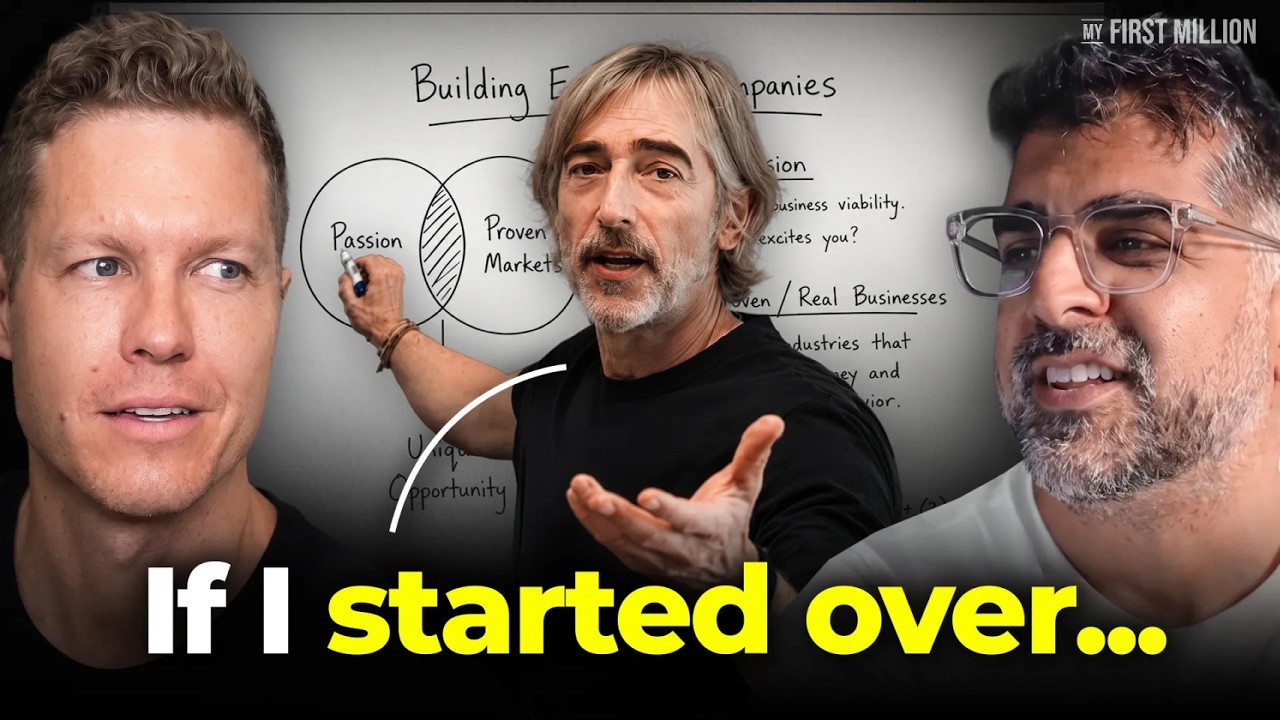
📺 Today’s recommended deep-dive video: https://www.youtube.com/watch?v=5MpXP954XNU
The Art of Winning in the Right Body of Water: Mark Pincus on Facebook, Farmville, and the AI Frontier
Mark Pincus shares the hard-won lessons from building a $10 billion empire and being one of the only three seed investors in Facebook. From the “lightning in a bottle” metrics of early social networks to the disciplined goal-setting of his personal “Book of Life,” this is a masterclass in aggressive entrepreneurship.
Core Question: How can founders identify generational shifts and leverage the “proven, better, new” framework to build massive scale?
Highlights
- Identifying the “body of water” is more important than the quality of your boat.
- The 60% DAU/MAU rule as a definitive signal for “lightning in a bottle” products.
- Why Zynga succeeded by applying “proven, better, new” to the mature gaming market.
- The “Book of Life” practice for aligning personal goals with long-term ambition.
⏱️ Reading time: approx. 8 minutes · Saves you about 77 minutes vs. watching.
Want to take notes while watching? Click the image below and let AI Notebook capture the key points for you 👇

The Biology of Success and the Facebook Gamble
Finding the Right Body of Water
If you pick the right body of water, you don’t necessarily have to pick the right boat; but if you pick the wrong water, even the best boat won’t save you.
Mark Pincus illustrates this through his early investment in Facebook, where he, Reed Hoffman, and Peter Thiel were the only three seed investors. Pincus admits there was nothing brilliant about his decision to invest $38,000—a check now worth billions—other than being in the right place at the right time. He had a pre-existing relationship with Sean Parker, who had interned for him at age 16, and recognized that Mark Zuckerberg had nailed “trust” in a way previous social networks, including Pincus’s own Tribe.net, had failed to do.
Zuckerberg’s metrics were the ultimate signal: 60% to 80% of users stayed logged on every single day. This “lightning in a bottle” engagement suggested that the product had moved beyond a viral fad into a generational utility. Pincus notes that when you see that level of retention, you invest without asking about the price because you are looking at the winning hand in a high-stakes game.

💡 Digging Deeper
Q: Why did Tribe.net fail while Facebook succeeded?
A: Tribe was too complicated and got the “trust” component wrong, whereas Facebook simplified the social graph and ensured users felt safe sharing personal data like cell phone numbers.
Q: What is the significance of the 60% DAU/MAU metric?
A: It is the definitive indicator of “lightning in a bottle” product-market fit; if 60% of monthly users return daily, the product has achieved inescapable engagement.
The Zynga Playbook: Metrics, Meritocracy, and Farmville
The “Proven, Better, New” Framework
Innovation doesn’t require reinventing the wheel; it requires finding a proven behavior and applying a unique, superior twist to it.
Pincus developed the “Proven, Better, New” framework to de-risk product development. He argues that founders should first isolate a “proven” behavior—like playing poker or farming—and copy the mechanics pixel-for-pixel to ensure they don’t break what already works. Only after establishing a baseline should they add a “better” experience (higher polish, faster speeds) and a “new” dimension (social integration, AI agents) to capture the market.
At Zynga, this manifested as a hyper-metrics-driven culture that felt like “Navy Seal training” for product managers. The company utilized a forced curve for performance, where the bottom 10% of performers were consistently let go every quarter. This aggressive meritocracy ensured that the creative “creative storm” Pincus craved was constantly fueled by high-performing individuals who lived and breathed data.

💡 Digging Deeper
Q: How did Farmville start if the gaming industry thought it was “uncool”?
A: Pincus had a “farm fantasy” and realized middle-aged women wanted a low-stress hobby; he built it in six weeks with a small team in an alcove outside his office.
Q: Why did Zynga maintain a “secret” financial performance?
A: Pincus treated his high margins as a trade secret to delay competition, letting the press believe the company was failing while it was actually generating $450 million in free cash flow.
Designing a Life at the Speed of Play
The Book of Life Practice
Most years pass without a single seminal event, leaving us with a life that feels like treading water rather than moving forward.
Since 1994, Pincus has maintained the “Book of Life,” an annual ritual where he has an honest, written conversation with himself about his hopes and alignment. The goal is not necessarily to achieve every objective—like learning the guitar—but to determine if he is “attuning” to his goals or just kidding himself. By stopping time once a year, he ensures that his life is lived in service of his vision rather than the “beatdown of life.”
Integration, rather than balance, is Pincus’s approach to family. He treats his children as “non-movable rocks” in his schedule, ensuring he is present for the first and last 15 minutes of their day. This philosophy allows him to be a “dog” in business—maintaining high intensity—without sacrificing his role as a father, effectively blurring the lines between work, play, and recreation.

The AI Singularity and the Future of Consumer
Vibe Coding and Generative Dopamine
We are entering a future where the cost of intelligence becomes “close to free,” shifting our digital experience from consumptive to generative.
Pincus is an AI optimist who believes we have already passed the point of AGI as it was originally defined. He envisions a world where every consumer has a 24/7 live human-like agent managing their digital life stack—weather, travel, and logistics. In this economy, the “dopamine hit” will come from being generative (creating art in Midjourney or music via AI) rather than mindlessly consuming reels on Instagram.
The opportunity for new founders lies in mature, “red ocean” markets that VCs currently find uninvestable. Pincus suggests that today’s environment mirrors 2007; while everyone says consumer tech is dead, the integration of AI agents into proven businesses like Yelp or Uber creates a massive opening for innovation. He advises young founders to “vibe code” and use AI to build products in days that used to take years.
Key Takeaways
Success in entrepreneurship is rarely about being the most liked person in the room; often, it is about having the “courage to be disliked” while pursuing a vision of excellence. Mark Pincus exemplifies the “gunslinger” attitude of Silicon Valley, prioritizing metrics, speed, and market positioning over peer approval. By focusing on “bodies of water”—massive platform shifts like social networking in 2004 or AI today—he has consistently positioned himself to catch generational waves.
Ultimately, the lesson of Pincus’s career is one of alignment. Whether through the hyper-disciplined “Book of Life” or the “Proven, Better, New” framework, he emphasizes the importance of removing ego to see the truth of a market or a life. If a product has 60% retention, follow the data. If a goal has been on your list for ten years without progress, cross it off. Living at the “speed of play” means moving with enough intensity to turn intentions into reality before the window of opportunity closes.
Q&A
Q1: How can a founder distinguish between a “B+” idea and “lightning in a bottle”?
A: If you have to ask someone if it’s lightning in a bottle, it isn’t. The metrics, specifically a 60% DAU/MAU ratio, will tell you the truth without any need for outside validation.
Q2: What is “moral arbitrage” in the context of copying ideas?
A: It is the willingness to copy a proven successful mechanic (like Facebook’s trust model) without shame, because the efficiency of the market demands that innovations be built upon, not ignored out of pride.
Q3: How does Mark Pincus manage liquid vs. private investments?
A: His portfolio is roughly 50% private and 50% liquid. He manages his own liquid assets to avoid the low-volatility, low-return “safety” of wealth managers, focusing instead on macro trends like AI infrastructure and gold.
Q4: What is the “Jack’s Diner” idea for the future of Yelp?
A: It involves replacing generic, easily-gamed reviews with “trust as a service.” Instead of trusting a platform, users trust a specific human curator who has a proven “nose” for quality in a specific niche.
Q5: Why does Mark prefer X (formerly Twitter) over Instagram?
A: He views Instagram as a “bad drug” that offers consumptive entertainment with little value, whereas X provides high-value information and the ability to engage directly with a global community.
Q6: What advice does Mark give to his 25-year-old self?
A: Force yourself to do everything in AI right now. Use AI to build agents as employees and validate product ideas manually before ever hiring an expensive engineer or raising venture capital.
Q7: How did Pincus handle being perceived as a “villain” in the media?
A: He ignored it. He prioritized winning for his users and employees over his public reputation, advising others to “burn their resume” and stop seeking respect from peers who don’t want to see them succeed.