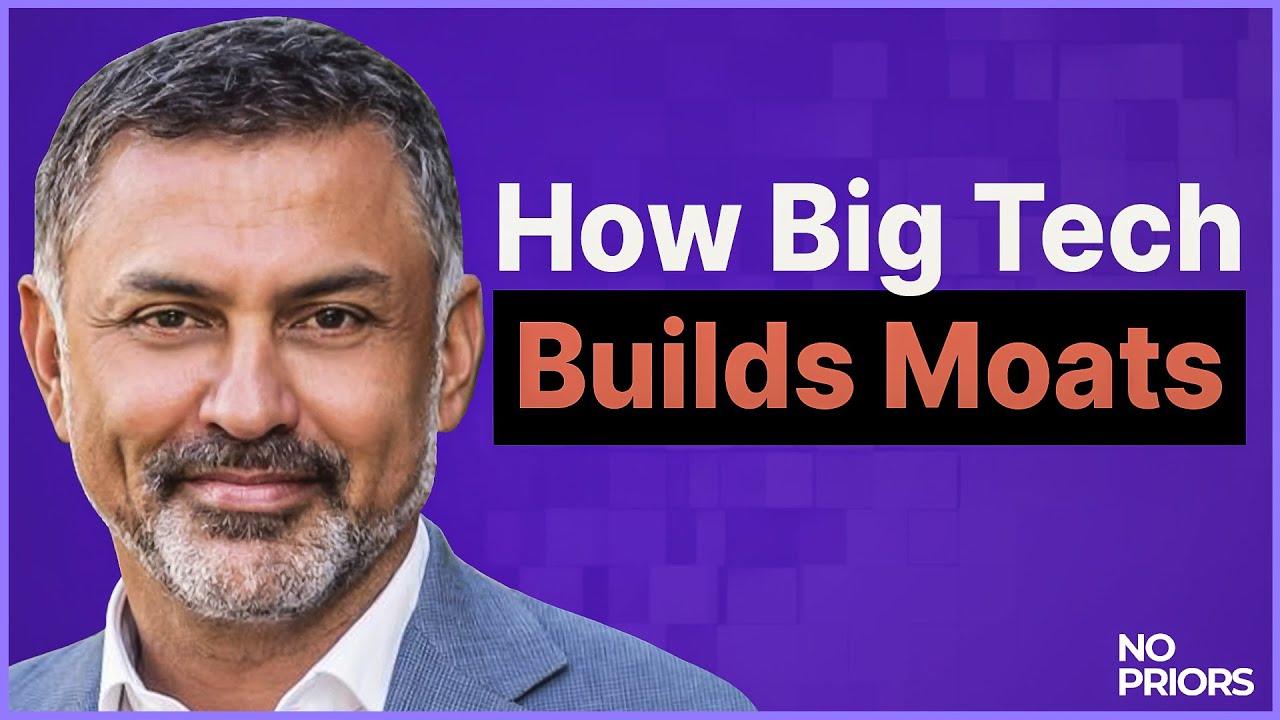
📺 Today’s recommended deep-dive video: https://www.youtube.com/watch?v=yFHFYFvZcvE
The Platform Playbook: Nikesh Arora on AI, Agents, and the Future of Search
Nikesh Arora, CEO of Palo Alto Networks and former Google executive, dissects the seismic shift from information retrieval to agentic intelligence. He argues that while generative AI is impressive, the real disruption lies in the “democratization of intelligence” and the automation of complex enterprise workflows.
Core Question: How must businesses and security architectures evolve to survive a world where AI agents can execute transactions and breach networks in minutes?
Highlights
- Search is evolving from providing a list of links to synthesizing intelligence and consummating direct transactions.
- Agentic AI is more disruptive than generative AI because it replaces the user interface with direct task fulfillment.
- Modern cybersecurity requires response times to drop from days to minutes to counter automated, AI-driven attacks.
- M&A should be viewed as “distributed R&D,” allowing large platforms to integrate specialized innovations at scale.
⏱️ Reading time: approx. 8 minutes · Saves you about 50 minutes vs. watching.
Want to take notes while watching? Click the image below and let AI Notebook capture the key points for you 👇

The Democratization of Intelligence
From Search Links to Consummated Transactions
The era of democratization of information is being replaced by the democratization of intelligence. For two decades, Google and others focused on making the world’s information accessible, but users are now demanding synthesis rather than just a list of links to sift through themselves.
Search used to be about finding the internet; now it’s about making the internet make sense for the specific intent of the user.
This shift creates a fundamental business model challenge for incumbents. Traditional search revenue relies on lead generation—sending a user to a website via an ad. However, if an AI agent can find the best blue pants or the fastest flight to Rome and consummate the transaction directly, the monetization must shift toward a consumption or transaction-based metric. The value moves from the “click” to the “fulfillment.”

💡 Digging Deeper
Q: How does the business model for search change with agents?
A: It likely shifts from lead generation to transaction fulfillment, where the platform gets paid for a completed action rather than a referral.
Q: Is Google’s distribution power still relevant?
A: Absolutely. Distribution through platforms like Android, Apple, and Facebook remains a massive advantage even as the underlying product architecture changes.
Q: Why was Larry Page’s original vision for search relevant today?
A: Page envisioned a system that answered a user’s intent rather than just their typed query, which is exactly what LLMs are finally achieving.
The Agentic Disruption in Enterprise
Why UI Managers are at Risk
Product managers have spent forty years acting as glorified UI managers. They built boxes, buttons, and forms because humans weren’t capable of speaking directly to the underlying engineering algorithms. We needed the interface to translate our needs into data.
Generative AI has started to strip away that layer by allowing natural language to interact with the backend.
The real danger for the current app ecosystem is the move toward agentic actions. If 50% of the world’s applications are essentially thin front-ends for transaction processing—like booking a flight or a restaurant—the UI becomes irrelevant. If an “Uber agent” or “Travel agent” can handle the API call directly, the traditional app interface loses its loyalty and its purpose.
Precision vs. Assistance
In the consumer world, we are remarkably tolerant of hallucinations or inaccurate answers from an LLM. We just re-prompt and try again. However, in the enterprise environment, the tolerance for error is effectively zero. An agent cannot “accidentally” shut down the wrong server or misallocate millions of dollars in accounts payable without catastrophic consequences.
Because of this, we are currently in an “AI as a Service” (AIaaS) training phase. Most current enterprise AI tools act as glorified assistants or researchers, keeping a human in the loop to verify every precision task before it is executed.

💡 Digging Deeper
Q: Will small models win over large models?
A: Large models are becoming so smart that smaller, specialized models often struggle to keep pace unless they are trained on highly proprietary data.
Q: What defines a successful enterprise AI app?
A: Success isn’t just about the AI wrapper; it’s about marrying the AI to a proprietary “system of record” that holds the company’s unique data.
Q: Are humans being displaced by AI in product development?
A: Not necessarily. AI is currently being used to eliminate technical debt and repetitive coding, allowing human developers to innovate faster.
Cybersecurity in the Age of AI
The 23-Minute Threat Window
Cybersecurity has always been a sensor business because you simply cannot stop what you cannot see. Traditional security was built to stop the “known bad”—malware or actors that had been identified previously. However, AI allows bad actors to unleash autonomous agents that can find “unknown bad” vulnerabilities and exfiltrate data with terrifying speed.
When Nikesh joined Palo Alto Networks seven years ago, the average time to identify and exfiltrate data was three to four days. Today, the fastest recorded attacks happen in under 23 minutes.
If a bad actor can compromise a network in under an hour, a human-led response time measured in days is a failure of physics. This creates an immediate need for automated, AI-driven defense mechanisms that can analyze data at the point of ingestion and block anomalous behavior in real-time.
The Problem with Fragmented Defense
Most large enterprises are currently suffering from a “fragmented architecture” problem, often managing over 100 different security vendors. This creates a data silo issue where the email security tool doesn’t talk to the firewall, which doesn’t talk to the endpoint sensor. If a user clicks a suspicious link in an email, the context is lost the moment they move to a different part of the network.
Consolidation is the only logical path forward. By moving toward a singular platform, companies can correlate data across all sensors. This allows the system to identify that while “Sarah” is a legitimate user, her sudden attempt to download the entire company database is an anomaly that requires an immediate, automated block.

💡 Digging Deeper
Q: Why is identity the new perimeter?
A: 89% of attacks involve credential theft. If an attacker becomes “you,” the only way to stop them is by analyzing behavioral anomalies.
Q: What is the risk of “model poisoning”?
A: As enterprises deploy LLMs, they must protect against prompt injection and data poisoning that could cause the model to leak secrets or provide malicious code.
Q: Is AI making social engineering easier?
A: Yes. Deepfakes and LLMs can answer arcane security questions and mimic voices, making traditional two-factor authentication increasingly vulnerable.
Key Takeaways
The transition from point solutions to integrated platforms is inevitable in every mature technology industry. Just as CRM, ERP, and HR systems consolidated into single platforms like Salesforce and Workday, cybersecurity must move away from its current fragmented state. The speed of AI-driven attacks makes the “whack-a-mole” approach of managing 118 different vendors not only inefficient but dangerous.
Leadership in this new era requires a focus on “distributed R&D” and aggressive communication. By treating M&A as a way to capture specialized innovation and folding it into a central platform, companies can maintain a “North Star” vision while staying at the bleeding edge.
Despite the risks of automated attacks and deepfakes, there is immense room for optimism. AI has the potential to eliminate repetitive, “punch-in-the-face” jobs like low-level customer support and documentation, freeing humans to focus on higher-level architectural problems and faster product innovation.
Q&A
Q1: How does Nikesh view the role of M&A?
A: He views it as “distributed R&D.” Instead of trying to innovate in every niche internally, Palo Alto Networks acquires the best-of-breed startups and integrates them into their platform.
Q2: What is the biggest threat AI poses to security?
A: The compression of attack timelines. AI allows attackers to move from entry to data exfiltration in minutes, requiring a move toward fully automated defense.
Q3: Will AI agents replace sales teams?
A: Unlikely. While SDR processes might become more efficient, large enterprise sales still require human-to-human trust and complex navigation that agents aren’t ready for.
Q4: What is “just-in-time” rights in security?
A: It is a shift away from persistent access. Instead of having permanent rights to a system, users are granted access only when needed, based on their current behavior and intent.
Q5: Why is customer support moving closer to product teams?
A: Nikesh believes support exists because products are too complicated or have bugs. By integrating support with product, companies can fix root causes rather than just managing complaints.
Q6: What did Nikesh learn from Larry Page?
A: That a technology company that loses sight of its product will inevitably decimate over time, regardless of its business chops.
Q7: How should enterprises handle proprietary data and LLMs?
A: They must use “ring-fenced” instances where their data is not used to train the public model, ensuring their IP remains secure while still benefiting from the LLM’s intelligence.