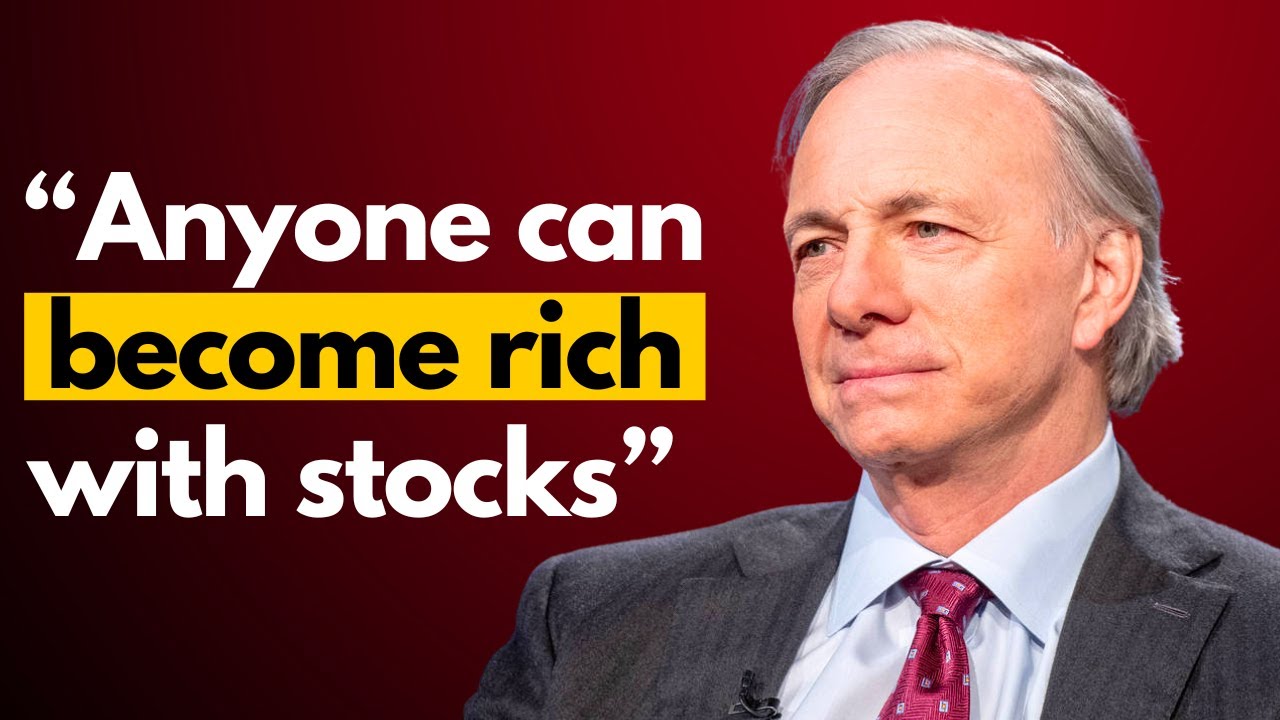
📺 Today’s recommended deep-dive video: https://www.youtube.com/watch?v=HGFyIgyW3cM
The Economic Machine: How to Navigate Debt Cycles and Market Extremes
Ray Dalio breaks down the global economy into a “perpetual motion machine” driven by mechanical cause-effect relationships. By understanding the interplay between productivity and debt cycles, investors can move beyond guesswork to build portfolios that survive any environment.
Core Question: How can we apply timeless economic principles to decode market cycles and achieve the “Holy Grail” of radical diversification?
Highlights
- The distinction between the steady climb of productivity and the volatile swings of short and long-term debt cycles.
- Why the current economic climate mirrors the 1930s, characterized by wealth gaps and rising populism.
- The “Holy Grail” of investing: how 15 uncorrelated return streams can reduce risk by 80% without sacrificing returns.
- The structural arc of reserve currencies, from innovation and military might to eventual decline.
⏱️ Reading time: approx. 6 minutes · Saves you about 33 minutes vs. watching.
Want to take notes while watching? Click the image below and let AI Notebook capture the key points for you 👇

The Mechanics of the Economic Engine
Forces, Equilibriums, and Levers
The economy functions as a perpetual motion machine driven by four primary forces, three equilibriums, and two main levers. Productivity is the most fundamental force; it represents our ability to do things better over time, steadily raising living standards through efficiency. While productivity is the most important factor in the long run, it is the debt cycles—both short and long-term—that create the turbulence we feel in our daily lives and market fluctuations.
Everything happens because of a specific cause.
Short-term debt cycles, or business cycles, typically last seven to ten years and are managed by central banks through the manipulation of credit. When the economy has too much slack, banks produce credit to stimulate buying power; when the economy overheats, they raise interest rates to put on the brakes. This cyclicality is inherent because credit allows us to spend more than we earn today, necessitating a period where we must spend less than we earn to pay it back.
Debt growth must align with income growth.
The long-term debt cycle is the accumulation of these smaller cycles, eventually reaching a point where interest rates hit zero and central banks are forced to print money. We are currently in the late stages of such a cycle, where the efficacy of traditional monetary policy is waning, and the “engine” is starting to struggle with the weight of unfunded liabilities like pensions and healthcare.

💡 Digging Deeper
Q: Why is credit considered “buying power”?
A: Credit is an agreement to provide cash now for a promise to pay later; by increasing credit, central banks immediately increase the total amount of spending in the economy.
Q: What happens when interest rates hit zero?
A: Central banks lose their primary lever for stimulation and must turn to “quantitative easing,” which involves printing money to buy financial assets.
Q: How does productivity affect the long-term cycle?
A: Productivity is the “baseline” growth, but it often slows late in a debt cycle as investment shifts away from innovation and toward servicing existing debt.
The Social and Geopolitical Feedback Loop
Wealth Gaps and the Rise of Populism
Since the year 2000, we have lived through a “golden age of capitalism” where profit margins doubled, largely at the expense of employee compensation and through the aid of globalization. While this has been fantastic for corporate earnings and stock prices, it has created a staggering wealth gap where the top 0.1% of the population holds nearly as much wealth as the bottom 90% combined. This disparity is not just a social issue; it is a primary driver of market volatility through the mechanism of populism.
We are seeing a conflict over capitalism versus socialism.
This internal polarity in countries like the United States and within Europe leads to extreme political shifts, where both the left and the right move toward their respective fringes. These shifts directly impact capital flows, as changes in corporate tax rates or social spending can turn previous market “tailwinds” into “headwinds” almost overnight. When the majority of the population cannot raise $400 for an emergency, the political system becomes ripe for structural upheaval.
History is a series of rising powers challenging existing ones.
This internal tension is compounded by external geopolitical cycles, specifically the rise of China challenging the United States’ dominance. This follows a classic historical arc where a rising power uses technology and education to gain economic strength, which then evolves into military power and reserve currency status. As these two giants compete over technology like 5G and AI, the resulting friction creates a high-stakes environment for global investors.

💡 Digging Deeper
Q: How does populism affect the stock market?
A: Populism often leads to policies that prioritize wealth redistribution or protectionism, which can compress profit margins and disrupt international trade.
Q: What defines a “Reserve Currency” status?
A: It is the final stage of a country’s power arc, achieved when their currency is used globally for trade and as a store of value by other central banks.
Q: Why compare today to the 1930s?
A: Both periods feature zero-bound interest rates, massive money printing, wide wealth gaps, and a rising global power challenging an incumbent.
The Holy Grail of Investment
Diversification and Systematic Rules
The “Holy Grail” of investing is the ability to find 15 or more good, uncorrelated return streams to build a portfolio that maximizes return while minimizing risk. Most investors make the mistake of thinking they are diversified if they own many different stocks, but because those stocks are often 60% correlated, the risk reduction is minimal. True diversification requires finding assets that react differently to the same economic environmental shifts, such as inflation or growth surprises.
Knowing how to deal with what you don’t know is more important than what you do know.
To achieve this, one must distinguish between “Beta”—the return of the market itself—and “Alpha”—the return generated by outperforming others. Because Alpha is a zero-sum game, it is incredibly difficult to sustain, whereas Beta can be structured to be “All Weather.” By balancing a portfolio based on the environmental drivers of assets rather than just dollar amounts, an investor can create a steady climb even when individual markets are crashing.
Don’t buy what did well; buy what is balanced.
Success comes from systemizing these decision-making rules so they are timeless and universal. By writing down criteria for every decision and back-testing them against history, an investor can remove the emotional impulse to buy at the top and sell at the bottom. This systematic approach allows you to anticipate the next move in the “perpetual motion machine” rather than reacting to it after the fact.

💡 Digging Deeper
Q: What is the “All Weather” strategy?
A: It is a portfolio design that balances assets so that it performs well in all four economic “seasons”: rising growth, falling growth, rising inflation, and falling inflation.
Q: Why is Alpha a “zero-sum game”?
A: For every investor who outperforms the market average, there must be another investor who underperforms it by the exact same amount.
Q: How many uncorrelated assets are needed to reduce risk by 80%?
A: Approximately 15 uncorrelated assets are required to reach that level of risk reduction without significantly lowering the expected return.
Key Takeaways
Ray Dalio’s approach is centered on the belief that the economy is a mechanical system that can be understood and navigated through rigorous, systematic principles. By viewing current events—such as the wealth gap, geopolitical tensions with China, and zero-interest rates—through the lens of historical cycles, we can see that these are not unprecedented anomalies but rather predictable stages in a long-term debt cycle.
The ultimate protection for any investor is not the ability to predict the future perfectly, but the ability to structure a portfolio that can withstand any outcome. This requires a humble acknowledgment of what we do not know and a commitment to the “Holy Grail” of diversification. By finding uncorrelated return streams and balancing them based on risk rather than dollars, we can turn the volatility of the economic machine into a source of steady progress.
Q&A
Q1: What is the most important force in the economy over the long term?
Productivity is the most important force. It is the steady improvement in output per man-hour that allows living standards to rise over decades, though it is often overshadowed by shorter-term debt cycles.
Q2: What is the difference between a short-term and a long-term debt cycle?
A short-term cycle is the standard 7-10 year business cycle managed by interest rates. A long-term cycle occurs over decades as debt accumulates, eventually requiring a “beautiful deleveraging” or money printing when rates hit zero.
Q3: Why does Dalio emphasize the “Wealth Gap”?
The wealth gap is currently at its highest level since the 1930s. It drives populism, which creates political instability and can lead to drastic changes in tax laws and trade policies, directly impacting market returns.
Q4: How does diversification “reduce risk more than it reduces return”?
By combining assets that are uncorrelated—meaning they don’t move together—you cancel out the individual “noise” and volatility of each asset while keeping the upward trend of the combined returns.
Q5: What are the “two levers” of economic policy?
The two levers are monetary policy (controlled by central banks through interest rates and money printing) and fiscal policy (controlled by the government through spending and taxation).
Q6: What is a “timeless and universal” principle?
It is a decision-making rule that works across all time periods and in all countries. Dalio tests his rules against hundreds of years of data to ensure they aren’t just specific to a single era.
Q7: How is China challenging the current global order?
China is following the classic arc of a rising power: improving technology and education, becoming a leader in global trade, and now expanding its military and the global use of its currency.