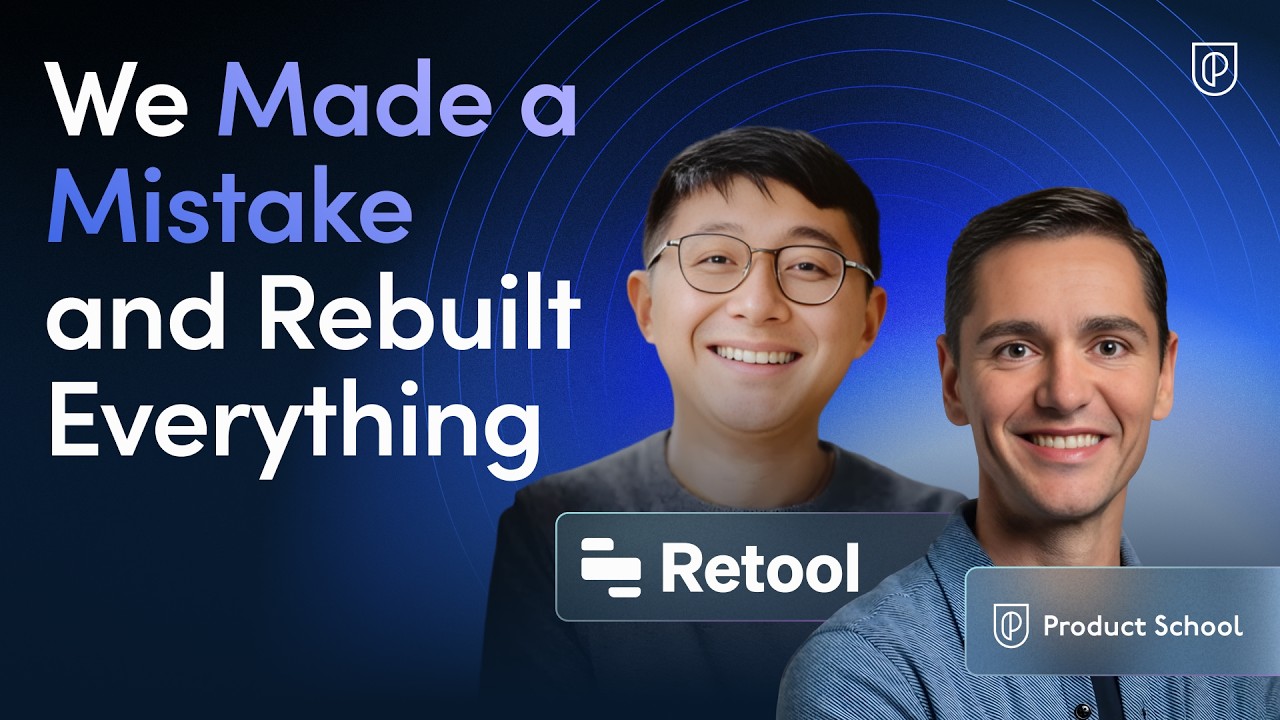
📺 Today’s recommended deep-dive video: https://www.youtube.com/watch?v=O-q9brSdRS4
Beyond Drag-and-Drop: Retool’s Pivot to an AI-Native Future
Retool CEO David Hsu reveals the messy, high-conviction process of re-architecting a nine-figure business for the age of LLMs. By moving away from traditional low-code components toward raw AI code generation, Retool is positioning itself as the “arms and legs” for the next generation of AI employees.
Core Question: How can established software companies cannibalize their core products to embrace a future where AI, not humans, writes and manages business logic?
Highlights
- Admitting the strategic error of teaching LLMs to use drag-and-drop interfaces instead of generating raw code.
- Why Retool deliberately avoids becoming a “system of record” to unlock massive enterprise and government contracts.
- The transition from deterministic software to “probabilistic” agents that possess judgment and agency.
- Why the “last mile” of software—governance, deployment, and security—becomes more valuable as the cost of building hits zero.
⏱️ Reading time: approx. 6 minutes · Saves you about 34 minutes vs. watching.
Want to take notes while watching? Click the image below and let AI Notebook capture the key points for you 👇

The Great Architectual Reset
From Visual Components to Code Generation
Retool is currently undergoing a massive internal shift, essentially deciding to throw away five years of debt to embrace a code-first AI approach. Initially, the team attempted to teach LLMs how to use Retool’s existing drag-and-drop system, treating the AI as if it were a human builder clicking on components.
David Hsu now classifies this as a mistake.
The team realized that while visual builders are great for humans, they create unnecessary friction for AI models that are natively proficient at writing React and SQL. By re-architecting the platform to let LLMs generate code that runs directly on Retool’s infrastructure, they are removing the “middleman” of the UI. This allows for faster iteration and more complex applications that a standard drag-and-drop interface would struggle to support.

💡 Digging Deeper
Q: Why was teaching an AI to “drag and drop” a bad idea?
A: It forced the AI to operate within the constraints of a human interface, whereas LLMs are far more efficient at writing raw, structured code.
Q: How do you handle the technical debt of a product making nine figures in revenue?
A: It requires “founder mode” conviction to put the existing product into maintenance and shift the core team toward a replacement that reflects the new technological reality.
Q: Is drag-and-drop dead?
A: Not for humans, but for AI-led development, it is a limiting abstraction that reduces the model’s creative and logical ceiling.
The Strategy of the “Boring” and Non-Defensive
Avoiding the “System of Record” Trap
In the world of SaaS, most founders are told that “defensibility” comes from becoming a system of record—the place where data is born and stored. Retool took a contrarian path by choosing to store zero operational data, acting instead as a highly compatible “connector” to existing databases like Postgres, Snowflake, or Salesforce.
This decision was initially criticized by VCs but has become Retool’s greatest competitive advantage.
By not being a system of record, Retool bypassed the massive security hurdles that usually stop startups from entering the enterprise. Large entities like the US Air Force and the US Navy can use Retool because their data remains in their own cloud or on-premise servers. This “anti-moat” strategy created a higher level of trust, allowing Retool to scale within the most secure environments in the world.

Winning in the “Unsexy” Market
More than half of the world’s software is built for internal facing use cases, yet it is often ignored by the limelight of Silicon Valley. Developers at legacy companies like Colgate spend their entire days building internal tools; this is a massive, sustainable market that doesn’t suffer from the high churn rates of consumer “vibe-coding” apps. Retool’s focus on these “unsexy” workflows provides a stable revenue base that allows them to experiment with AI without the pressure of 50% gross retention rates.
Giving LLMs “Arms and Legs”
The Rise of the AI Employee
The current state of AI is a “brain in a jar”—it is incredibly smart but lacks the agency to execute tasks across different business systems. Hsu’s vision for “Retool Agents” is to provide the arms and legs for these models, allowing them to send emails, update Salesforce, and query data bricks autonomously.
We are moving from deterministic software (if this, then that) to probabilistic software (handle this ambiguity).
Colgate has already set a target to have functional AI employees by 2028. This isn’t just a futuristic dream; it is a business necessity driven by the need to optimize cost structures in a high-inflation environment. When software can possess judgment, the total addressable market for automation expands from simple data entry to complex knowledge work.

The Governance Layer as the New Moat
As the cost of generating software drops to near zero, the difficulty shifts from writing the code to managing the code. If every employee can spin up an AI-generated app, a company can quickly face “application sprawl” where multiple versions of the same tool show different data.
The role of the platform team is to provide the guardrails. Retool is investing heavily in a “federated model” of governance, where a central IT team sets the security and data foundations, but individual departments are free to build within those safe boundaries. This ensures accuracy and “correctness” in a world where AI can produce thousands of apps a minute.
Key Takeaways
The shift to AI-native building requires a radical departure from the low-code models of the last decade. Founders must be willing to cannibalize their own successful products to ensure they don’t get leapfrogged by “vibe-coding” tools. The value is no longer in the abstraction of the UI, but in the efficiency of the code generation and the robustness of the execution runtime.
Success in the enterprise AI space depends on being “boring” enough to handle governance, security, and integration while being “bold” enough to give LLMs actual agency. By focusing on internal tools and avoiding the “system of record” trap, Retool has built a defensible business that thrives on the very data fragmentation that slows others down.
Q&A
Q1: What is “Founder Mode” in the context of Retool’s AI pivot?
A1: It is the ability for the CEO to make a high-conviction decision to re-architect the product, even if it risks short-term confusion, to ensure long-term alignment with technological shifts.
Q2: Why does Retool target non-developers if the product is moving toward code generation?
A2: Retool is targeting “tomorrow’s developers”—data analysts and business operators who understand SQL or basic logic and can use AI to generate the React code they previously couldn’t write.
Q3: How does Retool handle data security if it connects to everything?
A3: Retool can be deployed on-premise or in a customer’s private cloud, ensuring that the operational data never leaves the customer’s controlled environment.
Q4: What is the biggest risk of AI-generated internal tools?
A4: Sprawl and “correctness.” Without a governed layer, different departments might build conflicting apps that show inconsistent data, leading to a breakdown in business logic.
Q5: What is the “Federated Model” of AI adoption?
A5: A structure where a central team provides the data access and action layers (the foundations), while decentralized teams build specific AI agents and tools on top of those foundations.
Q6: Why is the AI employee “inevitable”?
A6: Because business economics demand it. High labor costs and inflation put pressure on margins that only the structural efficiency of AI labor can solve.
Q7: What tool is David Hsu using personally to stay on the “pulse”?
A7: He is spending significant time building with Multibot (formerly Boltbox) to understand how LLMs interact with browsers, calendars, and external tools.