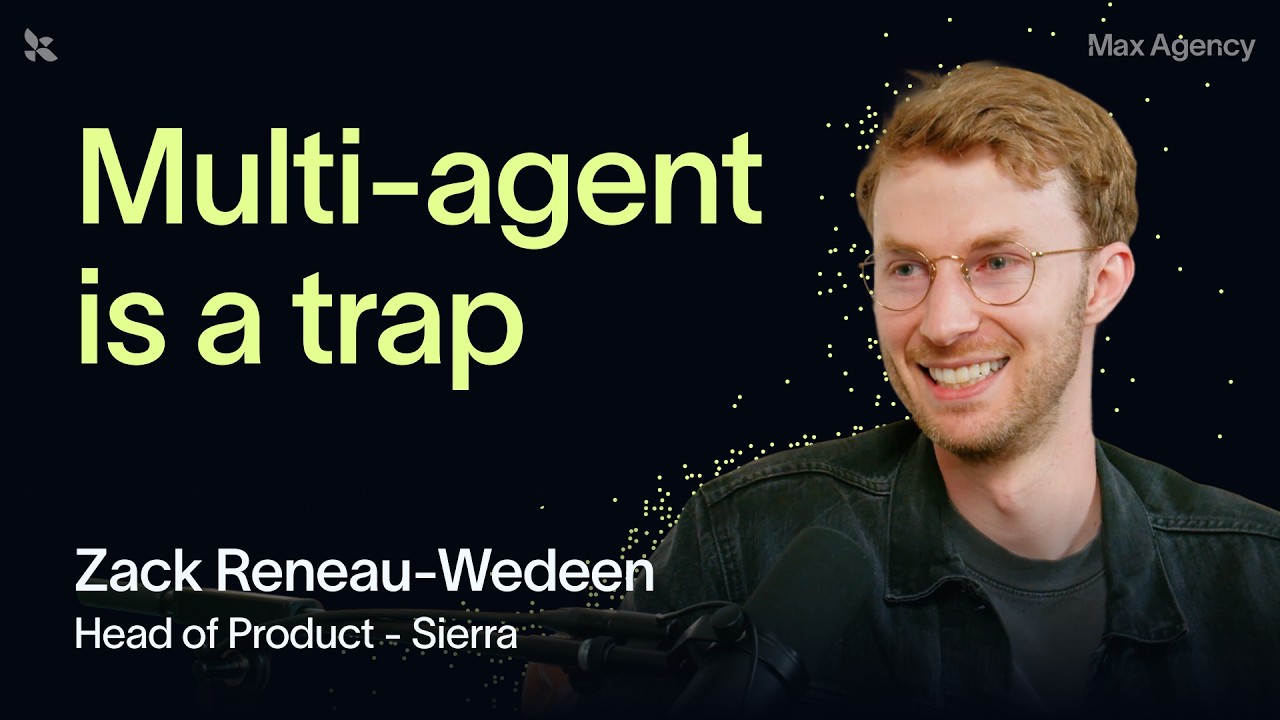
📺 Today’s recommended deep-dive video: https://www.youtube.com/watch?v=uCKhOmth2ms
Beyond the Chatbot: Engineering the Era of Agentic Commerce
Sierra is not just building better customer support; they are architecting the bridge between global brands and autonomous personal agents. By reimagining everything from payment infrastructure to voice parallelism, Zack Reno Wedeen and the Sierra team have turned traditional e-commerce into a high-stakes arena of agentic interactions.
Core Question: How can infrastructure be designed to allow AI agents to handle multi-billion dollar transactions and complex human emotions with low-latency reliability?
Highlights
- Parallel Thinking-Listening-Talking: Sierra’s voice architecture runs transcription, reasoning, and speech synthesis in parallel to eliminate the awkward pauses typical of LLMs.
- Declarative “Journeys”: A no-code layer that allows operations teams to define Standard Operating Procedures (SOPs) which compile deterministically into an underlying Agent SDK.
- PCI-Certified Commerce: Sierra built isolated infrastructure to handle secure payments, enabling agents to earn commissions and complete sales without exposing data to external LLM providers.
- The “Monolith” Philosophy: A preference for high-quality context engineering over complex multi-agent systems, avoiding the trap of “shipping your org chart” through fragmented agents.
⏱️ Reading time: approx. 8 minutes · Saves you about 79 minutes vs. watching.
Want to take notes while watching? Click the image below and let AI Notebook capture the key points for you 👇

The Three-Tier Architecture of Agency
From Natural Language to Deterministic SDKs
Building for the Fortune 20 requires a level of governance that standard agent harnesses often lack. Sierra’s platform is split into three main sections: Analyze, Build, and Release. While the “Build” phase often starts with Ghostwriter—an AI authoring agent similar to Claude Code—the underlying logic is stored in what Sierra calls Journeys.
Journeys act as a declarative no-code layer.
Operations managers, who possess the most depth regarding customer experience, can define workflows using natural language or SOP-like structures. These Journeys then compile down to the Agent SDK code isomorphically. This means an engineer can transition a flow from code to no-code and back again without losing the integrity of the logic, allowing for a seamless collaboration between technical teams and customer experience managers.
At the base of this stack sits Agent OS, a constellation of 10 to 15 different models invoked for every single conversation turn. A typical interaction might use a frontier model for reasoning, a handful of specialized in-house classifiers for intent, and speculative execution models to generate filler phrases (“Let me look that up for you”) to mask latency. By mapping internal structures to file systems—a format coding agents are naturally good at “grepping”—Sierra enables its authoring tools to build complex agents with high precision.

💡 Digging Deeper
Q: Why use a DSL like “Journeys” instead of just raw text prompts?
A: Raw text is non-deterministic. If you rely solely on prompting, you end up in the realm of trial-and-error engineering. A declarative DSL allows operations teams to define rigid rules while still letting the model reason within those guardrails.
Q: How does Sierra handle the conflict between internal abstractions and what models already know?
A: Zack follows an 80/20 rule: 80% of the time, they map Sierra’s logic to abstractions the model already understands (like Git or file systems). Only in the remaining 20% do they invest in training the model to understand a proprietary Sierra way of thinking.
Solving the Voice Latency Puzzle
Parallelism as a First-Class Citizen
Voice is the most demanding modality for agents because humans have zero tolerance for latency. If an agent doesn’t respond within one or two seconds, the user assumes the system is broken. To solve this, Sierra abandoned the sequential “transcribe then think then speak” loop in favor of a modular architecture that parallelizes thinking, listening, and talking.
Think of it like a human brain: you are often processing what you will say next while the other person is still finishing their sentence.
This modularity allows Sierra to ensemble different providers for transcription and synthesis. For instance, they discovered that certain transcription models are excellent at specific accents—like those from Northern UK—but hallucinate during silence. By running two models in parallel, Sierra can use one to detect silence and another to transcribe speech, merging the results for a perfect output.
This level of engineering extends to speech-to-speech native models. While Sierra is beginning to deploy these in production, they currently treat them as the “last mile” of a larger harness. The orchestrator still maintains a transcript to trigger API calls and internal logic, ensuring the agent doesn’t lose its “source of truth” while benefiting from the naturalism of voice-native inference.

💡 Digging Deeper
Q: Why not go 100% voice-to-voice native yet?
A: Cost and reliability. Voice-native models are currently an order of magnitude more expensive and less reliable at complex tool calling compared to text-based reasoning models.
Q: How do you handle interruptions in a parallel system?
A: By using a dedicated voice activity detection (VAD) layer that runs in parallel with the reasoning engine, the system can instantly kill a “talking” thread the moment it detects the user has started speaking again.
The Infrastructure of Agentic Commerce
Beyond E-Commerce: When Agents Buy from Agents
Agentic commerce is the transition from humans clicking buttons on Shopify to personal agents (like a user’s custom GPT or Claude) interacting with a brand’s agent to settle a transaction. Zack predicts this will eventually be bigger than e-commerce itself. To prepare for this, Sierra became the first voice-AI platform to achieve PCI DSS Level 1 certification.
This was not a simple software update.
Sierra had to build entirely isolated infrastructure where credit card data never touches an external large language model. Since frontier model providers like OpenAI or Anthropic are not PCI certified, the payment information is handled in a secure cluster, while the LLM only receives a confirmation that the transaction was successful. This enables “outcome-based pricing,” where Sierra can actually get paid a commission on a sale made by the agent.
In the future, brands won’t just optimize for SEO; they will optimize for “Agentic SEO.” They will need to present their products and checkout flows in a way that an external personal agent can easily parse and execute. Whether through the Model Context Protocol (MCP) or custom APIs, the goal is to make the brand’s agent the definitive endpoint for commercial action.

💡 Digging Deeper
Q: What is “outcome-based pricing”?
A: Instead of charging for tokens or seats, Sierra charges based on the value delivered—such as a resolved support ticket or a completed sale. This aligns Sierra’s incentives with the customer’s business goals.
Q: Will personal agents just talk to raw APIs?
A: Unlikely for high-value brands. Brands want to control how their products are presented and weighed. A Sierra agent serves as the “brand representative” that an external agent interacts with to ensure the brand’s policies and loyalty perks are applied correctly.
Context Engineering vs. Multi-Agent Bloat
The Monolith Loyalist Perspective
There is a growing trend toward complex multi-agent systems, but Sierra often pushes back against this. Zack warns that many developers build multi-agent systems simply because it matches their internal organizational chart or makes them feel more comfortable with problem separation. However, this often leads to “destructive value” where the triage agent lacks the procedural knowledge of the task agent, and vice-versa.
The real key to performance is Context Engineering.
Context engineering is the art of showing the agent exactly what it needs to do the job, and nothing more. Sierra uses “progressive disclosure,” only bringing specific knowledge into the prompt when it becomes relevant. This avoids the incoherence and hallucinations that occur when a prompt is stuffed with conflicting information.
By staying “monolith loyalist,” Sierra ensures that the agent maintains a single, coherent identity and memory. Instead of switching between five sub-agents, the system manages a high-dimensional context that evolves throughout the conversation. This results in higher resolution rates because the agent never loses the “thread” of the customer’s identity and past frustrations.
💡 Digging Deeper
Q: When is a multi-agent system actually appropriate?
A: Only when the tasks are truly separable and there is zero benefit to the first context being part of the second context. Otherwise, it’s usually better to solve the problem with better context engineering.
Q: How does Sierra handle long-term memory?
A: Memory is a first-class primitive in their “Agent Data Platform.” It allows the agent to recognize a returning caller, remember their preferences (like a pet in a cabin or a preferred aisle seat), and apply empathy based on the user’s recent history.
Key Takeaways
Building agents for the world’s largest enterprises requires moving past the “chatbot” mindset and into the realm of robust systems engineering. Sierra’s success lies in its ability to marry the non-deterministic reasoning of LLMs with the deterministic requirements of corporate governance and security. By treating “agency” as a core trait in their engineering team and “outcome-based pricing” as their business North Star, they’ve created a platform where the AI is responsible for billions of dollars in potential revenue.
The future of the industry is shifting from providing tools to providing results. As coding agents make the act of writing software cheaper, the value shifts toward product judgment and customer intuition. Developers who can drive the “Formula 1 car” of modern AI—handling the frequent pit stops of iteration and the high speeds of agentic execution—will be the ones who define the next decade of commerce.
Q&A
Q1: How does Sierra ensure its no-code “Journeys” stay reliable?
A1: They compile down to the Agent SDK isomorphically. This ensures that every natural language instruction maps to a deterministic execution path, allowing for rigorous testing and version control.
Q2: What is the most common reason an LLM “acts dumb” in a professional setting?
A2: Zack notes that if the model seems dumb, it’s usually the developer’s fault. It typically means there’s a conflict in the prompt or the context engineering hasn’t properly isolated the necessary information for the task.
Q3: How does Sierra handle massive traffic spikes like Black Friday?
A3: They use a multi-home provider strategy. If one LLM provider or transcription service goes down or hits capacity, the platform automatically routes tasks to other frontier models or internal fine-tuned models to ensure 100% uptime.
Q4: What is TaoBench?
A4: It is a specialized benchmark Sierra released to evaluate agentic tool-calling and process-following. They also released MuBench for multilingual transcription to help the community evaluate how models handle different global languages.
Q5: Why is memory so difficult for B2B AI startups?
A5: Memory requires authentication. To remember a user, you must be able to verify their identity securely. Many startups fail here because they don’t realize that selling “memory” actually means they have to sell “identification and security.”
Q6: What is an “AI-native interview”?
A6: It’s a process where candidates build a full product end-to-end in a few hours using coding agents. It tests a candidate’s “agency,” product judgment, and their ability to lead AI tools rather than just write syntax.
Q7: Will we eventually see a single “Master Agent” harness?
A7: Zack believes there will always be tradeoffs between latency, cost, and quality. While convergence is happening, specific architectures for voice, deep research, and commerce will likely remain distinct due to these fundamental engineering constraints.