📺 Today’s recommended deep-dive video: https://www.youtube.com/watch?v=t9HmOz8H0qI
The Fractional-Horsepower Revolution: Steve Jobs on the Future of Personal Computing (1983)
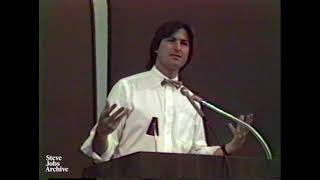
In this visionary 1983 address at the International Design Conference in Aspen, a young Steve Jobs outlines the transition from the television generation to the computer generation. He argues that the personal computer is not merely a tool for calculation, but a new, interactive medium of communication that will eventually be as portable as a book.
Core Question: How will the shift from shared mainframes to individual “fractional-horsepower” computers reshape human communication, education, and the objects in our daily lives?
Highlights
- The analogy of computing evolution to the electric motor, moving from massive centralized power to “fractional-horsepower” individual tools.
- A prediction of a “computer in a book” that users can carry anywhere and learn to use in twenty minutes.
- The critical need for industrial designers to intervene before the ubiquitous computers of the future become “junk objects.”
- Software as a way to capture the underlying principles of experience, potentially allowing us to “interact” with the minds of historical figures.
⏱️ Reading time: approx. 8 minutes · Saves you about 47 minutes vs. watching.
Want to take notes while watching? Click the image below and let AI Notebook capture the key points for you 👇

The Machine of Electrons
Speed, Simplicity, and the Illusion of Magic
A computer is essentially a simple machine where gears and pistons have been replaced by billions of electrons. Because we cannot see these moving parts, the technology often feels intimidating or magical to the uninitiated.
Jobs clarifies that computers are actually quite “dumb” and only follow the most mundane instructions, such as fetching a number or testing if a value is greater than zero. The illusion of intelligence comes solely from the incredible speed at which these tasks are performed.
If a human could move a hundred times faster than everyone else, they could run out, grab a bouquet of flowers, and return in a blink, appearing to be a magician. Computers do this at a rate of a million instructions per second, creating a layer of abstraction that allows us to eventually ask the machine to “pour a cup of coffee” rather than detailing every muscular movement.

💡 Digging Deeper
Q: Why did Jobs compare computers to the brain?
A: He noted that both are highly adaptive; just as the brain changes based on experience, a computer can move electrons differently based on the results of the previous operation.
Q: What is the “television generation” vs. the “computer generation”?
A: Jobs sees television as a passive medium, whereas the computer generation will treat the device as their predominant, interactive medium of communication.
The Evolution of the Motor
From the Factory Shaft to the Home Office
To understand the history of computing, Jobs points to the late 1800s and the invention of the electric motor. Initially, motors were so large and expensive that they could only be justified for massive industrial applications.
Eventually, factories used a single large motor to drive a shared shaft, distributing power to multiple workstations via belts and pulleys. This is the industrial equivalent of “time-sharing” in the 1960s, where many people used terminals connected to one central mainframe.
The real revolution occurred with the “fractional-horsepower” motor, which allowed power to be brought directly to individual tasks. Today, dozens of these small motors exist in every household. Apple’s success, Jobs explains, was stumbling onto “fractional-horsepower computing” five years before anyone else—putting the entire computer into a 13-pound box.

💡 Digging Deeper
Q: What was the “breadbox” mentioned in the talk?
A: It was the Lisa, Apple’s $10,000 computer. Jobs described it as the first step toward the “computer in a book.”
Q: Why did Jobs emphasize industrial design?
A: He observed that by 1986, computers would outsell cars, yet most designers were still working on automobiles while computers looked like “garbage.”
Computing as a New Medium
Beyond “I Love Lucy” habits
Every new medium initially mimics the one it replaces. Early television was just radio with a camera pointed at it, and early personal computing was stuck in “old-media habits” like business accounting and COBOL.
Jobs argues that the personal computer is a unique medium because it changes the process of communication. Unlike a telephone, which requires both parties to be present, electronic mail allows for asynchronous, geographically distributed interaction.
He highlights the “Aspen Movie Map” project as a glimpse into the future of interactivity. By linking a computer to a videodisc, users could “walk” through the streets of Aspen on a screen, even changing the seasons at will. This interactive nature is what separates the computer from the passive screen of the television.

💡 Digging Deeper
Q: What was Jobs’s vision for software distribution?
A: He proposed a “software radio station” where data is transmitted over phone lines, allowing users to trial software before purchasing it electronically.
Q: How did Jobs view the privacy issue?
A: He was less concerned with giant databases and more concerned with the lack of tools for individuals to distill useful knowledge from the overwhelming flood of information.
Key Takeaways
The personal computer represents a fundamental shift in how human beings will interact with information and each other. By moving away from centralized mainframes toward individual, portable machines, we are entering an era where the computer becomes the primary medium for all creative and communicative endeavors. Jobs’s obsession with “fractional-horsepower computing” highlights a future where technology is ubiquitous, individual, and—if designers step up—beautiful.
The “computer in a book” vision remains the most striking prediction of the talk. Jobs recognized that for a computer to truly integrate into society, it must be portable, wireless (using radio links), and accessible enough to be learned in minutes. This roadmap from the $10,000 Lisa to a sub-$1,000 portable device was the North Star for Apple’s development throughout the 1980s.
Finally, the talk emphasizes that software is more than just code; it is a way to capture the “underlying principles” of human thought. Whether through macroeconomic models for seven-year-olds or the potential to “ask Aristotle a question” by interacting with a machine that has captured his spirit, computing is framed as a tool for the expansion of the human mind and the preservation of human wisdom.
Q&A
Q1: What did Jobs mean by “The Kids Can’t Wait”?
A: It was a program to give one free computer to every school in California. Jobs realized that the educational bureaucracy moved too slowly to prepare students for the computer generation, so Apple acted as a catalyst.
Q2: How did Apple manage its rapid growth to 5,000 employees?
A: By maintaining a flat hierarchy (only three or four layers of management) and hiring “artists” who were better than the job required. Jobs emphasized that 100% of professionals at Apple owned stock, removing the traditional labor vs. management barrier.
Q3: When did Jobs predict voice recognition would be viable?
A: He estimated it was at least a decade away. He noted that while “toy” recognition existed, the contextual complexity of human language makes true interaction extremely difficult for machines.
Q4: Why did Jobs use the electric motor analogy?
A: To show that technology only becomes revolutionary when it is “fractionalized”—made small, cheap, and individual enough to be used for any mundane task in the home.
Q5: What was the “software radio station” concept?
A: Jobs envisioned a future where software (ones and zeros) would be transmitted directly between computers via phone lines or airwaves, allowing for instant trials and purchases, similar to hearing a song on the radio before buying the record.
Q6: Did Jobs believe computers would replace books?
A: He saw computers as an evolution of the book. While a book allows you to read a source directly, a computer allows you to interact with the source, potentially asking questions of a captured “spirit” or “model” of a great thinker.