📺 Today’s recommended deep-dive video: https://www.youtube.com/watch?v=zE-wzCqnxBM
The D5 Interview: A Historic Meeting of Digital Architects
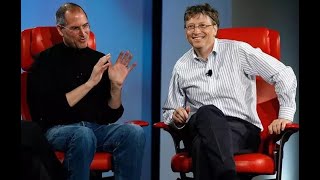
In a rare joint appearance at the 2007 D5 Conference, Steve Jobs and Bill Gates set aside decades of press-fueled rivalry to reflect on the evolution of the personal computer. They discuss their early collaborations, the near-collapse of Apple in the 1990s, and the philosophical divide between integrated hardware and modular software ecosystems.
Core Question: How did the contrasting philosophies of integrated elegance and broad software ecosystems define the tech industry’s past, and what role will they play in the looming post-PC era?
Highlights
- The revelation that Microsoft’s early floating-point BASIC was a critical component of the original Apple II.
- Jobs explains why ending the “zero-sum game” with Microsoft was essential for Apple’s 1997 survival.
- A debate on the “Post-PC” world, contrasting specialized devices like the iPhone with the enduring utility of the general-purpose computer.
- A look toward “Natural User Interfaces,” where vision, touch, and 3D environments replace the traditional mouse and keyboard paradigm.
⏱️ Reading time: approx. 12 minutes · Saves you about 70 minutes vs. watching.
Want to take notes while watching? Click the image below and let AI Notebook capture the key points for you 👇

The Foundations of a Digital Empire
Mutual Respect and the “High Order Bit”
Jobs highlights Gates’ early realization that software, not hardware, was the “high order bit” for building a successful company in an era when most only cared about the machines. He credits Gates with building the first true software company before the rest of the industry even understood the business model, noting that Bill’s focus remained steadfast for decades.
Gates recalls the sheer audacity of the original Apple II in 1977, noting that while others had products, Jobs pursued the dream of an empowering, mass-market phenomenon. He specifically credits Jobs’ “incredible taste and elegance” as the force that reinfused innovation into the industry when Apple was on the brink of failure in the late nineties, transforming a leaking ship into a vessel for the next generation of computing.
Both leaders are quick to deflect praise toward their teams, insisting they are merely representatives for the thousands of brilliant engineers at Apple and Microsoft. They emphasize that building a company requires extreme persuasion to keep the best people doing the best work of their lives, a challenge that both found more difficult than any technical engineering problem.

💡 Digging Deeper
Q: Why did Jobs consider Gates’ focus on software the “high order bit”?
A: Because at the time, the industry was hardware-centric; Gates realized that the business model of the future relied on the code that ran the machine, not just the box itself.
Q: How did Gates describe Jobs’ contribution to the Apple II?
A: He saw it as the first realization of a “mass-market machine” that empowered individuals, a dream Apple pursued uniquely compared to its contemporaries.
Q: What was the primary challenge of building these companies according to the duo?
A: The “persuasive ability” required to hire and retain the world’s best talent and keep them focused on their best work for years at a time.
The Collaborative Friction of the 1980s
The $31,000 Transaction and the Macintosh Risk
The legendary partnership actually began with a pragmatism that predates the Mac; Apple paid Microsoft $31,000 for a floating-point BASIC. While Steve Wozniak was a brilliant coder who wrote Apple’s original BASIC by hand on paper, he never got around to adding floating-point support, forcing Jobs to seek help from Gates’ team to make the Apple II viable for serious users.
The Macintosh project was a “bet-the-company” risk that saw Microsoft becoming a primary developer for graphical applications before Windows even existed as a mainstream product.
During the development of the Mac, Microsoft was one of the few companies allowed access to early prototypes in a dedicated, high-security environment. Gates recounts the challenge of working within a 128K memory limit, where the operating system and screen buffer took up nearly everything, leaving almost no room for the software itself. This forced a level of optimization that modern developers, accustomed to gigabytes of RAM, can scarcely imagine in today’s high-speed, high-resource environment.

💡 Digging Deeper
Q: Why didn’t Steve Wozniak write the floating-point BASIC himself?
A: Wozniak was a genius who wrote code on paper without an assembler, but he simply never prioritized floating-point, leading Apple to buy it from Microsoft.
Q: How much did Microsoft contribute to the original Mac?
A: They were the principal software creators, writing the applications that helped define the GUI paradigm while Apple focused on the OS and hardware.
Q: What was the “Twiggy” drive mentioned in the discussion?
A: It was an early, unreliable disk drive used in the Lisa and Mac prototypes that was eventually abandoned for the 3.5-inch Sony drive.
Beyond the Zero-Sum Game
The 1997 Reconnection and the Mobile Shift
When Jobs returned to Apple in 1997, the company was hemorrhaging cash and suffering from a toxic internal culture that believed Microsoft’s success necessitated Apple’s failure. Jobs realized that if the industry remained a zero-sum game, Apple would inevitably lose. He called Gates to “patch things up,” leading to a historic investment and a commitment to keep Microsoft Office on the Mac, effectively ending the hostilities.
Today, the relationship is one of the industry’s most successful developer partnerships, despite the colorful “I’m a Mac, I’m a PC” ad campaigns.
While Microsoft operates across a vast landscape including enterprise servers and search, Apple has refined its focus as a software company that happens to make beautiful boxes. Jobs believes the iPod exists because traditional consumer electronics giants lacked the software expertise to manage the entire ecosystem from device to cloud. He argues that an iPod is really just software in a beautiful box, just as a Mac is effectively OS X in a high-end enclosure.

💡 Digging Deeper
Q: What was the “Zero-Sum Game” Jobs wanted to break?
A: The idea that for Apple to win, Microsoft had to lose; Jobs felt Apple needed to focus on its own identity rather than competing directly for market share.
Q: How does Jobs view Apple’s identity?
A: Fundamentally as a software company, noting that their hardware success is a direct result of their ability to write superior code for the device and the cloud.
Q: Why did Gates invest in Apple in 1997?
A: To settle long-standing disputes and ensure that Microsoft’s Mac software team had a stable platform to continue their successful business relationship.
The Post-PC Horizon
Cloud Services and Natural Interfaces
The “death of the PC” is a recurring prediction that both men dismiss, though they acknowledge the rise of specialized devices. They agree that while the general-purpose computer will remain a hub for productivity, the “Post-PC” era will be defined by devices that prioritize specific functions—like the iPhone—built on a “clean slate” without the legacy of thirty years of desktop software.
Gates envisions a future where every surface is a projector and natural interfaces like speech, vision, and 3D navigation become mainstream. He remains “unrepentant” in his belief in the tablet form factor, suggesting that while pocket devices are essential for communication, the need for a rich, full-screen creation environment will ensure the personal computer survives as a central hub in our digital lives.
Jobs defines the “Post-PC” era as an explosion of devices that are not general-purpose, but focused on specific experiences like music or communication. He argues that while the PC provides a legacy of powerful applications, the most radical innovation will occur on platforms where developers aren’t burdened by software history. This allows for a “marriage” of sophisticated client apps and powerful cloud services that a simple browser cannot yet replicate.

💡 Digging Deeper
Q: Will the PC disappear in five years?
A: Neither thinks so; they see it morphing and co-existing with specialized devices, much like how the steering wheel remains the standard for cars.
Q: What is a “Rich Client” in Jobs’ view?
A: It is an application (like Maps on iPhone) that uses local processing power to provide a better experience than a browser-based service can offer.
Q: What “natural interfaces” does Gates anticipate?
A: He points to vision (cameras recognizing movement), touch (multi-touch surfaces), and voice as the revolutionary changes for the next decade.
Key Takeaways
The most striking realization from this dialogue is the shift from combatants to collaborators. Jobs and Gates both emphasize that their rivalry was often a creation of the press, whereas their actual work was defined by pragmatism. Whether it was Apple buying BASIC from Microsoft in the 70s or Microsoft saving the Mac office suite in the 90s, the two companies have been tethered by the necessity of each other’s software and hardware ecosystems.
Furthermore, the discussion highlights a fundamental agreement on the future: software is the soul of the machine. While they disagree on the delivery—Gates favoring a broad, modular ecosystem and Jobs favoring a tightly integrated user experience—they both view the next decade as an era of “Natural User Interfaces.” The move toward touch, vision, and cloud-integrated apps represents the first major departure from the Xerox PARC desktop paradigm they popularized together in the early 1980s.
Finally, both men offer a rare glimpse into their personal motivations. They dismiss the pursuit of wealth as a primary driver, instead pointing to the “passion” required to persevere through the “insane” difficulty of building a company. Their shared legacy is not just the products they shipped, but the creation of an industry that turned the personal computer into a resilient, ever-morphing hub of human activity.
Q&A
Q1: What did Steve Jobs say was Bill Gates’ greatest contribution?
A1: Jobs credited Gates with building the first software company and realizing, before anyone else, that software was the most important part of the computer business.
Q2: How did Bill Gates describe Steve Jobs’ impact on Apple?
A2: Gates praised Jobs’ “incredible taste” and his ability to take massive risks, like the original Macintosh, which reinfused innovation into the entire industry.
Q3: Why does Jobs think the PC will stay relevant despite the rise of smartphones?
A3: He views the PC as a “digital hub” that is increasingly mobile and tightly coupled with backend services, remaining the best tool for general-purpose productivity.
Q4: What is the “Post-PC” device category?
A4: Jobs uses this term to describe specialized devices like the iPod or iPhone that focus on a specific set of functions rather than trying to be a general-purpose computer.
Q5: What was the main lesson Jobs learned about hiring?
A5: He emphasized the need to be a “talent scout,” noting that no matter how smart a leader is, they need a team of great people to succeed, requiring refined intuition to hire well.
Q6: What does Gates believe is the future of the living room?
A6: Gates sees the living room becoming a “10-foot experience” connected to the internet, where gaming, entertainment, and social interaction (like Xbox Live) merge.
Q7: How did the duo describe their aging process in the industry?
A7: Jobs quoted a Beatles song, “You and I have memories longer than the road that stretches out ahead,” reflecting on how they went from being the youngest in the room to the oldest.