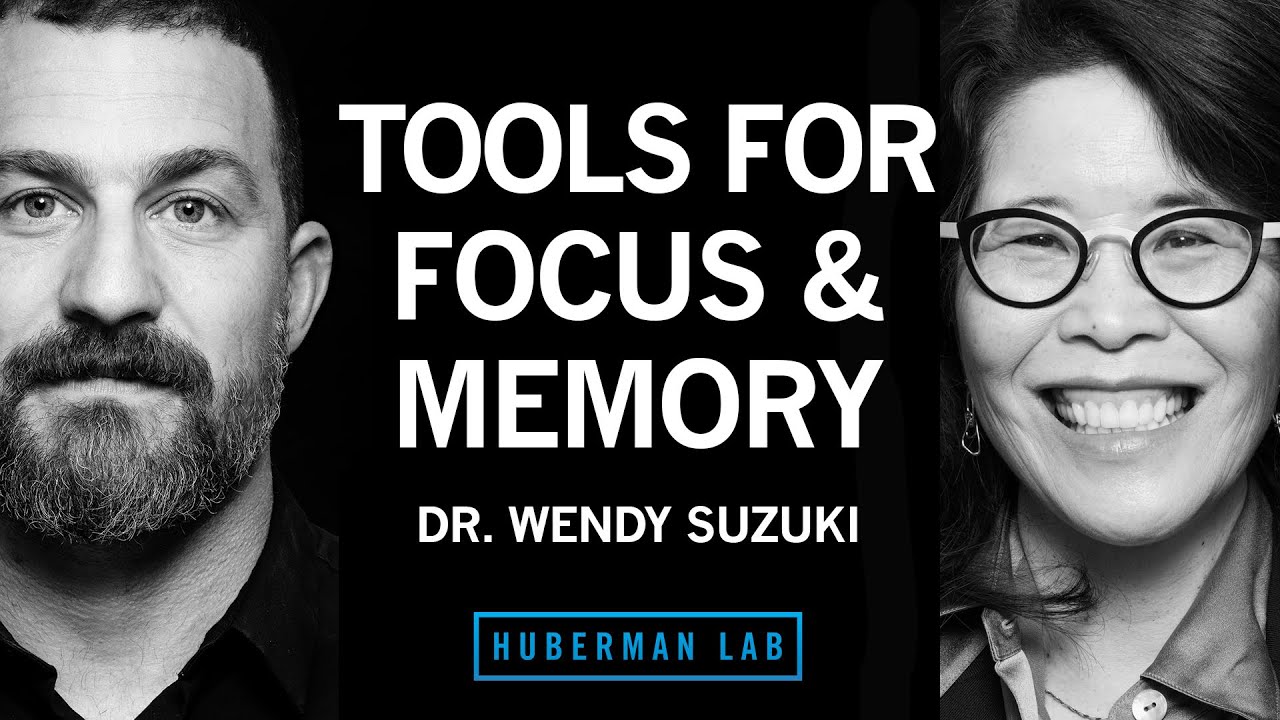
📺 Today’s recommended deep-dive video: https://www.youtube.com/watch?v=099hgtRoUZw
Build a Better Brain: How Exercise and Meditation Reshape Memory and Focus
Dr. Wendy Suzuki joins the podcast to discuss how physical movement serves as a “neurochemical bubble bath” for the brain, enhancing everything from daily focus to long-term memory. By leveraging the brain’s ability to grow new neurons, we can shield ourselves from cognitive decline while boosting our current emotional and cognitive performance.
Core Question: How can we use physical movement and mindfulness to biologically upgrade our memory, mood, and long-term brain health?
Highlights
- The four pillars of memory: novelty, repetition, association, and emotional resonance.
- How aerobic exercise triggers BDNF release to grow a “fat, fluffy,” and resilient hippocampus.
- The specific roles of muscle-derived myokines and liver-derived ketones in brain health.
- Practical daily protocols for 10-minute walks and 12-minute meditations to reduce anxiety.
⏱️ Reading time: approx. 8 minutes · Saves you about 99 minutes vs. watching.
Want to take notes while watching? Click the image below and let AI Notebook capture the key points for you 👇

The Anatomy of a Memorable Life
The Four Pillars of Encoding
Your brain is not a passive recorder; it is an active filter that decides what is worth saving based on four specific biological triggers.
Novelty and repetition serve as the primary anchors for our attention. When we encounter something entirely new, our brain’s attentional systems fire up, while repetition signals that a piece of information is critical for long-term survival and future utility.
Association and emotional resonance provide the deeper context required for complex memories. By linking new data to existing knowledge or stamping it with a high-intensity emotional charge from the amygdala, the brain ensures these moments are prioritized. This is why you likely remember a traumatic event with crystal clarity while forgetting what you had for lunch just three days ago.
The Hippocampus: More Than a Memory Bank
Shaped like a seahorse and nestled deep in the temporal lobe, the hippocampus is the engine of our personal history. Without it, as seen in the famous case of patient HM, we lose the ability to form any new memories of facts or events.
Modern neuroscience has revealed that this seahorse-shaped structure is equally vital for creative imagination and predicting complex future scenarios based on past data.

💡 Digging Deeper
Q: Is the hippocampus the permanent storage site for memory?
A: No; it acts as an intermediate storage area. Long-term memories eventually migrate to the neocortex for permanent residency.
Q: Why does the brain prioritize negative memories?
A: This is an evolutionary survival mechanism that uses the amygdala to “stamp in” dangerous locations or situations to prevent future harm.
Q: Can the hippocampus function without the amygdala?
A: It can, but the memories will lack emotional “flavor” and the “one-trial learning” speed associated with highly salient events.
The Neurochemical Bubble Bath
How Movement Rebuilds the Brain
Dr. Suzuki describes the physiological response to exercise as a “bubble bath” for the brain. This isn’t just a metaphor; it represents a surge in neurochemicals like dopamine, serotonin, and noradrenaline that instantly lift mood and sharpen focus.
The most transformative element is the release of Brain-Derived Neurotrophic Factor (BDNF). This growth factor acts like fertilizer for the hippocampus, promoting neurogenesis—the birth of new neurons. Even in sedentary individuals, a shift to regular aerobic exercise can lead to a “fatter, fluffier” hippocampus that is better equipped to resist the ravages of aging and dementia.
Ultimately, consistency is the primary variable that turns a temporary post-workout mood boost into a permanent, structural biological upgrade for the brain.
The Liver and Muscle Pathways
Communication between the body and brain happens through two primary channels during exertion. Muscles release myokines, proteins that cross the blood-brain barrier to trigger BDNF production, while the liver releases ketones like beta-hydroxybutyrate.
These liver-derived ketones serve as a secondary stimulant for brain health, proving that the entire body’s metabolic state influences cognitive function. This systemic response explains why even age-appropriate, moderate exercise helps individuals in their 90s maintain better reaction times and lower hostility levels compared to their sedentary peers.

💡 Digging Deeper
Q: Do you need to be on a ketogenic diet for the liver pathway to work?
A: No; ketones like beta-hydroxybutyrate are released naturally during exercise stress, regardless of your dietary carbohydrate intake.
Q: Does exercise help if I already have a “good” memory?
A: Yes; unpublished data from “mid-fit” individuals shows that increasing exercise frequency further improves spatial memory and positive affect.
Q: How long do the cognitive benefits of a single workout last?
A: Research suggests the improvements in focus and reaction time last for at least two hours following the cessation of exercise.
Protocols for Peak Performance
The Minimum Effective Dose
You do not need to train for a marathon to see a measurable improvement in your cognitive clarity or emotional stability.
Research confirms that a simple 10-minute walk is sufficient to trigger a significant shift in mood and reduce anxiety. For those seeking deeper cognitive benefits, 30 to 45 minutes of aerobic exercise—enough to get the heart rate up—is the gold standard for improving prefrontal cortex function.
The “mid-fit” population also sees gains when increasing their frequency. Dr. Suzuki’s data suggests that “every drop of sweat counts,” with participants who exercised up to seven days a week showing the most robust improvements in spatial memory and positive affect.
Mindfulness and Mindset
Meditation acts as a focused workout for the brain’s attentional circuits. By practicing a 12-minute daily body scan, individuals can significantly lower their physiological stress response and improve their ability to remain anchored in the present moment.
Combining movement with positive affirmations, a practice called IntenSati, can further reshape self-image and combat the “negative chatter” that often plagues the modern mind.

💡 Digging Deeper
Q: When is the best time to exercise for brain function?
A: Ideally in the morning, right before you need to use your brain for your most important cognitive tasks.
Q: Can meditation replace exercise?
A: No; they work through different mechanisms. Exercise builds the “hardware” (neurons), while meditation refines the “software” (attentional control).
Q: Is tea meditation different from a body scan?
A: Tea meditation focuses on the sensory details of brewing and drinking, serving as an external anchor for mindfulness.
Key Takeaways
The synergy between physical movement and cognitive health is the most powerful tool we have for longevity. By understanding that the brain requires biological signals—specifically BDNF and increased blood flow—to maintain its vitality, we can move from passive aging to active neuroprotection. It is never too late to start; neurogenesis has been observed in humans well into their ninth decade, provided the stimulus is present.
Prioritizing morning routines that include cardiovascular exercise, cold exposure, and mindfulness creates a “neurochemical shield” for the day ahead. This doesn’t just improve memory; it reduces hostility and enhances our ability to focus in an era of constant digital distraction. By treating exercise as a non-negotiable medicine, we grow the “fat, fluffy” hippocampus necessary to thrive in our later years.
Q&A
Q1: What exactly happened to Patient HM?
A: To treat severe epilepsy, surgeons removed his hippocampi in 1954. He immediately lost the ability to form any new memories of facts or events for the rest of his life, though he could still learn new motor skills.
Q2: What is BDNF and why is it called “miracle-gro” for the brain?
A: Brain-Derived Neurotrophic Factor is a protein that supports the survival of existing neurons and encourages the growth and differentiation of new neurons and synapses.
Q3: How does a 10-minute walk compare to a spin class for brain health?
A: A 10-minute walk primarily boosts mood and lowers anxiety, while a 45-minute spin class (cardio) is required to trigger significant BDNF release and improve executive function.
Q4: Can we really grow new brain cells as adults?
A: Yes. While once controversial, current evidence suggests that neurogenesis occurs in the adult human hippocampus even into the 80s and 90s.
Q5: What is “IntenSati”?
A: It is a workout protocol that combines high-energy physical movements (kickboxing, dance) with spoken positive affirmations to improve both physical fitness and mental self-image.
Q6: Does the liver play a role in memory?
A: Yes; during exercise, the liver releases the ketone beta-hydroxybutyrate, which crosses the blood-brain barrier and stimulates the production of BDNF in the hippocampus.
Q7: Why is morning exercise specifically recommended?
A: Exercise spikes cortisol and triggers a release of “wake-up” chemicals like norepinephrine; doing this in the morning aligns with natural circadian rhythms and prepares the brain for the day’s cognitive demands.