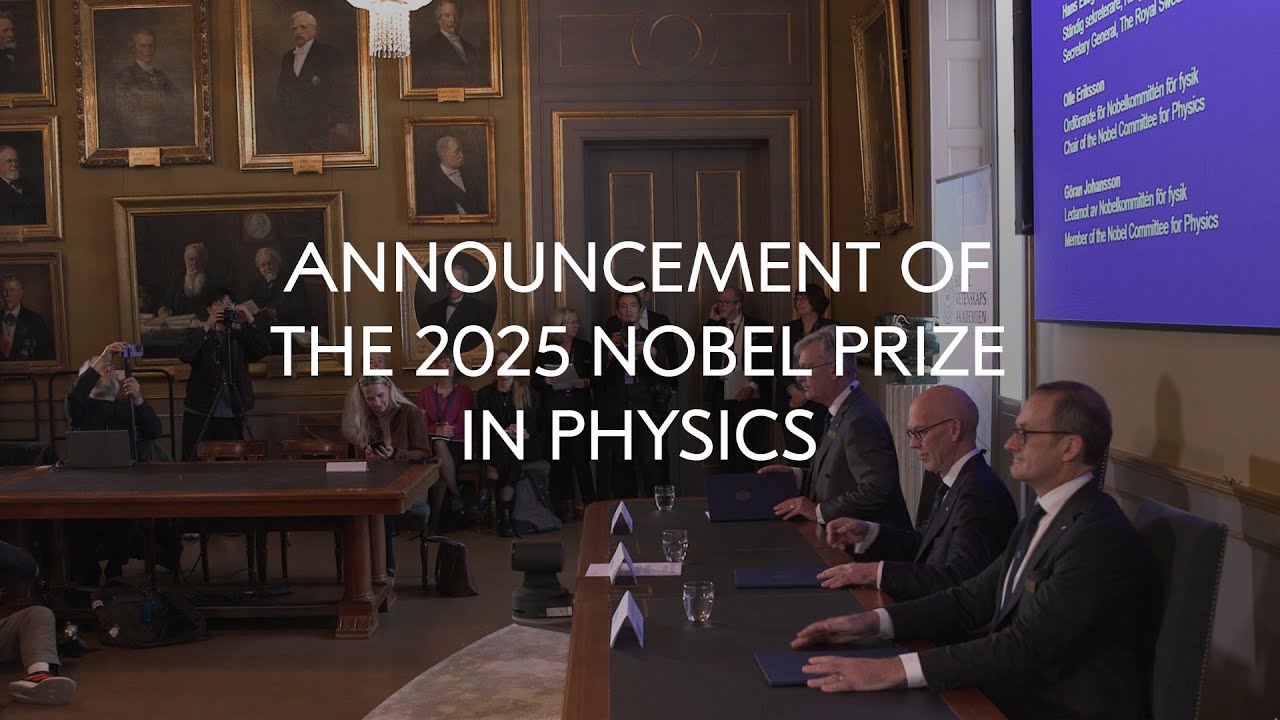
📺 Today’s recommended deep-dive video: https://www.youtube.com/watch?v=m9FUkAis62s
Scaling the Quantum: The 2025 Nobel Prize in Physics
For a century, quantum mechanics was confined to the invisible world of atoms and subatomic particles, appearing only as a theoretical framework for the very small. The 2025 Nobel Prize in Physics honors John Clark, Michelle Devore, and John Martinez, the pioneers who proved these strange phenomena exist in the visible world of electrical circuits. Their work demonstrated that even objects made of billions of particles can “tunnel” through solid barriers and absorb energy in discrete packets.
Core Question: Can quantum mechanical effects be observed and controlled in macroscopic objects rather than just individual atoms?
Highlights
- Experimental proof of microscopic quantum tunneling in superconducting circuits.
- Discovery of quantized energy levels in macroscopic electrical systems.
- Development of high-precision filtering techniques to isolate quantum states from the environment.
- The establishment of “artificial atoms” as the fundamental building blocks for modern quantum computers.
⏱️ Reading time: approx. 6 minutes · Saves you about 25 minutes vs. watching.
Want to take notes while watching? Click the image below and let AI Notebook capture the key points for you 👇

Crossing the Macro Barrier
Bridging the Micro and Macro
Traditional quantum mechanics describes the behavior of single electrons and atoms, where particles routinely perform “magic” tricks that defy classical logic.
Quantum tunneling, for instance, allows a particle to pass through a barrier it shouldn’t be able to cross, much like a ball passing through a brick wall. While this is standard for subatomic particles like those involved in radioactive alpha decay, physics long questioned whether large-scale objects could behave similarly. The 2025 laureates addressed this by using superconducting circuits where billions of electrons act in unison, essentially forming a single macroscopic wave function that obeys quantum laws.
By observing these large systems, they confirmed that the laws of the microcosmos apply to our macro world.

💡 Digging Deeper
Q: Why was this considered “macroscopic” if the chip is small?
A: Because the effect involves billions of Cooper pairs (electron pairs) acting as a single entity, rather than just one subatomic particle.
Q: What is a Cooper pair?
A: It is a pair of electrons in a superconductor that move together without resistance, allowing them to condense into a single quantum state.
Q: How does this relate to radioactive decay?
A: Alpha decay is the subatomic version of tunneling; the 2025 prize proves this same fundamental “leaking” through barriers happens in electric circuits.
The Berkeley Breakthrough of 1985
The Josephson Junction as a Quantum Laboratory
The core of the experiment relied on the Josephson junction, a weak link between two superconductors where current can flow without voltage.
In 1985, John Clark, John Martinez, and Michelle Devore applied a current that classically should have been stuck behind an energy barrier. However, they observed the circuit switching to a voltage state through tunneling, providing the “smoking gun” evidence of macroscopic quantum behavior. To achieve this, they had to invent specialized copper-powder filters to shield the delicate junction from thermal noise, which would otherwise “distract” the electrons.
This isolation was critical because even the smallest interaction with the environment can destroy quantum coherence.

💡 Digging Deeper
Q: What was the role of the copper powder?
A: It acted as a filter to absorb environmental radiation and noise that would have ruined the quantum state of the junction.
Q: Who is Anthony Leggett in this context?
A: He was the theorist who in 1978 suggested that such macroscopic tunneling should be possible, providing the roadmap for the laureates.
The Foundation of the Quantum Era
Engineering Artificial Atoms
Beyond tunneling, the team proved that these circuits possess quantized energy levels, similar to how electrons in an atom absorb specific frequencies of light. By irradiating the junction with microwaves, they demonstrated that the circuit could only absorb energy in discrete packages or “quanta.” This realization transformed the Josephson junction from a simple electronic component into what we now call an “artificial atom,” which can be engineered with specific properties.
These artificial atoms are the fundamental building blocks of today’s superconducting quantum processors.
Unlike natural atoms, which are fixed by the laws of nature, these engineered circuits allow scientists to customize energy levels and coupling strengths. This flexibility has turned the Josephson junction into the primary candidate for scalable quantum computing, where qubits must be controlled with extreme precision to perform calculations that would take classical supercomputers centuries to complete.

Key Takeaways
The 2025 Nobel Prize in Physics marks a definitive shift in our understanding of the boundary between the classical and quantum worlds. By proving that billion-electron systems can exhibit tunneling and energy quantization, Clark, Devore, and Martinez dismantled the idea that quantum mechanics is only for the subatomic. Their 1985 experiments at Berkeley provided the experimental rigor needed to confirm that the “weirdness” of the quantum world could be harnessed in solid-state devices.
This discovery is the direct ancestor of the modern quantum computer. While early quantum mechanics gave us the transistor and the laser, this “second quantum revolution” allows us to engineer individual quantum states in macroscopic circuits. As we move toward functional quantum processors, the work of these three laureates remains the bedrock upon which all superconducting qubits are built.
Q&A
Q1: Was the Nobel Prize a surprise to the laureates?
A1: Yes, John Clark described it as the “surprise of my life” and noted that at the time of the discovery, they did not realize it would lead to a Nobel Prize.
Q2: How does this discovery affect the average consumer today?
A2: While the discovery is foundational for future quantum computers, the principles of quantum mechanics it reinforced are already present in the technology of smartphones and memory chips.
Q3: What is the “smoking gun” evidence for macroscopic tunneling?
A3: It is found when experimental data points deviate from classical diagonal lines in a specific way, showing the system is switching states through a barrier rather than going over it.
Q4: Can we see these “artificial atoms” with the naked eye?
A4: Yes, modern quantum chips feature superconducting circuits that act as artificial atoms which are large enough to be seen on a silicon chip.
Q5: Is there a hard boundary between the classical and quantum worlds?
A5: The laureates’ work shows that the boundary is fluid; macroscopic objects can behave quantum mechanically if they are sufficiently isolated from environmental noise.
Q6: What did the laureates use to prove energy quantization?
A6: They used microwave radiation to show that the Josephson junction absorbs energy in specific, discrete packets rather than a continuous stream.
Q7: Who were the other major influences on this work?
A7: The laureates credited Brian Josephson (who predicted the junction behavior) and Anthony Leggett (who theorized macroscopic tunneling) as essential to their success.