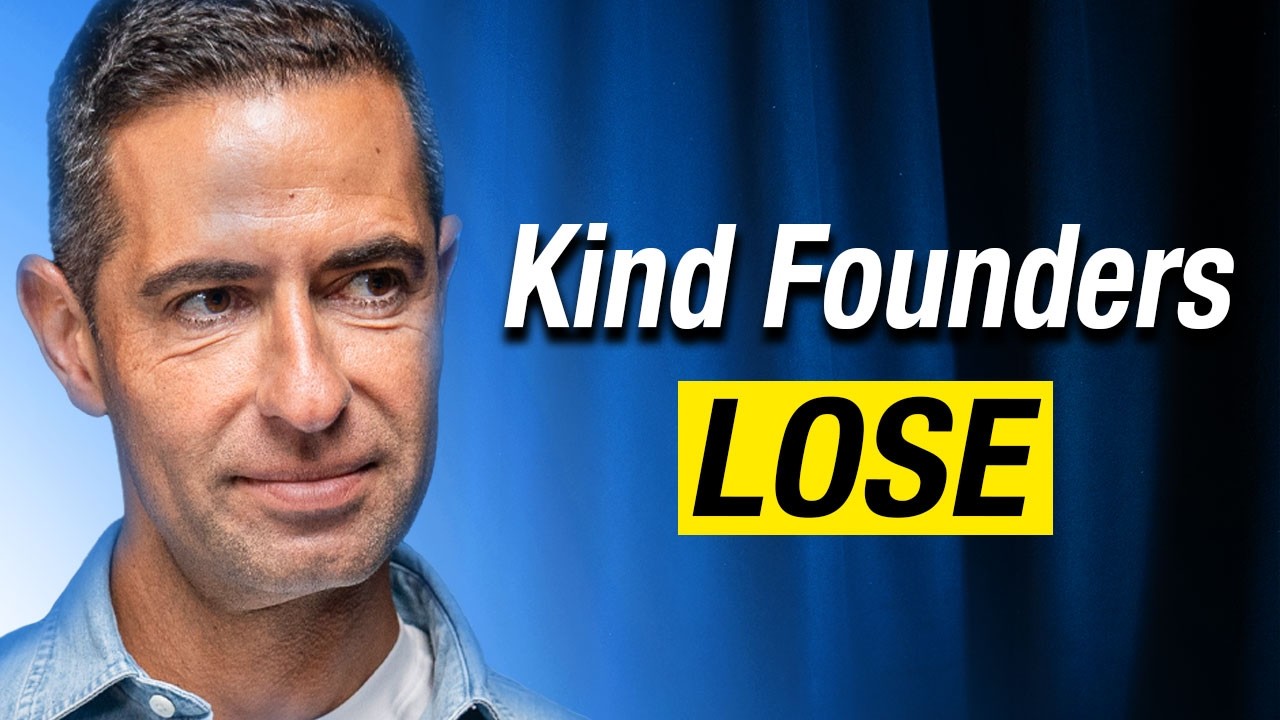
📺 Today’s recommended deep-dive video: https://www.youtube.com/watch?v=dlPCz8Jwypw
The 92% Recovery: How AppLovin Rebuilt for the AI Era
Adam Foroughi oversaw one of the most dramatic stock recoveries in tech history, watching AppLovin’s valuation crater by 92% before rebounding into a $150 billion powerhouse. By stripping away corporate bloat and pivoting to an aggressive “culture of doers,” he proved that high-scale efficiency requires a radical rejection of traditional management.
Core Question: How can a public company CEO maintain conviction during a total market collapse while successfully pivoting to an AI-native operating model?
Highlights
- The psychology of surviving a 92% stock price drop and the “loneliness” of the turnaround.
- Why AppLovin operates with no Chief People Officer, no 1:1 meetings, and no formal reviews.
- The “Axon 2” pivot: Throwing out legacy technology to build a world-class AI recommendation engine.
- Why Foroughi believes 80-90% of his company’s code is now AI-generated and why “token budgeting” is a mistake.
⏱️ Reading time: approx. 10 minutes · Saves you about 70 minutes vs. watching.
Want to take notes while watching? Click the image below and let AI Notebook capture the key points for you 👇

Survival and the Psychology of the Crash
Conviction in the Trough
To succeed as a founder, you must be motivated by the thrill of winning rather than the fear of failure.
Adam Foroughi highlights that protecting the downside prevents material “shots” at success, emphasizing that money eventually stops being a motivator for the best performers. For him, the real drive comes from personal growth and intellectual stimulation, which allowed him to reject a massive cash-out in 2015 to chase a “home run” instead of a “single” that would have satisfied his bank account but not his ambition.
This long-term conviction was tested when AppLovin’s market cap fell from $40 billion to under $4 billion in a single year during 2022. Foroughi didn’t just watch the ticker; he tied his own $83 million compensation package to a recovery that seemed impossible to most observers, requiring the stock to jump from $9 to over $80 for him to see a dime.
Running a public company during a 92% drop is an incredibly lonely and stressful experience where the world assumes you are either incompetent or on the verge of a breakdown.
💡 Digging Deeper
Q: Why did Foroughi take such a high compensation package in 2023?
A: It was entirely performance-based and granted at the bottom of the market in 2022 to align him with investors; he only got paid because the stock recovered 10x.
Q: How did he manage the stress of the 2022 bloodbath?
A: He reset his health, started surfing to force himself to disconnect from his phone, and committed to being 100% present with his children for small, 10-minute blocks.
Q: Did he consider walking away?
A: While he had the wealth to start a fourth company, he felt a responsibility to stay committed to the investors and the team he had built.
The “Culture of Doers” and Radical Lean
Eliminating the Management Layer
AppLovin currently generates over $10 million in EBITDA per employee in its core business, a feat achieved by firing the “gatekeepers” of process.
Foroughi made the controversial decision to eliminate roles like the Chief Human Resources Officer and Chief Marketing Officer because he believes A-players don’t need mentorship or hand-holding. In his view, a “Chief People Officer” often manages managers who manage doers, creating a game of telephone that slows down execution. By slimming an 80-person HR department down to 15 “individual contributors,” the company returned to its founding roots of speed and directness.
If you don’t like what a direct report is doing, you tell them in real-time via Slack; if you like it, you stay out of their way.
This philosophy extends to the lack of 1:1 meetings and formal onboarding. Foroughi expects new hires to be curious enough to use AI tools to summarize Slack histories and transcripts to teach themselves the business. He argues that structured learning is often un-retainable slop, whereas self-directed investigation creates a more capable, AI-native employee.

💡 Digging Deeper
Q: Why are layoffs necessary if a company is already growing?
A: To avoid keeping people in “dead-end roles” that will eventually be automated by AI, which Foroughi believes creates a hit to morale and culture.
Q: Can a company have 100% A-players?
A: Foroughi admits some roles are just for “keeping the lights on,” but insists that A-players won’t stay if they are surrounded by B and C players.
Q: What is the downside of this aggressive culture?
A: Foroughi acknowledges he is often perceived as an “asshole” or overly aggressive, but he prefers that to the hidden costs of “sugar-coating” and inefficiency.
Engineering in the AI-Native Era
From Code Writing to Code Auditing
We are entering a world where 80% to 90% of code is generated by AI agents, shifting the engineer’s role from a writer to a high-level auditor.
At AppLovin, engineers are expected to function as product managers because the company has eliminated the product organization entirely. Foroughi believes that if an engineer isn’t imaginative enough to understand the business value of what they are building, they aren’t a 10x contributor in the AI era. The goal is “value creation,” where the cost of AI tokens is directly justified by the revenue growth seen in the recommendation models.
A recommendation system is not just an interface on an LLM; it is a custom-built machine learning engine that drives billions of dollars in real-time transactions.
Foroughi warns that companies building simple interfaces on top of OpenAI or Anthropic are in a dangerous position. These “wrapper” businesses face commoditization because the frontier model companies are exceptionally talented at releasing their own product layers. To survive, companies must build deep, proprietary moats in specific domains, such as AppLovin’s “Axon 2” advertising model.

💡 Digging Deeper
Q: Why doesn’t AppLovin use “token budgeting”?
A: Because if you budget tokens, people create “slop” to hit quotas; Foroughi prefers to invest unlimited tokens as long as they drive measurable KPI growth.
Q: Is the “SAS Apocalypse” real?
A: Yes, because the rapid advancement of AI makes traditional enterprise software hard to value years into the future, leading to a “downward spiral” of stock and talent.
Q: Does AppLovin use its own models or frontier models?
A: They use frontier models like Claude for productivity, but their core recommendation engine is a highly specialized, proprietary machine learning stack.
Key Takeaways
The most profound lesson from Foroughi’s tenure is that extreme efficiency is a choice, not a byproduct of scale. By maintaining 84% EBITDA margins and a lean staff of roughly 400 in the core business, AppLovin has decoupled revenue growth from headcount growth. This “AI-native” state requires a founder who is willing to be the “bad guy,” firing those who fight adoption and rewarding those who use agents to 10x their own output.
Ultimately, Foroughi argues that the “loneliness” of the CEO role is the price of admission for the massive upside of the public markets. Whether dealing with short-seller attacks or a 92% valuation drop, the only defense is a “short-term memory” and an aggressive focus on the 3-to-5-year horizon. In a world where things that don’t make sense are often labeled as “cheating,” AppLovin’s numbers suggest that radical simplicity might be the most “cooler” technology of all.
Q&A
Q1: How does Foroughi view the “Founder Mode” trend?
A: He sees it as an extreme reaction to the bloat created in Silicon Valley over the last decade, but notes that if you have a team of A-players, delegation is actually more powerful than micromanagement.
Q2: What is the biggest mistake CEOs make when trying to fix a bloated culture?
A: Trying to fire only 50% of a mediocre team. Foroughi suggests that if a culture is truly mediocre, you almost have to fire 99% and rebuild from the ground up because B-players will only hire more B-players.
Q3: Why did AppLovin shut down its Investor Relations for two years?
A: During the 92% crash, Foroughi felt explaining the business to people who were determined to sell was a waste of time. He chose to focus entirely on internal execution until the business results forced the market to pay attention.
Q4: What is Foroughi’s stance on Stock-Based Compensation (SBC)?
A: He believes it should only be given to the top 10-15% of the company who can actually drive equity value. For everyone else, cash is better because people living “paycheck to paycheck” shouldn’t bear the risk of a 90% stock drop.
Q5: How does he feel about short sellers?
A: He views them as a “forcing function” that eventually required him to get better at marketing the company’s story, though he finds the lack of regulatory downside for misleading short reports frustrating.
Q6: Does he believe in the “Trillion Dollar” potential for AppLovin?
A: Yes, but it doesn’t require becoming a social network. It requires hitting ~$35B in annual cash flow by dominating mobile gaming and successfully porting performance advertising to Connected TV (CTV).
Q7: What is the “uncomfortable truth” about being a high-performing parent?
A: You cannot be the best at everything simultaneously. To be the best in business, you inevitably de-prioritize your personal life, and anyone who says otherwise is likely not being honest about the sacrifice required.