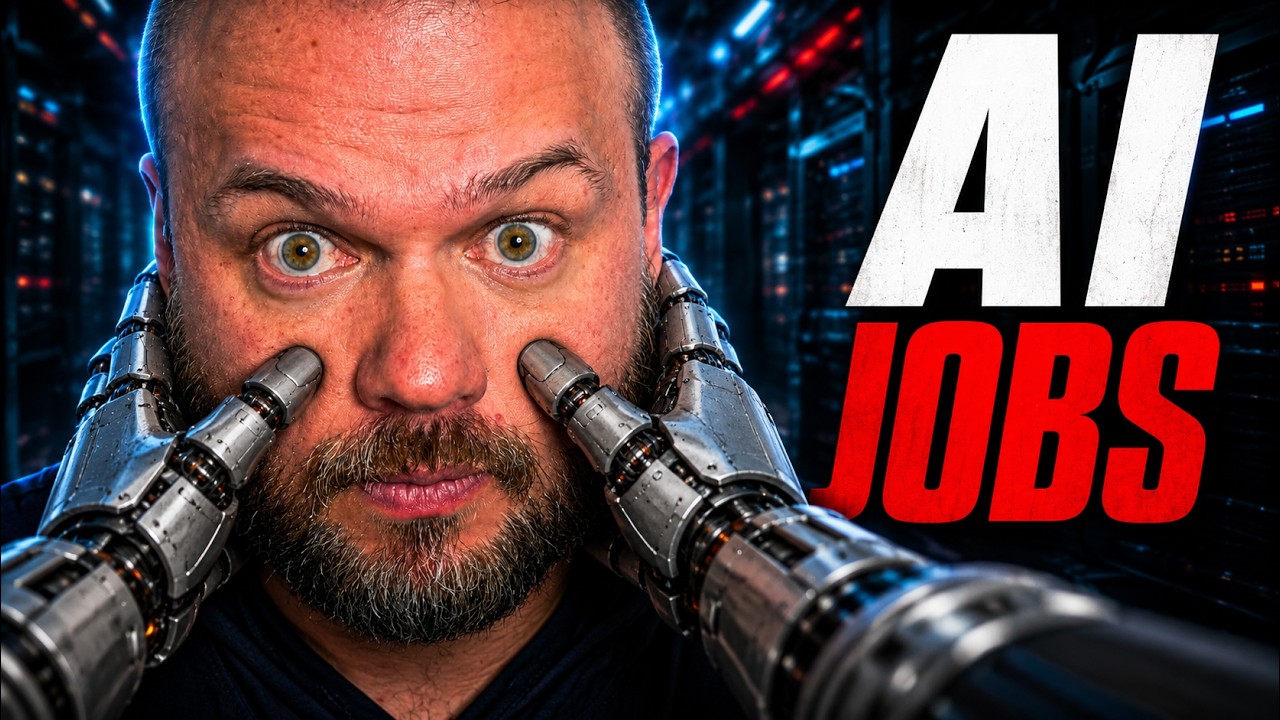
📺 Today’s recommended deep-dive video: https://www.youtube.com/watch?v=jZg1EkujbJ0
The AI Job Apocalypse is Canceled: Why Silicon Valley is Changing Its Tune
For years, the tech elite warned that artificial intelligence would render the middle class obsolete, forcing a global pivot toward universal basic income. Yet, as the technology matures, the leaders of OpenAI and Anthropic are quietly backpedaling on their doomsday predictions in favor of a “productivity multiplier” narrative.
Core Question: Why is the narrative shifting from a white-collar “bloodbath” to a reality where AI actually creates more work for humans?
Highlights
- Sam Altman and Dario Amodei have significantly softened their predictions regarding mass unemployment and job category elimination.
- The “Jevons Paradox” suggests that as the cost of “competence” drops, the demand for high-quality human output actually explodes.
- Modern workflows are evolving into a “Human Sandwich” model where humans frame the task, AI executes, and humans judge the final output.
- The primary risk is shifting from “job loss” to “company obsolescence” for businesses that fail to integrate these new productivity tools.
⏱️ Reading time: approx. 6 minutes · Saves you about 27 minutes vs. watching.
Want to take notes while watching? Click the image below and let AI Notebook capture the key points for you 👇

The Great Narrative Reversal
From Bloodbaths to Productivity Multipliers
Not long ago, Sam Altman and Dario Amodei were predicting a job market “bloodbath” where entire categories of knowledge work would simply vanish overnight. They painted a bleak picture of a permanent underclass, suggesting that the only solution to mass unemployment would be a government-mandated universal high income for everyone.
However, as these companies approach their massive initial public offerings, the tone in Silicon Valley has shifted from existential dread to optimistic corporate synergy.
During a recent conference in Sydney, Altman admitted his social and economic predictions were largely off the mark, expressing delight that we haven’t seen a clean signal of AI-driven unemployment. Instead of categories being eliminated, we are seeing the emergence of a “productivity multiplier” effect. Amodei now argues that if you automate 90% of a job, the remaining 10% simply expands to fill the void, creating an entirely new and more complex full-time role for the human worker.

💡 Digging Deeper
Q: Why are CEOs changing their message now?
A: While critics suggest it’s PR for upcoming IPOs, the shift likely reflects the reality that automation is creating new bottlenecks in human judgment rather than replacing it entirely.
Q: Is there any data supporting an “unemployment shock”?
A: No. While there have been tech layoffs, studies from Stanford and data from Anthropic haven’t found a definitive cause-and-effect link between AI and mass unemployment yet.
Q: What happened to the “Peppa the Pig” episode in Australia?
A: It was banned because it taught children that spiders are harmless friends; in Australia, where deadly spiders are common, that is dangerous advice—much like assuming AI is harmless without human supervision.
The Jevons Paradox of Human Competence
Why “Cheap” Work Results in More Work
We are currently witnessing the “Jevons Paradox” applied to intelligence: when a resource becomes more efficient and cheaper to use, the total consumption of that resource actually increases instead of decreasing. In the past, human competence—the ability to write code, draft a legal brief, or design a logo—was a scarce and expensive resource. AI has essentially collapsed the cost of this competence to near zero, making it a commodity.
Because it is now “cheap” to produce high-quality work, businesses are not firing everyone and stopping; they are simply producing ten times more than they did before.
The bottleneck has moved from “production” to “understanding” and “taste.” You can automate the research, the drafting, and the initial coding, but you cannot automate the human understanding required to verify if the output is actually useful or true. This creates a new burden on the human worker to act as a high-level manager of an army of digital agents, filling their days with review and strategy rather than manual execution.

💡 Digging Deeper
Q: What is “slopification”?
A: It is the flood of mediocre, identical AI-generated content that occurs when people use AI without adding human expertise or unique “taste” to the output.
Q: How does AI affect the “moat” of a business?
A: Companies that built their value on “expensive competence” (like basic legal drafting) find their moats gone, while companies with unique data and elite workflows gain a larger market share.
Q: Will “Project Manager” become the universal job title?
A: Essentially, yes. As specific technical skills are automated, the role of the worker shifts toward managing inputs, outputs, and the integration of various AI-generated parts.
The Human Sandwich and Parallel Worlds
Rethinking the Daily Workflow
The most effective way to work in 2026 is the “Human Sandwich” model, a term popularized by Dan Shipper of Every. In this framework, a human starts by framing the problem and setting the context (the top bread), the AI performs the heavy lifting and data processing (the meat), and the human returns at the end to judge, refine, and take ownership of the result (the bottom bread).
This workflow allows for a radical new technique: running “parallel universes” for a single project.
Instead of working on one version of a task, a user can launch five or ten AI agents simultaneously, each in its own isolated environment or “scratchpad.” Each agent attempts a different solution to the same problem. The human then reviews all ten versions, picks the best UI from one, the best logic from another, and the best copy from a third, merging them into a superior final product. This doesn’t reduce work—it increases the complexity and quality of what a single person can achieve.

💡 Digging Deeper
Q: What is “Vibe Coding”?
A: It’s a meme-turned-methodology where a person uses AI to write code they don’t fully understand, essentially “vibe-checking” the output until it works, often while on the move via mobile devices.
Q: Why is human ownership still necessary?
A: AI lacks the ability to take responsibility for an outcome; if a legal brief is wrong or a bridge collapses, a human must be the one who signed off on the decisions.
Q: What is the “Everyone Else” problem?
A: It refers to the gap between the top 5% of “power users” who build custom agents and the 95% of workers who try a basic prompt once, get a mediocre result, and never use AI again.
Key Takeaways
The narrative shift from Sam Altman and other AI leaders isn’t just marketing fluff; it’s a reflection of how the technology is actually being used by “power users” in the real world. We aren’t seeing a mass disappearance of jobs, but rather a massive explosion in the volume of work produced. This creates a new kind of fatigue where the human isn’t tired from doing the work, but from managing the relentless output of their AI assistants.
Ultimately, the risk of a “rogue AI” or a “job apocalypse” appears to be decreasing as we realize that the most powerful AI systems still require a human “judgment” bottleneck to be useful. If you want to survive this transition, your goal shouldn’t be to compete with AI on production. Instead, you must become an expert at the “Human Sandwich”—mastering the framing of the input and the critical evaluation of the output.
Q&A
Q1: Is the “Job Apocalypse” gone for good?
A: It is likely “overstated” for now. The hypothesis has changed from “replacement” to “evolution,” though we are still in the early stages of data collection.
Q2: How does the Jevons Paradox apply to my daily work?
A: If it used to take you four hours to write a report, AI might let you do it in twenty minutes. Instead of taking a nap, you will likely be expected to produce twelve reports in that same four-hour window.
Q3: What is the biggest risk if jobs aren’t going away?
A: The risk moves from individuals to companies. Firms that don’t adapt to these productivity multipliers may be wiped out by “AI-native” competitors that can do 100x the volume with the same headcount.
Q4: Should I be worried about AI “X-risk” (extinction risk)?
A: If the current pattern holds, AI remains a tool that requires human direction. This negates the fear of a “self-aware” AI acting independently to harm humanity, as it still lacks independent agency.
Q5: What should I focus on to stay relevant?
A: Focus on “judgment” and “taste.” Learn to write in-depth instruction files and manage the “input side” (context, model selection, prompting) to ensure the AI creates something unique rather than “slop.”
Q6: What is Hapax, and how does it fit into this?
A: Hapax is a tool designed to solve the “everyone else” problem by watching how people work and automatically building AI agents for them, removing the need for complex prompt engineering.
Q7: Can I truly automate “understanding”?
A: No. You can automate research and data aggregation, but “Eyeball Mark 1” (the human brain) still has to interact with the idea to actually understand and apply it.