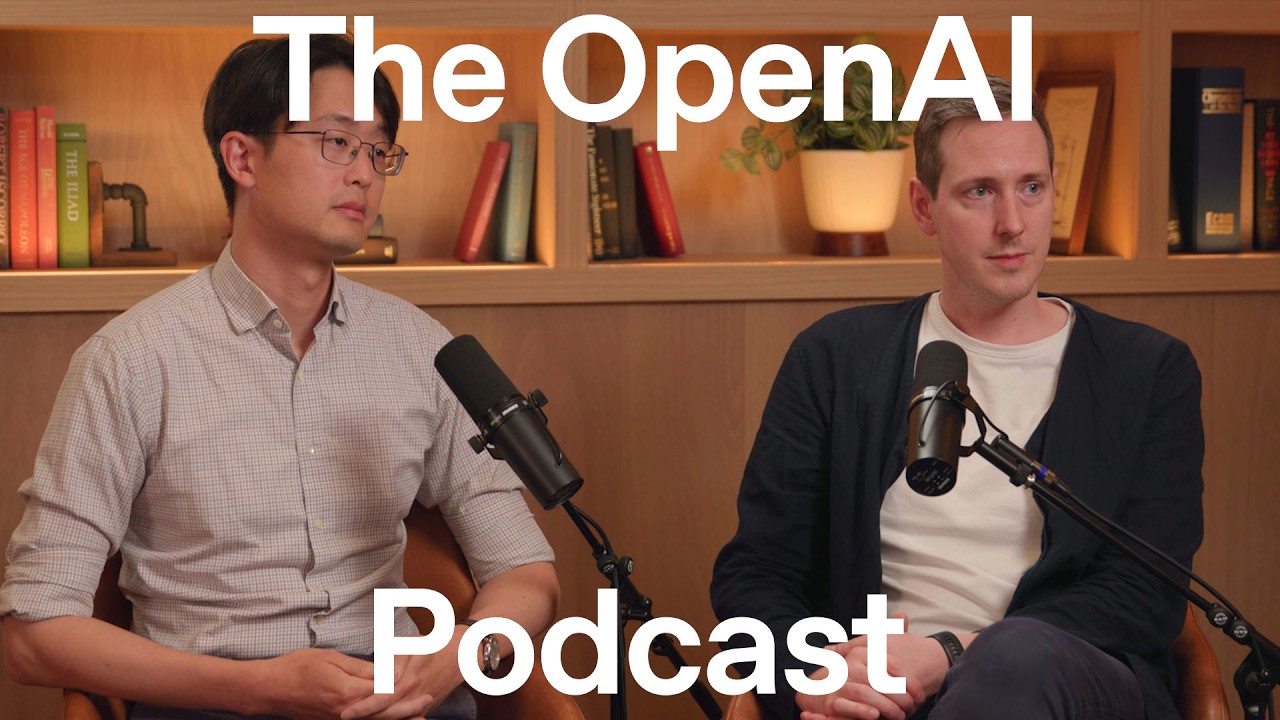
📺 Today’s recommended deep-dive video: https://www.youtube.com/watch?v=9-TVwv6wtGQ
From Logic to AGI: The Great Mathematical Leap
AI has evolved from struggling with basic arithmetic to solving 42-year-old open mathematical problems in mere hours. Researchers Sebastian Bubeck and Ernest Ryu explore how this leap in reasoning is transforming science and paving the way toward Artificial General Intelligence.
Core Question: How does the rigorous, verifiable nature of mathematics serve as the ultimate training ground for AGI?
Highlights
- AI has transitioned from simple “language” tasks to achieving gold-medal performance at the International Math Olympiad.
- A researcher solved a decades-old open problem in optimization theory by acting as a “verifier” for ChatGPT.
- The concept of “AGI Time” measures progress by how many days or weeks an AI can maintain consistent, complex reasoning.
- AI is now uncovering novel solutions to Erdos problems that were previously unproven or hidden in obscure literature.
⏱️ Reading time: approx. 7 minutes · Saves you about 36 minutes vs. watching.
Want to take notes while watching? Click the image below and let AI Notebook capture the key points for you 👇

The Leap from Language to Logic
The 12-Hour Breakthrough
Two years ago, reasoning models didn’t exist, and the idea of an AI solving a major mathematical theorem felt like a distant fantasy to most academics.
In a startlingly short period, we have witnessed a transformation where large language models have moved from simply generating text to performing at the level of the top high school contestants in the world. This transition wasn’t just about scaling up data; it required architectural shifts that allowed the models to handle the extreme sensitivity of mathematical logic, where a single error in a fifty-page proof renders the entire effort worthless.
Ernest Ryu demonstrated this power by tackling a 42-year-old problem in optimization theory, interacting with ChatGPT over three intensive nights to uncover a specific divergence behavior in the Nesterov accelerated gradient method. By acting as a human verifier, he guided the model through novel approaches until a rigorous proof emerged, effectively compressing months of human labor into a dozen hours of collaboration.
Benchmarking AGI
Mathematics provides the perfect laboratory for testing intelligence because the questions are non-ambiguous and the answers are objectively verifiable by the community.

💡 Digging Deeper
Q: Why was the Nesterov problem significant?
A: It focused on whether a famous algorithm could fail in specific “worst-case” scenarios, a question that remained genuinely open in optimization theory for four decades.
Q: How does math verify reasoning better than other subjects?
A: Unlike a creative essay, a math proof requires a long chain of consistent logic; if any single link fails, the entire argument is destroyed, forcing the model to “reason” perfectly.
The Erdos Treasure Trove
Deep Literature Synthesis
Paul Erdos was a prolific mathematician who left behind a “treasure trove” of approximately one thousand open problems that have challenged the community for decades.
Initial tests with GPT models revealed that the AI could solve some of these problems by performing “deep literature searches,” connecting disparate mathematical fields that humans hadn’t yet linked. In one instance, the model found the answer to an Erdos problem by scanning thousands of papers in an unrelated field where the solution was written in an entirely different mathematical language.
By bridging these niche silos, the AI acts as a universal reader that remembers and synthesizes every paper ever archived.
Generating Original Proofs
The progress didn’t stop at literature search; models are now producing solutions to Erdos problems that are entirely new and publishable in top-tier journals.
OpenAI researchers have already identified more than ten actual solutions to Erdos problems that are completely original, moving beyond mere recombination to actual mathematical discovery. This acceleration is staggering, as the field has moved from “Is this possible?” to “This is happening daily” in less than a year. It signals a future where AI isn’t just a library but a collaborator capable of generating the “sparks of insight” once thought to be purely human.

💡 Digging Deeper
Q: What is an “Erdos Number”?
A: It is a measurement of the collaborative distance between a person and Paul Erdos; having a low number is a badge of honor in the math community.
Q: How did the model solve the 10 problems?
A: It utilized a systematic approach to check the thousand-problem database, initially finding solutions in existing literature and later progressing to original proofs.
The Future of the Human Scientist
Navigating “AGI Time”
The concept of “AGI Time” refers to the duration an AI can mimic human thinking, evolving from seconds of focus to hours, days, and eventually weeks.
Current models are reaching the “day or week” threshold, allowing them to act as autonomous researchers that don’t just answer questions but propose their own. This shift toward the “automated researcher” model requires the AI to maintain a massive context, effectively keeping “math notes” over long periods to solve problems that require more than 50 pages of rigorous thought.
We are moving toward a world where the timeline for a breakthrough is limited only by the compute time we allocate to the model’s internal reasoning.
The Expertise Premium
While AI handles the grueling calculations, the danger lies in “mental atrophy,” where humans might stop doing the hard work of deep understanding.
Expertise is actually more valuable now than it ever was because the human must guide the AI toward problems that matter, such as curing diseases or building sustainable materials. AI doesn’t have a personal stake in biological health; it requires a human “professor” to set the goals and verify the high-level logic of the “student” model. If we stop training our own minds, we lose the ability to verify if the AI’s output is a brilliant breakthrough or a plausible-sounding hallucination.

💡 Digging Deeper
Q: Will AI replace mathematicians?
A: No; it will make the field more social and fun by removing the grueling, painful parts of proof-checking and allowing humans to focus on high-level connections.
Q: What is the main risk of using AI for math?
A: Shallow understanding; relying too much on the tool can lead to a lack of deep mastery, making it harder for humans to spot subtle but fatal errors.
Key Takeaways
The transition of AI from a “language model” to a “reasoning model” has been validated most clearly through the lens of mathematics. By achieving gold-medal performance at the Olympiad level and solving 42-year-old open problems, AI has proven that it can handle long-chain logic where every step must be perfect. This makes math the primary benchmark for the development of AGI, as it forces the model to avoid hallucinations and maintain consistency over long “thinking” sessions.
However, the rise of the “automated researcher” does not render human scientists obsolete. Instead, it places a higher premium on deep expertise and the ability to ask the right questions. While AI can synthesize obscure literature and verify 300-page proofs with tireless patience, the human role remains essential for setting the direction of research and ensuring that scientific progress serves human needs. The future of science is an interconnected, social enterprise where AI acts as the ultimate bridge between niche disciplines.
Q&A
Q1: What exactly was the “Nesterov problem” that was solved?
A1: It was a 42-year-old open question in optimization theory regarding whether a specific acceleration algorithm could diverge (fail) in certain cases; the AI proved that it could.
Q2: How long did it take the researcher to solve this problem with AI?
A2: It took roughly 12 hours of interaction over three nights, compared to the 40+ hours the researcher had previously spent failing to solve it alone.
Q3: What is the current “AGI Time” for modern models?
A3: We are currently in the “days to one week” range, meaning models can maintain complex, consistent reasoning over that duration.
Q4: Why is AI good at solving Erdos problems?
A4: AI can perform a “deep literature search,” identifying connections between disparate fields of math that humans may have missed because they only follow their own niche.
Q5: Can AI actually “ask” good math questions?
A5: Yes; researchers found that internal models are now capable of asking questions so insightful that human mathematicians are writing papers based on them.
Q6: Is there a risk of AI contributing to incorrect science?
A6: Yes, there is a risk of “plausible-sounding” but wrong proofs. This is why human expertise is critical for verification and why AI is also being used to build better verification agents.
Q7: How will this affect the next generation of students?
A7: It will likely accelerate their learning, acting as a “world-class tutor” that can explain complex concepts like Maxwell’s equations in a tailored, interactive way.