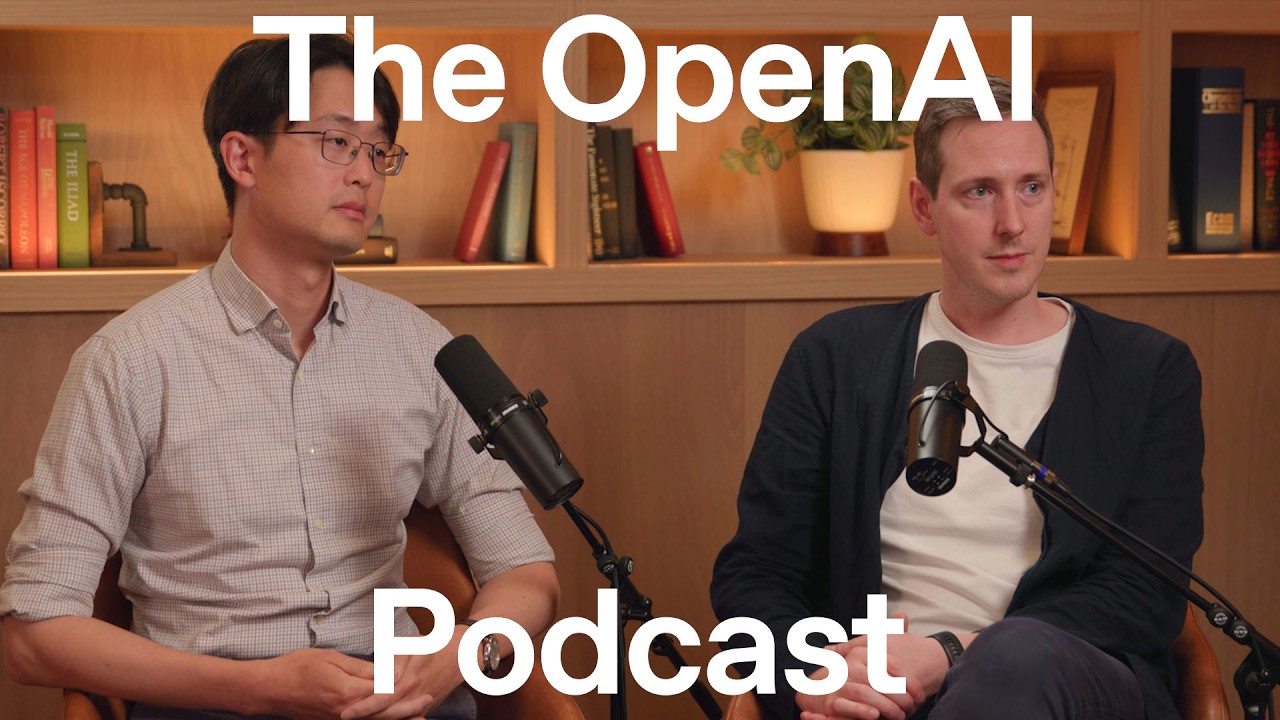
📺 Today’s recommended deep-dive video: https://www.youtube.com/watch?v=9-TVwv6wtGQ
From 2+2 to Fields Medals: How AI Solved Math’s 40-Year Cold Cases
Mathematics was once the Achilles’ heel of large language models, but in just two years, AI has transitioned from failing basic scheduling to solving 42-year-old open research problems. OpenAI researchers Sebastian Bubeck and Ernest Ryu explain how these models are becoming “automated researchers” capable of reasoning for days or weeks at a time.
Core Question: How does the transformation of AI into a mathematical powerhouse redefine scientific discovery and the role of the human expert?
Highlights
- Miraculous Progress: AI has evolved from struggling with coordinate geometry to achieving Gold Medal performance at the International Math Olympiad in just four years.
- Cold Case Success: Researcher Ernest Ryu used ChatGPT to solve a 42-year-old open problem in optimization theory by acting as a “human verifier.”
- AGI Time: The industry is moving from “AI seconds” (quick answers) to “AI weeks,” where models perform autonomous, long-horizon research.
- The New Expertise: Deep human subject matter expertise is becoming more valuable, not less, as humans shift from “calculators” to “directors” of AI intelligence.
⏱️ Reading time: approx. 6 minutes · Saves you about 37 minutes vs. watching.
Want to take notes while watching? Click the image below and let AI Notebook capture the key points for you 👇

The Miraculous Leap from Arithmetic to Research
From Billing to Breakthroughs
Two years ago, reasoning models didn’t exist; today, they are assisting Fields Medalists in their daily research.
The shift began with simple tool usage, like calculators, but evolved into an implicit understanding of complex logic. In early 2023, models struggled to split a camping bill or coordinate a Zoom call across three time zones. Those days are gone, as the architecture has moved beyond mere pattern matching into the realm of long-horizon reasoning that mimics the focus required for a professional mathematician to solve deep problems.
Mathematics provides the perfect benchmark because the answers are non-ambiguous and verifiable. Unlike creative writing, math requires a chain of logic where a single mistake kills the entire argument. This “perfection requirement” is exactly what forces models to develop the robust internal reasoning necessary for broader AGI.

💡 Digging Deeper
Q: Why was the “International Math Olympiad” performance such a turning point?
A: It proved that models could solve “canned” but extremely difficult problems on par with the world’s top high school contestants, setting the stage for novel research.
Q: Is AI math better than human math yet?
A: For 99% of the population, yes. Unless you are a professional mathematician inventing new fields, ChatGPT can likely handle any STEM math you require.
Q: What was the “Minerva” model?
A: A 2022-era Google model that impressed researchers just by being able to find a line through coordinates—a feat that seems trivial by today’s standards.
Solving the Unsolvable: The 42-Year Case
Interaction as the New Proof
Ernest Ryu took a classical problem regarding the Nesterov accelerated gradient method—a question that had remained open for over four decades—and interacted with ChatGPT over twelve hours to find the answer. By playing the role of the verifier, he guided the model away from dead ends and toward novel approaches until they produced a verifiable proof of divergence that shocked the academic community.
This wasn’t just a fluke of the training data; it was a collaborative synthesis of logic.
Similarly, the models initially succeeded by performing deep literature searches to connect disparate fields, but they have since moved on to creating entirely new proofs for “Erdos problems” that were previously unsolved. In one instance, ChatGPT connected two unrelated mathematical languages to solve a problem that humans hadn’t realized was already answerable through cross-disciplinary logic.

The Dawn of the Automated Researcher
Measuring Progress in AGI Time
Sebastian Bubeck introduces the concept of “AGI Time,” tracking the progress of models as they move from thinking in seconds to thinking for days or weeks.
Just as human mathematicians summarize months of work into a thirty-page paper, future AI models will likely use expanded context windows or repository-based memories to manage complex projects. This “Automated Researcher” vision isn’t just about faster calculations but about consistent, error-free logic across fifty-plus pages of abstract thinking where a single mistake can invalidate the entire endeavor.
We are moving toward a world where AI doesn’t just answer questions; it knows how to ask them.

💡 Digging Deeper
Q: What is a “context window” in math?
A: It’s the “working memory” of the AI. Currently, models can handle roughly 50 pages of math, but breakthroughs require much longer chains of thought.
Q: How do “Erdos Numbers” relate to this?
A: They measure collaboration distance from Paul Erdos. AI is now effectively lowering everyone’s Erdos number by surfacing his unsolved problems and providing solutions.
Q: Will AI replace the need for grad students?
A: No, but it will change their role. Instead of doing grueling manual experiments, they will act as high-level directors of AI-driven simulations.
Key Takeaways
The progress of the last few years has been nothing short of miraculous, moving from “laughable” arithmetic to “Olympiad-level” logic. Mathematics has served as the ultimate proving ground for AGI because of its unforgiving nature; you cannot hallucinate a proof and expect it to survive a rigorous verification process.
However, this transition places a higher premium on human expertise. While AI can solve the “how,” humans must still define the “why” and ensure that we don’t succumb to mental atrophy. The future of science belongs to the “augmented researcher” who uses AI to compress decades of discovery into weeks, while maintaining a deep, intuitive grasp of their craft.
Q&A
Q1: Can ChatGPT solve problems that aren’t in its training data?
A1: Yes. The resolution of the Nesterov problem and the new solutions to Erdos problems prove that models can now synthesize new knowledge rather than just repeating what they’ve seen.
Q2: What is “AGI Time”?
A2: It is a metric for how long an AI can mimic human-level consistent thinking. We have moved from AGI seconds to AGI days, with the goal of reaching AGI weeks or months.
Q3: Does AI math help other sciences like biology?
A3: Absolutely. The training techniques are general. If a model can handle the rigorous logic of math, it can handle the complex sequences of biology or material science.
Q4: Is there a danger of “shallow understanding” if we use AI?
A4: Yes. Sebastian warns that relying too much on AI explanations could lead to a loss of the “patient sitting” required to truly own a skill.
Q5: Can AI find mistakes in existing human research?
A5: Yes, OpenAI has already deployed agents internally that have flagged errors in published papers and suggested correct alternatives.
Q6: What should a student interested in math do today?
A6: Treat ChatGPT as a personalized tutor. It can explain Maxwell’s equations or complex geometry in terms tailored to your specific background and previous reading.
Q7: Will AI eventually “run out” of math to solve?
A7: Unlikely. Just as the first computers in the 1940s opened new branches of math rather than closing them, AI is expected to make mathematics a much richer, more interconnected enterprise.