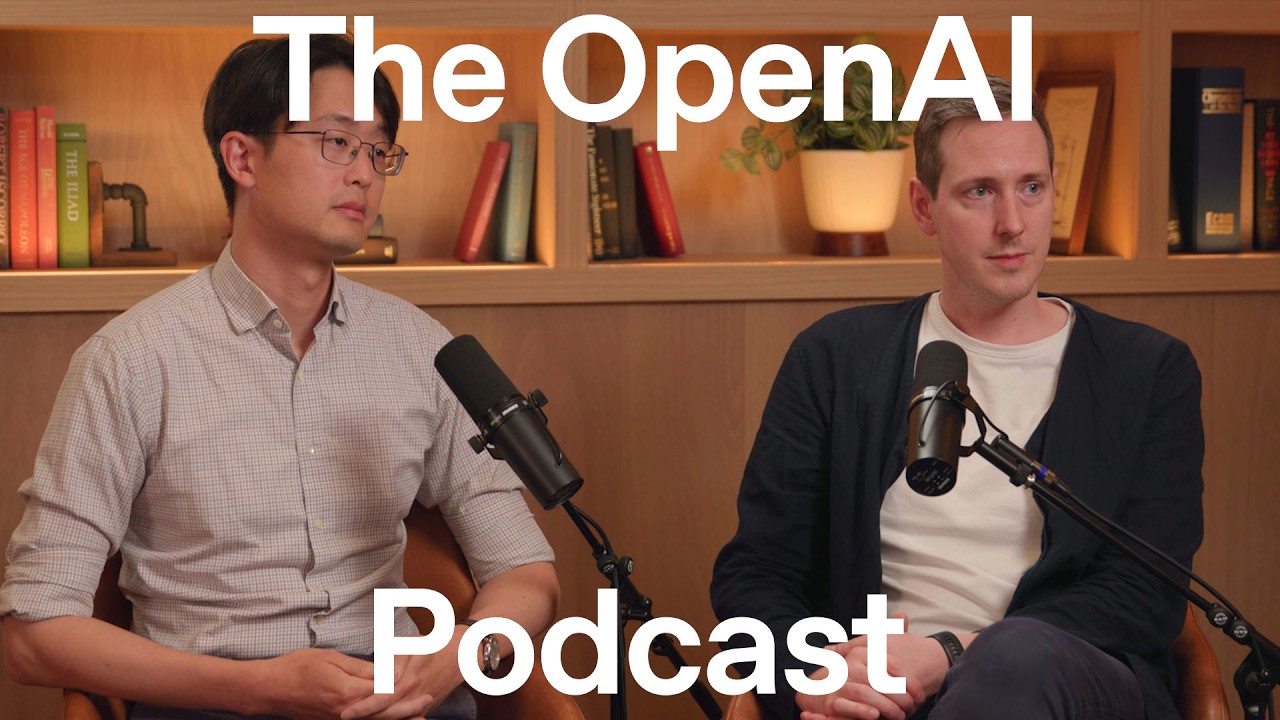
📺 Today’s recommended deep-dive video: https://www.youtube.com/watch?v=9-TVwv6wtGQ
From IMO Gold to Research Frontiers: How AI is Redefining the Language of Mathematics
For decades, the idea of a machine solving a 42-year-old open mathematical problem seemed like science fiction. Now, researchers at OpenAI are proving that Large Language Models are no longer just calculators; they are becoming collaborative partners capable of the deep, sustained reasoning required to push the boundaries of human knowledge.
Core Question: How does the rapid advancement of AI in mathematics serve as a blueprint for the future of General Artificial Intelligence across all scientific fields?
Highlights
- The “Miraculous” Jump: AI has evolved from struggling with basic coordinate geometry to solving International Mathematical Olympiad (IMO) problems at a gold-medal level in just four years.
- Research Breakthroughs: Researchers used AI to solve a long-standing 42-year-old open question in optimization theory through a collaborative “teacher-student” interaction.
- Erdős Problems: Models have recently moved beyond literature searches to generating over 10 entirely original solutions to Erdős problems worthy of publication in top journals.
- The Concept of “AGI Time”: Progress is measured by how long a model can maintain consistent logical reasoning, moving from seconds of thought to days, with the goal of reaching weeks or months.
⏱️ Reading time: approx. 11 minutes · Saves you about 33 minutes vs. watching.
Want to take notes while watching? Click the image below and let AI Notebook capture the key points for you 👇

The “Miraculous” Leap in Mathematical Reasoning
From Coordinate Geometry to Research Partner
The transformation of AI from a basic calculator to a research collaborator occurred with a speed that shocked even the researchers building the systems.
Just two years ago, the mathematical community was skeptical that scaling Large Language Models would ever result in solving open research problems, with an eighty percent majority in workshops voting against the possibility. Today, that skepticism has been replaced by awe as models transition from solving high school competition problems to assisting Fields Medal winners in their daily work, proving that logical rigor is a transferable skill across intelligence domains.
Ernest Ryu demonstrated this power by tackling a 42-year-old open question in optimization theory regarding Nesterov’s accelerated gradient method. By using ChatGPT as a sounding board and error-checker over a twelve-hour period, he achieved a breakthrough that previously defied months of manual effort.

💡 Digging Deeper
Q: Why is mathematics such a critical benchmark for AI development?
A: Math is non-ambiguous and verifiable; every step in a proof must be correct for the whole to stand, making it the perfect stress test for logical reasoning.
Q: How did the model help solve the Nesterov optimization problem?
A: It didn’t just give the answer; it acted as an apprentice, proposing novel directions while the human researcher acted as the verifier and course-corrector.
Mining the Erdős Legacy
The Shift from Search to Original Discovery
Paul Erdős was famous for his itinerant lifestyle and his uncanny ability to pose problems that defined the trajectory of modern combinatorics. With over 1,500 papers to his name, Erdős left a legacy of open questions that serve as the ultimate “gold mine” for testing AI intelligence.
While the first AI breakthroughs involved exhaustive literature searches to find solutions hidden in disparate fields, the models have now evolved to generate entirely original proofs.
Sebastian Bubeck notes that current models have successfully solved over ten Erdős problems that were genuinely open, with results worthy of publication in top-tier journals. This transition marks a fundamental shift from AI as a sophisticated search engine to AI as a creative generator of knowledge, bridging the gap between simply understanding existing literature and inventing new mathematical structures.

💡 Digging Deeper
Q: What is a “literature search” breakthrough in AI?
A: It is when the AI finds a solution to a problem in one field by identifying a hidden connection in a completely unrelated field’s existing papers.
Q: Are these AI-generated proofs actually new to humanity?
A: Yes; the most recent solutions to the Erdős problems were not found in any existing literature and represent genuine “state-of-the-art” discoveries.
Toward the “Automated Researcher”
Scaling the Duration of AGI Thought
A critical metric for the future of AI is what the researchers call “AGI Time”—the duration over which a model can maintain a coherent, error-free chain of reasoning.
Four years ago, models could only “think” for seconds before losing the logical thread. We are now entering an era where models can sustain research-level reasoning for days or even a full week, moving toward a future where “automated researchers” could work autonomously on complex biological or physical problems for months at a time.
This evolution requires moving beyond the standard chat window. While a typical conversation context is about 50 pages, human research often involves hundreds of pages of notes and iterations.
The transition to agents like Codex allows models to manage massive “repositories” of mathematical notes, just as they manage codebases. By compacting long-term interactions, these systems can eventually summarize months of thought into a single, elegant 30-page paper, mimicking the long-term cognitive process of a human mathematician.

💡 Digging Deeper
Q: What is “AGI Time”?
A: It is a measurement of how long an AI can simulate human-level thinking on a single complex problem without diverging into errors.
Q: How does the model handle context limits?
A: Similar to how humans take notes, the models are learning to summarize and organize their “thoughts” into manageable structures like code repositories.
The Human Element in the Age of AI Math
The Paradox of Expertise
The rise of powerful AI tools does not render the human scientist obsolete; rather, it makes deep expertise more valuable than ever before.
There is a real danger of “mental atrophy” if students and researchers rely on AI to simplify every concept without doing the “hard work” of deep internal understanding. The researchers warn that without a rigorous foundation, users can be easily misled by plausible-looking but fundamentally flawed AI proofs, a phenomenon already appearing in amateur mathematical circles on social media.
However, the future is bright for those who embrace these tools as social collaborators. Math has traditionally been a solitary, often painful pursuit where results might sit in an archive for decades before being understood. With AI, every niche result becomes discoverable and interconnected, turning the “lonely” act of proof-writing into a global, accelerated conversation where the computer acts as the ultimate librarian and tutor.
💡 Digging Deeper
Q: Will AI replace the need for mathematicians?
A: No; it will allow them to solve much harder problems and spend less time on tedious calculations, similar to how computers transformed physics in the 1940s.
Q: How can AI improve the reliability of published math?
A: AI agents can act as hyper-patient peer reviewers, checking 300-page proofs for minor logical errors that humans might miss over years of review.
Key Takeaways
Mathematics serves as the foundational “gymnasium” for training general reasoning. Because math requires a perfect sequence of logic where a single error invalidates the whole, it forces AI models to develop the same rigorous thinking patterns that humans use to solve problems in physics, biology, and materials science. We are moving from a world where AI solves “pre-packaged” classroom problems to one where it generates original research that advances the frontier of science.
The future of research will likely be defined by “Automated Researchers”—AI agents that can think for weeks at a time, guided by human experts. While the AI manages the vast complexity and interconnectedness of modern knowledge, the human remains in control, setting the goals and providing the spark of inspiration. The goal isn’t just to solve problems for the sake of solving them, but to use these new capabilities to cure diseases, understand the universe, and improve the human condition.
Q&A
Q1: Can someone without a math background use these tools to discover new theorems?
A: It is unlikely. While AI can generate pages of proofs, a human still needs deep expertise to verify the logic and guide the model toward meaningful questions. Without foundational knowledge, users risk producing “garbage” that looks mathematically sound but is fundamentally wrong.
Q2: What was the “Nesterov problem” mentioned in the talk?
A: It was a 42-year-old open question in optimization theory regarding whether a specific algorithm (Nesterov’s accelerated gradient) always converges or if there are “worst-case” scenarios where it fails. The AI helped prove the latter.
Q3: How does AI help connect different fields of math?
A: AI can read and remember millions of papers across all disciplines. It can spot when a technique used in an obscure combinatorics paper is actually the “missing piece” needed to solve a problem in optimization or physics.
Q4: Is the model using a calculator for these problems?
A: While models can use tools, the recent breakthroughs in research-level math come from the model’s internal reasoning capabilities, not just external computation.
Q5: What is the biggest risk of using AI in the classroom?
A: The risk is “mental atrophy.” If students use AI to bypass the struggle of learning, they won’t develop the “mental muscles” required to verify if the AI’s output is actually correct.
Q6: How will AI change the peer-review process?
A: AI agents can provide near-instant feedback on the correctness of a paper, allowing the community to build on new results immediately rather than waiting years for human verification.
Q7: How should a beginner start using AI for math?
A: Start by asking it simple, “silly” questions like “How many M&Ms fit in a bathtub?” and work your way up to explaining your specific background so the AI can tailor its explanations to your current knowledge level.