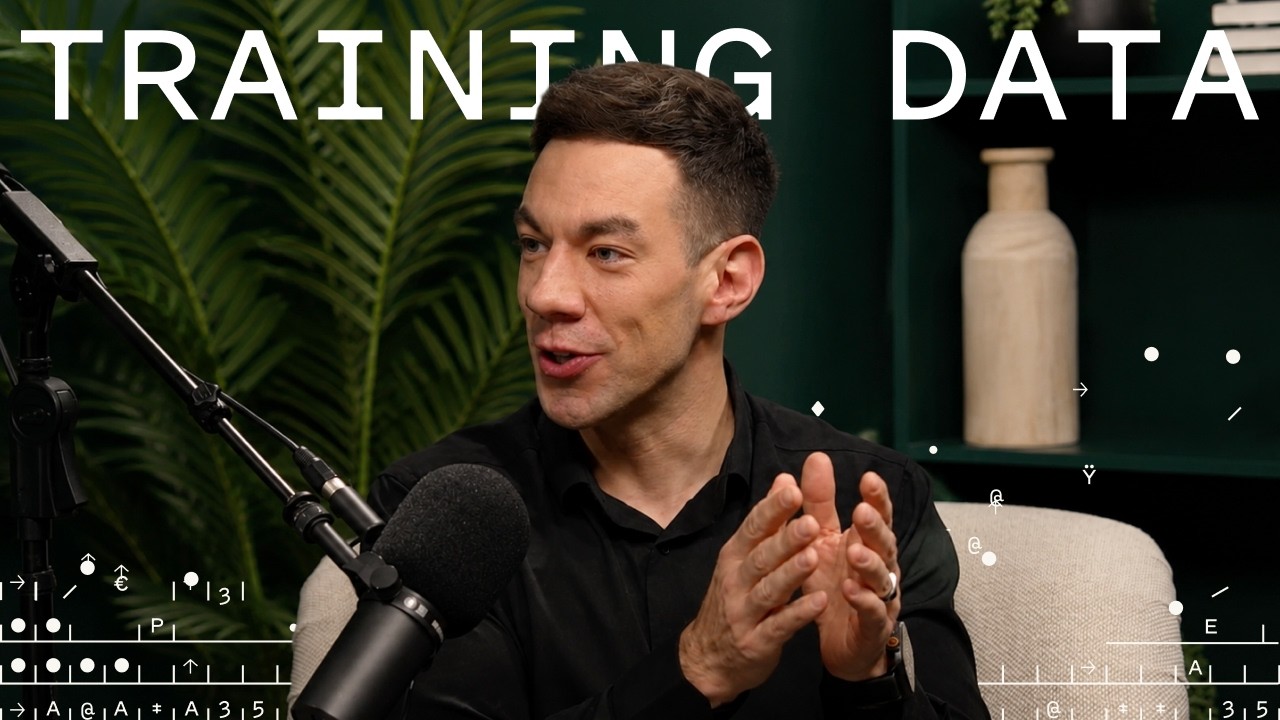
📺 Today’s recommended deep-dive video: https://www.youtube.com/watch?v=j7ypvRUFY7M
Closing the Gap: Rebuilding the Enterprise with AI-Native Workflows
Most professionals spend more time on repetitive tickets and manual data entry than the creative work they were hired for. Jake, CEO of Serval, is building the AI-native successor to ServiceNow to bridge the gap between our idealized careers and the daily administrative reality that often bogs us down.
Core Question: How can AI-native architectures transform enterprise service management from a manual bottleneck into an autonomous engine for productivity?
Highlights
- AI-native automation allows workflows to be generated instantly via natural language rather than through weeks of developer resources.
- A dual-agent architecture balances employee autonomy with the rigorous security controls required by large-scale enterprises.
- The “Fewer Better” philosophy drives a high-talent density culture capable of disrupting entrenched incumbents with infinite resources.
- Sustainable unit economics are achieved by generating persistent code (TypeScript) rather than continuously reselling expensive model tokens for every request.
⏱️ Reading time: approx. 6 minutes · Saves you about 32 minutes vs. watching.
Want to take notes while watching? Click the image below and let AI Notebook capture the key points for you 👇

Beyond the Ticketing Abyss
The Evolution of Enterprise Primitives
ServiceNow revolutionized the enterprise by treating software as simple workflows on top of databases, yet today those very systems have become bureaucratic bottlenecks.
While the underlying primitives of workflows and databases remain correct, the friction lies in the manual effort required to build and maintain them. In a traditional setup, creating a new automation requires weeks of dedicated developer resources and expensive consultant hours. By the time a solution is finally deployed to the production environment, the original business process has often shifted, leaving the organization stuck with outdated tools that no longer serve their intended purpose.
Serval solves this by using generative AI to turn natural language descriptions into functional code instantaneously.
This shift ensures that the time to automate is significantly shorter than the time to perform a manual task, effectively nudging employees toward scalable efficiency rather than one-off fixes. If it is easier to build an automation than it is to manually reset a password, the organization naturally trends toward total autonomy.

💡 Digging Deeper
Q: Why isn’t a database and a simple workflow builder enough anymore?
A: Because business processes change faster than manual coding can keep up with; by the time you build a manual workflow, the business has moved on.
Q: How does Serval handle the “slop” of having too many similar automations?
A: An agent with full contextual awareness monitors all built workflows, suggesting deletions or merges to keep the system clean and logical.
Q: Is the goal to replace ServiceNow entirely?
A: Yes, the goal is to be the platform for employee support where help is provided instantly and automatically without waiting for a human to track down a ticket.
The Dual-Agent Architecture
Balancing Autonomy and Enterprise Control
To satisfy the rigorous security demands of large-scale enterprises, Serval employs a distinct two-pronged agent architecture.
This design separates the “Admin Agent,” which configures tools and permissions, from the “Help Desk Agent,” which interacts directly with end users to resolve their daily technical or administrative issues. The Help Desk agent can use its full reasoning intelligence to solve problems, but it is strictly limited to the “skills” and APIs expressly granted by the IT administrators.
This structure ensures that the AI can act with full reasoning capabilities without ever exceeding the specific boundaries set by IT.
When an employee asks for help, the Help Desk agent draws from a library of approved skills—such as provisioning software or fetching data—that have been vetted and published by human administrators. Because the agent only operates within these defined guardrails, companies can deploy powerful AI across hundreds of thousands of employees without elevating their security risk or allowing for unapproved autonomous actions.

💡 Digging Deeper
Q: Which models perform best for these specific tasks?
A: OpenAI models currently lead in end-user interaction and tool-calling, while Anthropic’s models (Claude) are proving superior for complex code generation.
Q: How do you manage model “upgrades” that might break existing prompts?
A: Through automated eval suites and a slow release process; sometimes the team even downgrades models if the newer version is less predictable for enterprise guardrails.
Q: Do the costs of running these models make the business unsustainable?
A: No, because Serval generates persistent TypeScript code. Once a workflow is built, it runs as standard code without consuming expensive LLM tokens for every execution.
The Talent Density Advantage
Building an AI-Native Organization
Operating as an AI-native company requires a fundamental shift in how internal teams are structured and managed.
Jake advocates for a “Fewer Better” approach, prioritizing extreme talent density over the massive headcount typically seen in enterprise software companies. By keeping the organization lean and agile, the company can pivot its entire product direction in months rather than years, a necessity in an era where model capabilities are evolving on a weekly basis.
This agility is maintained by replacing traditional roles like SDRs and Solutions Engineers with AI-augmented account executives who handle their own technical requirements.
While the company lacks traditional mentorship programs or rigid career ladders, it thrives on ambiguity and high energy. Employees are expected to be productive on day one, leveraging internal AI tools to navigate complex cross-departmental workflows across HR, legal, finance, and security functions. The focus is on finding individuals who enjoy the “blank canvas” of a rapidly evolving market.
Key Takeaways
The ultimate goal of enterprise AI is to unlock meaningful work by automating the repetitive tasks that characterize the “ticketing abyss.” By closing the gap between the idealized version of a job and its daily reality, tools like Serval allow IT professionals to move away from provisioning access and toward building technology. This shift requires a focus on customer empathy, which Jake maintains by staying embedded in every single customer Slack channel, even as the company scales.
From a technical standpoint, the future of the enterprise lies in the tension between individual autonomy and organizational control. While employees want agents that can do everything, the organization requires guardrails. The winners in the application layer will be those who provide a robust “translation layer” that makes these powerful models safe for the most complex environments.
Success in this new era isn’t measured by tokens or headcount, but by the ability to reinvent the product as fast as the underlying models evolve. A small, elite team that embraces disruption—even disrupting their own previous work—is the only sustainable moat left in a world where software can be generated in seconds.
Q&A
Q1: How does Serval differentiate itself from being a mere “wrapper” on top of LLMs?
A1: Serval builds the “boring” but essential enterprise infrastructure—permissions, audits, logs, and integrations—that allows models to operate safely in a corporate environment.
Q2: Why doesn’t Serval have Solutions Engineers (SEs)?
A2: The Account Executives use Serval itself to answer technical questions and generate sales assets on the fly, eliminating the need for a separate technical sales tier.
Q3: What is the “Dream Team Draft” at Serval?
A3: It is an automated recruiting workflow where employees post high-quality LinkedIn profiles, and Serval automatically triggers nurture campaigns to “warm up” top talent over the long term.
Q4: How does Serval handle the rapid release of new models from OpenAI and Anthropic?
A4: They treat new models as opportunities to improve the product rather than threats, but they rely on internal evals to ensure new models don’t lose the “predictable guardrails” of their predecessors.
Q5: What is the biggest barrier to adoption in large enterprises?
A5: Coordination. In companies with hundreds of thousands of employees, the rate-limiting step is often the number of committees and decision-makers involved in changing a process.
Q6: What does Jake mean by “gradient descent for product improvements”?
A6: It refers to the rapid, iterative feedback loop between forward-deployed engineers and customers that makes the product noticeably better every single week.
Q7: Will AI-native companies eventually have thousands of employees?
A7: Likely not. Jake believes that talent density and small team size are the keys to agility, allowing a company to “turn the ship” much faster than traditional giants.