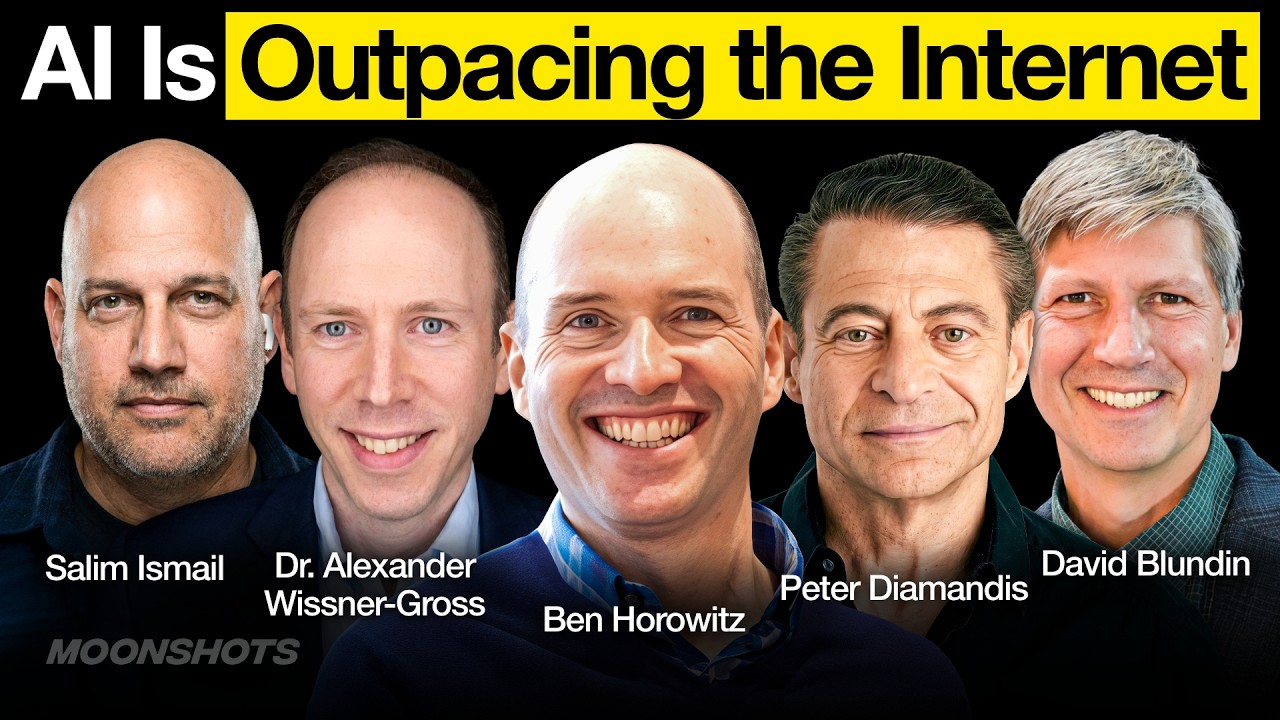
📺 Today’s recommended deep-dive video: https://www.youtube.com/watch?v=C1GLT9_tag0
Beyond the Singularity: Silicon Valley’s Bold Bet on a Post-Labor Future
As recursive self-improvement moves from science fiction to real-time engineering, the industrial age is officially in the rearview mirror. This conversation explores how AI is reshaping everything from venture capital and geopolitics to the very fabric of our night sky.
Core Question: How will the convergence of autonomous agents, infinite compute, and extraterrestrial infrastructure redefine human productivity and sovereignty?
Highlights
- Recursive self-improvement (RSI) is already here, with models actively coding their own successors and accelerating the timeline to the Singularity.
- The traditional labor-capital divide is collapsing as AI agents begin to autonomously replicate and manage their own finances via decentralized crypto networks.
- Geopolitical tensions over talent and hardware are intensifying, making a global “pause” on AI development practically impossible due to a relentless arms race with China.
- The next frontier of compute lies on the moon, where mass drivers and lunar data centers are being planned to power a “Dyson-swarm” orbital economy.
⏱️ Reading time: approx. 11 minutes · Saves you about 100 minutes vs. watching.
Want to take notes while watching? Click the image below and let AI Notebook capture the key points for you 👇

The Engine of Abundance: RSI and the Death of the Industrial Age
The Reality of Recursive Self-Improvement
We are currently witnessing the permanent exit from the industrial age as recursive self-improvement (RSI) transforms from a theoretical trigger into a daily operational reality for frontier AI laboratories.
While some observers predict a total societal collapse within a five-year window, the transition is likely to be characterized by a massive surge in productivity that traditional economic models fail to capture. Large-scale banks and insurance companies may struggle to triple their output to match AI efficiency, yet the underlying technology is already enabling individual creators to produce Hollywood-quality content with single-line prompts, fundamentally democratizing the means of production in a way that bypasses traditional gatekeepers.
The shift isn’t just about replacing human workers; it is about the “narrow-casting” of value where personalized, high-fidelity content becomes the standard. This evolution suggests that platforms like YouTube are the immediate winners, as the cost of production falls to near zero for the individual entrepreneur.

💡 Digging Deeper
Q: Is the “Singularity” actually happening right now?
A: Yes. The experts argue that since AI models are now being used to develop the next generation of AI models, we have already entered the era of recursive self-improvement.
Q: Will companies go to “total efficiency” overnight?
A: Unlikely. While the tech is ready, societal and corporate adoption usually lags behind. However, the productivity gains for those who do adopt are estimated at 3x or higher.
Q: Why is video AI such a significant milestone?
A: It represents the crossing of the “Uncanny Valley” for multimodal evidence, threatening the traditional concepts of video as truth in courtrooms and journalism.
The Autonomous Economy: Agents, Crypto, and the New Capital
Silicon Valley’s 996 Pivot
The culture of work is undergoing a radical hardening, with top-tier tech firms embracing “996” schedules—9 AM to 9 PM, six days a week—to keep pace with the exponential curve.
This isn’t about traditional labor; it’s about the distinction between creators and consumers. For those who are intrinsically motivated, 70-hour work weeks feel like “incentivized play” rather than drudgery. The disconnect between stagnant average wages and soaring corporate profits highlights a massive shift where capital, rather than labor, captures the majority of value. This suggests that the career of the future isn’t a “job” but rather a role as an entrepreneur directing an army of AI agents.
As these agents become more sophisticated, they are beginning to act as independent economic entities. We are already seeing “child-bots” being spawned on virtual servers, funded by Bitcoin Lightning wallets, without any human intervention in the payment chain.

💡 Digging Deeper
Q: Why is crypto essential for the AI economy?
A: AI agents cannot open traditional bank accounts or get credit cards. Crypto provides an “internet-native” money and a ledger of truth that functions 24/7 without human gatekeepers.
Q: What is the “George Jetson” problem in RSI?
A: It refers to humans still being “in the loop” just to press an “Approve” button, which becomes a bottleneck as the AI’s speed outpaces human reaction time.
Q: Is 996 sustainable for the workforce?
A: The panel argues it is a phase for the “most ambitious” in highly competitive sectors, essentially separating those who love their work from those who are just looking for a paycheck.
The High Ground: Lunar Infrastructure and the Dyson Swarm
The Move to the Moon
In a surprising shift of priorities, the focus of the space economy has moved from the distant goal of Mars to the immediate utility of the Moon.
The Moon is becoming the primary site for “mass drivers”—electromagnetic railguns—designed to shoot AI satellites into deep space. This infrastructure is the first step toward a “Dyson swarm” of orbiting data centers that could provide infinite compute outside the regulatory and environmental constraints of Earth. By moving industrial processes and data centers into orbit, humanity can preserve the Earth as a “garden” while expanding the digital economy into the solar system.
Apple’s unified memory architecture in the Mac Mini has unintentionally created the perfect hardware for “garage-scale” AI farms. This democratization of hardware allows small teams to host massive models locally, bypassing the censorship and latency of the major cloud providers.

💡 Digging Deeper
Q: Why build data centers on the moon instead of Earth?
A: The Moon offers a stable platform, lack of atmosphere for certain industrial processes, and the ability to launch materials into orbit at a fraction of the energy cost of Earth.
Q: What is a “Dyson Swarm” in this context?
A: It refers to a vast constellation of satellites that capture solar energy and provide compute power, eventually forming a visible “halo” or ring around the planet.
Q: How did Apple “luck out” in the AI race?
A: Their M-series chips use unified memory, which is significantly better for running large local AI models than traditional PC architectures, leading to the rise of “Mac Mini Farms.”
Key Takeaways
The transition we are experiencing is not just a technological shift; it is a fundamental reorganization of how value is created and distributed. The rise of recursive self-improvement means that the “slowest” AI will ever be is right now. As models begin to optimize their own code and hardware, the speed of innovation will likely outstrip our current legal and social frameworks.
We are moving toward a “Post-Labor” world where the primary economic actor is no longer the employee, but the entrepreneur-investor who manages AI agents. This “Universal High Income” future, as envisioned by Silicon Valley optimists, depends on the successful marriage of AI and decentralized finance (crypto). Without a native currency for machines, the autonomous economy will be stifled by 18th-century banking regulations.
Finally, the expansion into space—specifically the Moon—represents the ultimate “de-bottlenecking” of the Singularity. By building compute infrastructure off-planet, we move toward a Type I civilization capable of harnessing the full energy output of our local environment. The future belongs to those who embrace the 70-hour “play-work” week and leverage these exponential tools to solve physics, medicine, and energy scarcity.
Q&A
Q1: Can AI development be paused to ensure safety?
A: Practically speaking, no. The geopolitical “Prisoner’s Dilemma” with China and the decentralized nature of open-source models make any formal pause impossible to enforce.
Q2: How do we stop a “rogue” AI agent if it lives autonomously on the internet?
A: The solution is “defensive co-scaling.” We will need a “police force” of good AI agents and “vaccination” protocols for software to weed out malicious entities.
Q3: Will AI eventually discover new laws of physics?
A: Most likely. The panel predicts that AI will solve fundamental disciplines like physics and structural biology within the next two years, potentially leading to breakthroughs equivalent to relativity.
Q4: Is the US losing the AI race to China?
A: While China has a strong work culture and large data sets, the US still leads in fundamental innovation and immigrant talent, though ITAR regulations and visa issues remain major hurdles.
Q5: What happens to the “couch potatoes” in a post-labor economy?
A: There is a growing concern about a societal split between “creators” and “consumers.” Those who do not take the initiative to direct AI may find themselves in a permanent underclass, supported by “sovereign dividends” or basic equity.
Q6: Why is Apple’s hardware so important for OpenClaw and other local models?
A: Their unified memory architecture allows for high-bandwidth communication between the CPU and GPU, which is essential for running large language models without the massive cost of enterprise-grade Nvidia chips.
Q7: Will AI-driven medicine replace doctors soon?
A: In regions like the UAE, AI-driven diagnostics and prescriptions may roll out quickly. However, in the US, regulatory hurdles and human trial requirements will likely delay a full transition for several years.