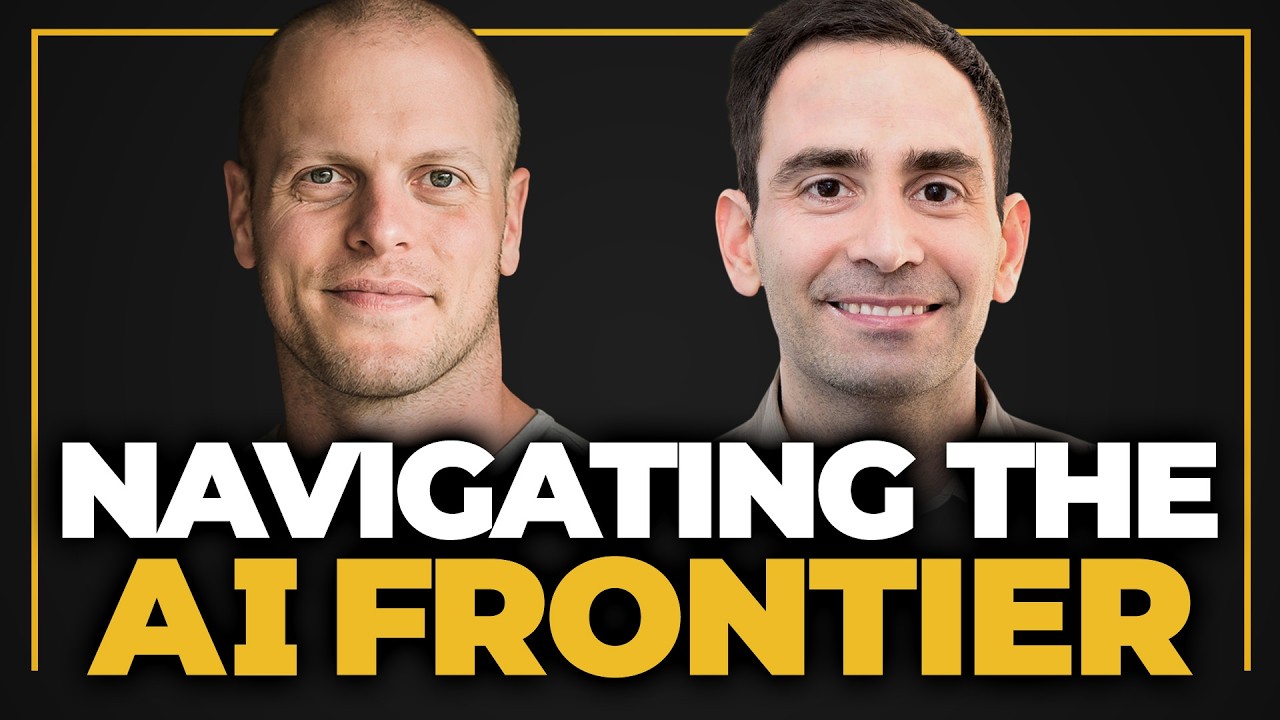
📺 Today’s recommended deep-dive video: https://www.youtube.com/watch?v=HutNi2cNsCg
The Personal IPO and the AI Compute Ceiling
The artificial intelligence revolution is creating a new class of “Personal IPOs,” where top-tier researchers are receiving compensation packages worth hundreds of millions of dollars before their companies even go public. Expert investor Elad Gil explores why the current compute bottleneck is actually preventing any single AI lab from winning a monopoly and why most AI startups should consider exiting within the next 18 months.
Core Question: How do compute constraints and aggressive talent wars define the current trajectory of the AI market?
Highlights
- The “Personal IPO” phenomenon: Top AI researchers are now earning compensation packages on par with successful company exits.
- Memory, not just chips, is the current primary bottleneck preventing AI labs from pulling ahead of one another.
- AI companies like OpenAI and Anthropic are achieving $10 billion to $30 billion revenue run rates faster than any previous tech generation.
- Historical context reveals that aggressive distribution, not just product quality, is the secret engine of multi-billion dollar tech giants.
⏱️ Reading time: approx. 8 minutes · Saves you about 93 minutes vs. watching.
Want to take notes while watching? Click the image below and let AI Notebook capture the key points for you 👇

The Era of the Personal IPO
The Talent War and Market Parity
Meta’s aggressive bidding for AI researchers has triggered a seismic shift in Silicon Valley’s compensation structure. Historically, an “IPO moment” was reserved for founders and early employees of a single successful company, but today, a specific class of high-end researchers across various labs is experiencing the equivalent of a personal public offering through outsized pay packages. These offers often range from tens of millions to hundreds of millions of dollars, reflecting the extreme economic value placed on the handful of people capable of pushing the frontier of large-scale models.
This influx of capital into the talent pool mimics the crypto boom of 2017, where a whole demographic of builders became wealthy simultaneously.
Currently, a technical ceiling exists because every major lab is constrained by the same supply chain bottlenecks, specifically High Bandwidth Memory (HBM) produced by a few Korean manufacturers. This “compute ceiling” means no single player—be it OpenAI, Google, or Anthropic—can purchase ten times more compute than its rivals. Consequently, we are likely to see a period of capability parity for at least the next two years until these infrastructure constraints are resolved.

💡 Digging Deeper
Q: Why is the output of months of compute just a “flat file”?
A: It is a remarkable compression of human knowledge. Just as three billion base pairs of DNA specify the entire human brain, these files encapsulate humanity’s collective information, logic, and reasoning capabilities into a single, usable document.
Q: What happens when the memory constraint is lifted?
A: There is a possibility that a single lab could finally pull far ahead. Once the “artificial ceiling” is gone, the company with the most capital and the best infrastructure strategy might achieve a capability gap that competitors cannot bridge.
Q: Is this talent wealth sustainable?
A: It depends on the continued ROI of the labs. Currently, the “Personal IPO” is a rational strategy for companies spending tens of billions on compute; they need the best minds to ensure that hardware doesn’t go to waste.
The 18-Month Exit Window
Survival Rates in Tech Cycles
Elad Gil suggests that 90% to 95% of current AI startups will eventually go bust, following the historical pattern of the 1990s automotive industry and the 2000s dot-com bubble. Out of 2,000 companies that went public during the late 90s, only about a dozen became truly durable, world-changing entities. For the vast majority of founders, the next 12 to 18 months may represent a value-maximizing moment to exit before their products become commoditized or integrated into the core foundation models.
Founders must objectively assess whether they possess a durable moat or if they are simply a feature that a major lab will eventually replicate.
The buying power of tech incumbents is currently unprecedented, with multi-trillion dollar market caps allowing companies to spend $30 billion on a single acquisition—a mere 1% of their value. This creates a unique window where even specialized application companies in legal, healthcare, or customer success might find massive exit opportunities. However, those who do not sell during this window may find themselves facing the “second derivative” of growth: a plateau where competition from labs and other startups erodes their initial advantage.

💡 Digging Deeper
Q: What makes a “handful” of companies durable?
A: Durability usually comes from being deeply embedded in a workflow. It’s not just about the quality of the AI, but how much “change management” a customer would have to go through to replace the system.
Q: Is proprietary data a real moat?
A: Data moats are often overstated. While a “system of record” view is useful, most successful companies win by building a cohesive product suite that becomes the primary interface for the user’s daily work.
The Secret of Aggressive Distribution
Market First, Team Second
While the common Silicon Valley refrain is to back the “best team,” Elad Gil argues that the market is actually the primary driver of success. An amazing team can be crushed by a terrible market, while a mediocre team in a booming, open market can still achieve significant scale. He looks for “why now” factors, such as regulatory shifts or technology breakthroughs like the Transformer architecture, which opened up the entire world of white-collar work to automation.
The fastest way to fail is to ignore the distribution engine that powers every multi-billion dollar tech giant.
Technologists often fall into the trap of believing that the best product wins by merit alone. However, historical titans like Google and Facebook scaled through extremely aggressive distribution tactics, such as paying hundreds of millions to distribute search toolbars or buying ads against personal names in Europe to create immediate network liquidity. Distribution is often the “forgotten” secret of the tech world; you need a brilliant product engine, but you also need a relentless distribution engine to protect that product.

💡 Digging Deeper
Q: What did Vinod Khosla teach Elad about market entry?
A: He distinguished between market entry and market disruption. SpaceX entered with launch services, but their true disruption is Starlink, which leveraged their cost advantage to create a new global network.
Q: Is it currently smart to be a contrarian?
A: There are moments to be contrarian, but right now, being “consensus” on AI is the smartest move. Overthinking it to find a “hidden” hardware play might lead you to miss the obvious value being created in software and models.
Key Takeaways
[Paragraph 1: ~30 words]
The AI landscape is currently defined by an infrastructure-led stalemate. While talent compensation is soaring, the primary labs remain neck-and-neck due to a shared global shortage of high-bandwidth memory.
[Paragraph 2: ~75 words]
Founders must navigate a market that is more “open” than any in recent memory, but they should be wary of the historical 95% failure rate of tech cycles. The rapid revenue ramps of companies like OpenAI—reaching percentages of US GDP in record time—signal a massive shift in how work is sold. Instead of selling software “seats,” we are moving toward a world where companies sell “labor equivalents” and cognitive output directly.
[Paragraph 3: ~50 words]
Successful investing requires identifying the “one thing” you must believe about a company to see a 10x outcome. Whether it’s an index on e-commerce like Stripe or an index on crypto like Coinbase, simple, high-conviction beliefs usually outperform complex, 50-page financial models that fail to capture market shifts.
Q&A
Q1: What is the “Personal IPO”?
A: It is a phenomenon where top AI researchers receive massive compensation packages, sometimes totaling hundreds of millions of dollars, as tech giants like Meta bid aggressively for the talent needed to run their multi-billion dollar compute clusters.
Q2: Why won’t one AI lab win everything in the next year?
A: All major labs are hitting the same “compute ceiling.” Bottlenecks in the supply chain, particularly memory (HBM) and data center power, prevent any single company from scaling significantly faster than its competitors.
Q3: Why should some AI founders consider selling their companies now?
A: History shows that most companies in a tech cycle go bust. Given the current high valuations and the risk of commoditization by larger labs, the next 12-18 months represent a peak value-maximizing window for many.
Q4: What is Elad’s hierarchy for investing?
A: He prioritizes “Market First” and “Team Second.” He believes that a great market can pull a company forward, whereas even the best team will struggle to survive in a closed or declining market.
Q5: What is a “fake TAM” (Total Addressable Market)?
A: It is when a company claims a massive market (like “global e-commerce”) when they actually only provide a niche service (like “SMB website optimization”). A real TAM is defined by the specific, reachable units a company can actually capture.
Q6: How does Elad use AI models for research?
A: He runs deep-dives by querying multiple models (Claude, GPT-4, Gemini) simultaneously. He uses them to aggregate clinical trial data, summarize primary literature, and “cold read” personality traits from images for fun.
Q7: What is the current bottleneck after chips?
A: While packaging was the issue a year ago, the current constraint is HBM (High Bandwidth Memory). In the future, the bottleneck is expected to shift toward the physical power and energy required to run massive data centers.