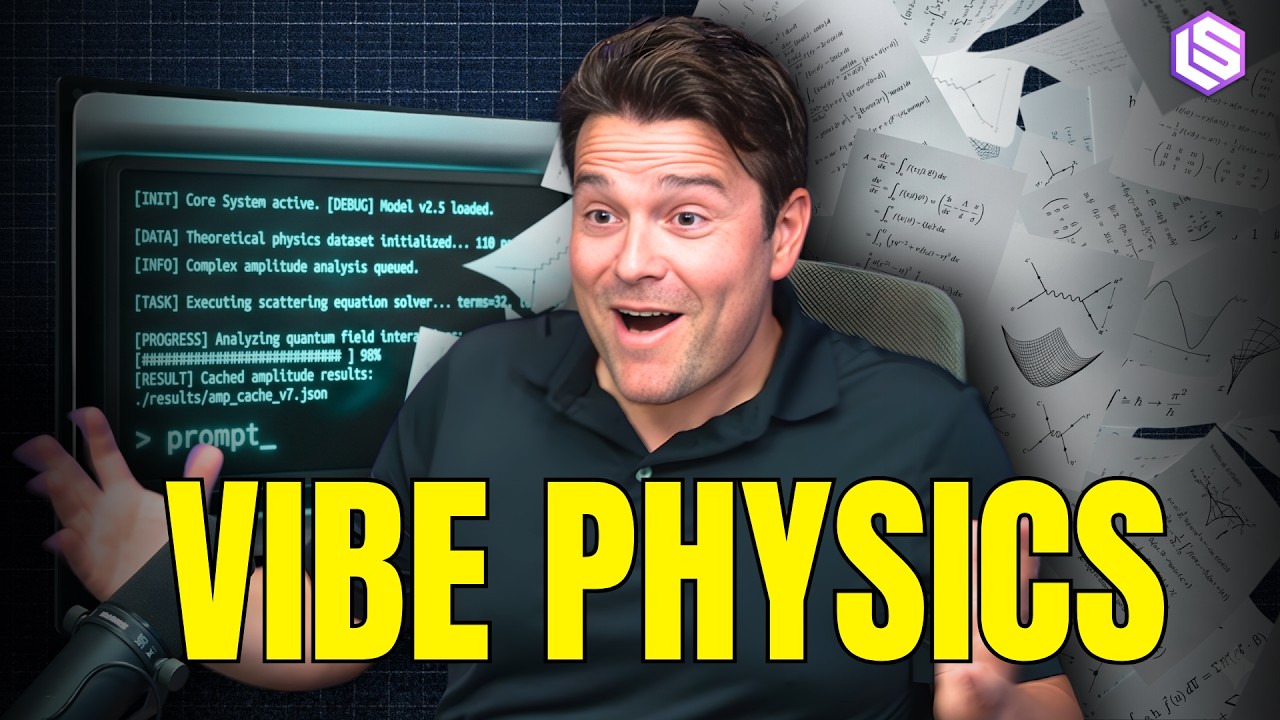
📺 Today’s recommended deep-dive video: https://www.youtube.com/watch?v=9d899Ram9Bs
Beyond the Paper: How AI is Solving the Unsolvable in Theoretical Physics
For decades, the “blackboard and chalk” era of theoretical physics seemed immune to the disruption of automation. Alex Lubyansky, a fellow at OpenAI and Breakthrough Prize winner, shares how the latest reasoning models solved a year-long quantum field theory puzzle in minutes, signaling a permanent shift in how we explore the laws of nature.
Core Question: Can AI transcend its role as a writing assistant to become a creative collaborator capable of pushing the frontiers of quantum gravity?
Highlights
- The discovery that “single minus” gluon and graviton amplitudes are non-zero, overturning long-held physical assumptions.
- The transition from GPT-3 (useful for emails) to GPT-5 and reasoning models capable of reproducing world-class research.
- The “scout” methodology: using AI to probe multiple research pathways simultaneously to avoid human “roadblocks.”
- The upcoming crisis in academic training as AI begins to “crush” the traditional hurdles used to train graduate students.
⏱️ Reading time: approx. 8 minutes · Saves you about 84 minutes vs. watching.
Want to take notes while watching? Click the image below and let AI Notebook capture the key points for you 👇

The Threshold of Superhuman Reasoning
From Writing Emails to Solving Equations
Physics was always supposed to be the final bastion of human exclusivity, a field where intuition and deep mathematical rigor could never be mimicked by a simple word-prediction machine. Alex Lubyansky explains that this skepticism evaporated when he saw a model reproduce his most complex research in under thirty minutes. This wasn’t just a summary; it was a full derivation of symmetries that only a handful of humans could grasp, effectively passing a profound threshold in scientific capability.
The transition from GPT-3 to the newer reasoning-heavy models represents more than just a speed increase; it is a qualitative shift in how machines interact with logical structures. In the past, AI could summarize a paper or fix grammar, but it couldn’t provide the “Move 37” moment required to identify flaws in long-standing physical assumptions or discover new symmetries in black hole equations without being explicitly told they existed.
Research is inherently about being confused.
Lubyansky notes that he now spends significantly less time in that state, using AI as a collaborator that can “unfold” complex mathematical truths or catch subtle errors in real-time. This doesn’t just speed up the work; it changes the nature of what a physicist can dare to wonder about, knowing the “drudge work” of calculation is no longer a deterrent.

💡 Digging Deeper
Q: Why did Lubyansky go to OpenAI? A: He realized that being a spectator to this shift was a mistake; he needed to understand the mechanics of how AI was suddenly solving problems that stumped his senior colleagues.
Q: What was the “warm-up” problem? A: He primed the model with flat-space symmetries—a 200-year-old solved problem—before asking it to tackle the far more complex black hole perturbations.
Breaking the Zero-Amplitude Myth
The Single-Minus Gluon Discovery
In the study of the strong nuclear force, physicists often use “scattering amplitudes” to predict the probabilities of particle interactions. For years, textbooks taught that “single minus” amplitudes—interactions where only one gluon has a different polarization—were strictly zero. This assumption simplified the math, but it turns out it was wrong.
A year of human effort by world experts failed to find a simple formula for these non-zero interactions.
The AI, however, identified a specific “collinear” region in space-time where the usual arguments fall apart. By providing the model with a few five-point and six-point examples, the researchers watched the AI conjecture a general formula for $n$ particles that exhibited linear growth rather than the terrifying factorial complexity usually expected.
This result is the “Parke-Taylor formula” of our generation.
Just as the 1980s saw a miraculous simplification of gluon math, this AI-driven discovery provides a concise, elegant solution to a problem that grows “super-exponentially” in complexity for humans. It wasn’t just a lucky guess; an internal OpenAI reasoning model eventually derived the full proof from scratch, demonstrating that the machine understood the underlying physics of these previously “forbidden” interactions.

💡 Digging Deeper
Q: What is a gluon? A: It is the exchange particle for the strong force, essentially the “glue” that binds the nucleus of an atom together despite the repulsion of protons.
Q: What is helicity? A: It refers to the “wind” or polarization of a particle as it travels; “single minus” means one particle is rotating in the opposite direction of all the others in the interaction.
The Future of Scientific Discovery
The “Scout” Methodology
Modern research often involves a physicist standing at point A and trying to chart a course to point C through a fog of unknowns. Traditionally, this required picking one path and spending months calculating to see if it led anywhere. AI allows a researcher to launch “ten instances of chat” as scouts, probing multiple theoretical directions simultaneously to see which one remains logically consistent.
This changes the “bottleneck” of science from calculation to verification.
We are entering an era where AI can churn out papers at a rate that threatens to inundate the academic community with “AI slop” if not properly steered. Lubyansky argues that the response shouldn’t be to slow down, but to raise the bar. If the “easy” problems are now solvable by machines, human physicists must shift their focus to the deep, creative questions that have stumped the community for decades.

💡 Digging Deeper
Q: Will AI replace graduate students? A: Not exactly, but it removes the “arduous rites of passage” like manual calculations, forcing a rethink on how we build self-confidence and foundational knowledge in new researchers.
Q: What is the “bottleneck” Lubyansky wants to remove? A: The static, slow nature of paper writing; he envisions a future of “interactive papers” that exist within LLMs where readers can zoom into details or ask for derivations.
Key Takeaways
Theoretical physics has passed a point of no return. The “Move 37” moment for science has arrived, where models are not just retrieving data but are performing novel reasoning that overcomes human cognitive limits in combinatorial complexity. The discovery that single-minus gluon and graviton amplitudes are non-zero is a landmark case study in how AI can identify loopholes in established physical laws.
The role of the physicist is shifting from “calculator” to “director” or “scout leader.” Success in this new regime requires “taste”—the ability to ask the right questions and steer a superhumanly competent “graduate student” (the AI) toward fruitful frontiers. As calculation costs drop to near zero, the value of creative intuition and rigorous verification will become the primary currency of scientific achievement.
Finally, academia must evolve its training and communication models. The traditional six-month cycle for a research project is being compressed into weeks, and the static PDF paper may soon give way to interactive, AI-powered knowledge bases. We are on a trajectory where the “missing pieces” of fundamental physics, like quantum gravity, may finally be within reach if we learn to collaborate with these new intelligences.
Q&A
Q1: How did the AI prove the graviton paper so much faster than the gluon paper?
A: The researchers used the gluon paper as a “seed.” By priming the model with the logic of the first discovery, the AI was able to apply a different set of mathematical tools—like the directed matrix tree theorem—to gravity in a matter of days.
Q2: Was the AI’s math actually original or just pulled from the training data?
A: While models are trained on existing data, the AI’s ability to combine obscure mathematical theorems to solve an open problem that stumped experts for a year suggests a level of functional reasoning that goes beyond simple retrieval.
Q3: Does the AI make mistakes in these complex calculations?
A: Yes. Lubyansky notes that they still spend a majority of their time verifying the AI’s output. The AI can “go off the deep end” if the prompt is poorly posed, making human oversight critical for high-stakes science.
Q4: What is “Celestial Holography”?
A: It is a program led by Andy Strominger (Alex’s collaborator) that attempts to understand the symmetries of quantum gravity by looking at the “flat” boundary of space-time, a field where these AI results are particularly useful.
Q5: How does this affect the training of PhD students?
A: It creates a “desert” between classroom learning and the research frontier. If AI can solve the “easy” research problems professors usually give students, we need new ways to teach students how to build intuition and self-confidence.
Q6: What is the significance of “Two Space, Two Time” dimensions mentioned?
A: It is a mathematical “signature” of space-time used in these papers to make the loophole for non-zero amplitudes visible; while not our physical reality, it provides the necessary mathematical consistency to find the correct formulas.
Q7: Can we expect AI to solve quantum gravity soon?
A: It is a clear line of attack. Lubyansky believes that by using AI to solve increasingly harder problems that have stumped the community for decades, we may eventually reach a breakthrough in our fundamental understanding of the universe.