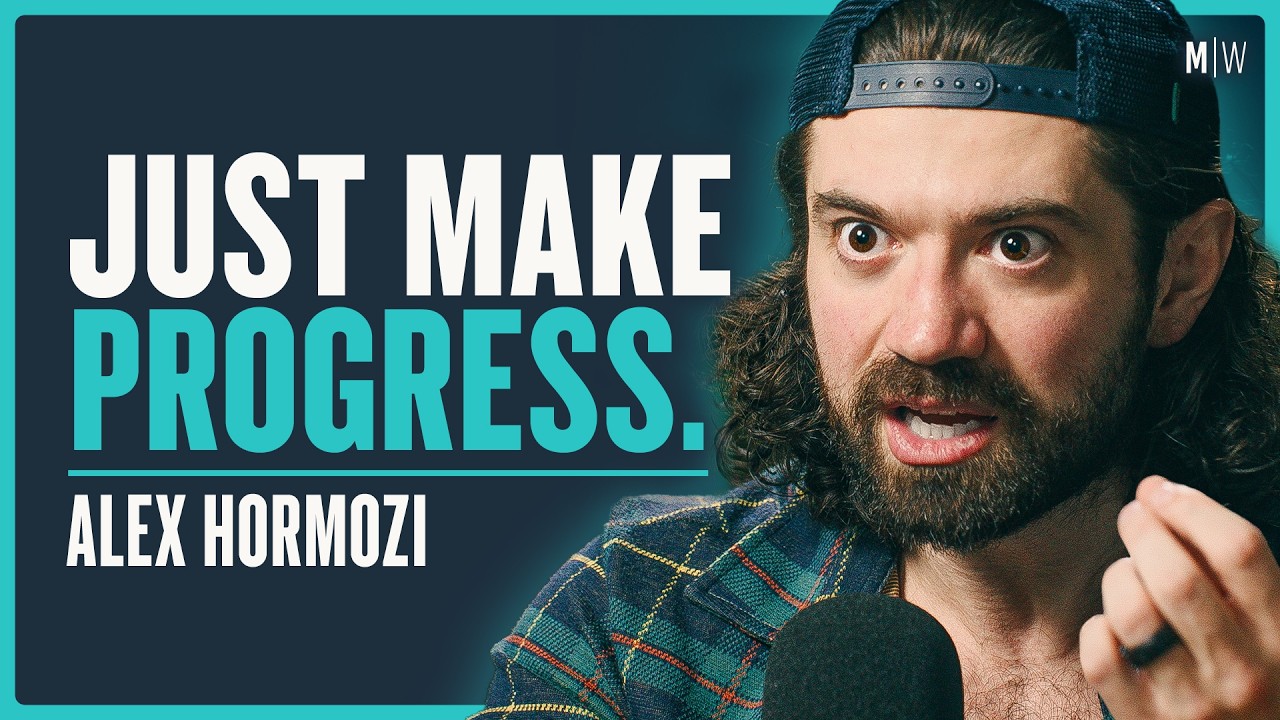
📺 Today’s recommended deep-dive video: https://www.youtube.com/watch?v=ky1oHHJ5Ne8
The Brutal Math of Happiness: Alex Hormozi on Success, Suffering, and Cosmic Irrelevance
Most high-achievers spend their lives building monuments that the wind will inevitably blow away, forgetting that the universe is undefeated by human ego. True freedom isn’t found in the final achievement, but in the radical acceptance that your biggest dreams are cosmically irrelevant.
Core Question: How can we reconcile the pursuit of massive success with the inevitable reality of our own decline and eventual irrelevance?
Highlights
- V-Shaped Resiliency: How to decrease the time between an aversive stimulus and a return to baseline behavior.
- The Error of Complaining: Why complaining is a signal of a faulty reality model rather than a valid critique of the world.
- Operational Gratitude: Using the “Reverse Loss” technique to manufacture gratitude when you feel nothing.
- The Cost of Excellence: Understanding that the skills required for business success often act as poison for personal happiness.
⏱️ Reading time: approx. 12 minutes · Saves you about 228 minutes vs. watching.
Want to take notes while watching? Click the image below and let AI Notebook capture the key points for you 👇

The Resiliency Playbook
Achieving a V-Shaped Recovery
Resiliency is best defined as the amount of time it takes to return to baseline behavior after a bad thing happens.
If you hit the bottom of the pool and shoot back up instantly, you are “V-shaped,” and that speed is determined by how many tools you have to reframe the impact. Cosmic irrelevance is perhaps the sharpest tool in this kit; it forces you to realize that a printing error in your book or a bad day at the office is a mere rounding error in a galaxy expanding faster than light.
The Queen of England died eighteen months ago, and despite her status, the world simply kept spinning while people argued about the catering at her funeral. When you realize that everyone you know will eventually go to a restaurant and eat dinner right after your burial, the stakes of your current “catastrophe” drop to nearly zero.

💡 Digging Deeper
Q: What is the “Frame of the Veteran”?
A: It is a mental exercise where you imagine an inconvenience happening for the 1,000th time. By the 1,000th repetition, you would accept it as just “how life is,” proving that feeling calm on the 1st time is a choice of perspective, not a result of the circumstance.
Q: How does Hormozi distinguish between toughness and resiliency?
A: Toughness is the length of your fuse—how much you can take before you crack. Resiliency is how fast you recover after the bomb has already gone off.
The Logic of Complaining and Control
Why Complaining is a Calculation Error
Complaining is essentially an admission that you do not understand how the world works because reality is not meeting your expectations.
When you complain, you are telling the universe that it should bend to your will, which is a delusional stance to take against an undefeated opponent. Every negative comment or external frustration can be translated into a simple sentence: “The world is existing in a way that I would not prefer.”

The Big Three of Suffering
Psychologically, all human pain and suffering are cast upon three primary targets: circumstances, other people, or the self.
Blaming circumstances or other people provides no leverage and yields zero ROI for your future well-being. By skipping directly to the “Self” category, you find the only variable that you can actually manipulate to change the outcome of your life.
It is far more useful to ask, “How did I fail to predict this?” than to ask, “Why did they do this to me?”
The Architecture of a Good Life
The Good Day Formula
In some seasons of life, maintaining is winning, and a happy life is simply the result of which moments you choose to dwell on.
Most of our memories are just a handful of snapshots, yet we allow five bad minutes to turn into a “bad year” through constant rumination. To combat this, you must recalibrate your scale for what constitutes a “win.” If you can stay in a good mood in the absence of things to be in a good mood about, you have mastered the single greatest skill a human can possess.

Falling in Love with the Person, Not the Institution
Choosing a partner is the most tactical decision a high-achiever can make because the person you marry either acts as a rocket pack or a lead weight.
Many people fall in love with the idea of being married—the institution—rather than the specific person, leading to a mismatch in goals and values. A great partner kills drama instead of starting it and wants you to win even more than you want it for yourself. They don’t just love who you are; they love the person you are desperately trying to become.
Buying Back the Clock
The $70,000 Skill Gap
Money does not buy happiness directly, but it buys the freedom to be happy by removing the “administrative rot” of daily life.
For about $1,500 a month, you can effectively buy back ninety hours of your life by outsourcing laundry, cleaning, and meal preparation. Most people stop their financial progress at a nice house or a car, failing to realize that the highest ROI on wealth is the total elimination of tasks you despise.

Meditation as Mental Violence
If achieving massive success doesn’t fill the internal void, the only remaining option is to move the internal median of happiness itself.
Data on long-term meditators shows that subjective well-being can be shifted three to four standard deviations above the norm. This isn’t a “soft” pursuit; for someone like Hormozi, it is viewed as a violent brute-forcing of the brain to achieve a constant state of bliss that external achievements cannot provide.
Key Takeaways
The fundamental struggle of the high-achiever is the trade-off between objective success and subjective peace. We often sacrifice the very thing we want (happiness) for the thing that is supposed to buy it (success), only to realize the exchange rate was a scam. By the time we reach the top of the mountain, we realize we are still the same person, just with more “books” and less time to read them.
Ultimately, victory is found in “winning the day” through volume and consistency. Success isn’t about the one-off lucky break; it’s about doing so much work that it becomes unreasonable for you to fail. Whether it’s in business, fitness, or relationships, the bar for excellence is incredibly low because most people quit the moment the “suck” stops being novel and starts being a grind.
Q&A
Q1: How do you operationalize gratitude when you aren’t feeling it?
A1: Imagine something you love is gone, sit with that pain, and then remember that it is actually still here. Gratitude is essentially playing pretend to create a positive “delta” between reality and a worse imagined state.
Q2: Should a 22-year-old focus on work-life balance?
A2: No. If you are 22 and talking about balance, you are hanging out with the wrong people. You have peak energy and nothing to lose; you should use that time to front-load the work required to buy freedom later.
Q3: What is “Inverse PTSD”?
A3: It is workload exposure therapy. Every time you survive a soul-crushing period of work or stress, you prove to yourself that you have the capacity to handle more, turning past trauma into future confidence.
Q4: Is original thinking actually possible?
A4: Most people’s opinions are just ventriloquism from their favorite influencers. Original thinking is rare and requires reasoning from first principles—starting with observable facts and building upward rather than copying a narrative.
Q5: Why is “knowing why” less important than “what happened”?
A5: “Why” is usually a narrative we craft to feel better, which may have no bearing on reality. Focusing on “what behavior changed” allows for predictable, actionable adjustments in the future.
Q6: What is the benefit of a “V-shaped” recovery?
A6: It maximizes your time spent in a productive state. The faster you can move from “this sucks” back to “I am working,” the more volume you can produce over a lifetime.
Q7: How does one spend money most effectively for happiness?
A7: By buying back time. The first $1,500-$5,000 of “discretionary” spending should go toward eliminating chores, driving, and meal prep to free up 100+ hours a month.