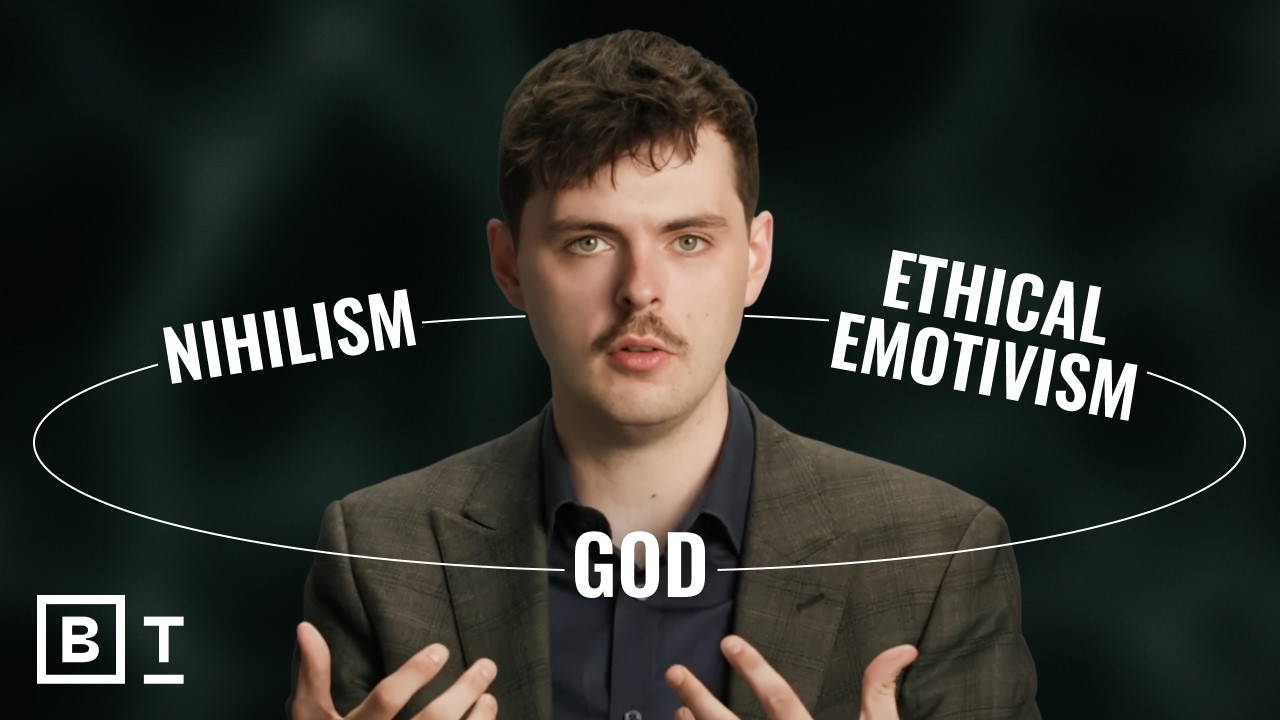
📺 Today’s recommended deep-dive video: https://www.youtube.com/watch?v=aqWTlUOhowk
Beyond the “Edgy Atheist”: Alex O’Connor on God, Nihilism, and Ethical Emotions
Former “edgy atheist” Alex O’Connor navigates the dense forest of meta-ethics and metaphysics to find what remains when dogmatic certainty fades. By dismantling the “first cause” and interrogating why we find certain acts disgusting, he reveals a world where meaning might be subjective, yet remains undeniable.
Core Question: Is the universe sustained by a necessary foundational principle, or are our values and meanings merely biological preferences disguised as objective truths?
Highlights
- The “First Cause” is better understood as a hierarchical sustaining power rather than a temporal first domino.
- Nihilism does not remove values; it simply exposes them as subjective preferences rooted in evolutionary biology.
- Ethical statements like “murder is wrong” may actually be emotional expressions (Emotivism) rather than factual claims.
- The “problem of suffering” remains the most potent argument against a benevolent, traditional Judeo-Christian God.
⏱️ Reading time: approx. 11 minutes · Saves you about 75 minutes vs. watching.
Want to take notes while watching? Click the image below and let AI Notebook capture the key points for you 👇

The Sustaining Cause: Rethinking the First Mover
From Temporal Dominos to Hierarchical Support
We often mistakenly imagine God as the first domino in a long temporal chain, a creator who set the universe in motion and then stepped away.
However, a more robust philosophical argument focuses on hierarchical causation, where every actor borrows its power from a more fundamental source in this exact moment. If you hold a glass of water, your hand causes its position, your arm supports your hand, and the floor supports your body; if any link in this simultaneous chain vanished, the glass would fall instantly. This implies a “sustaining” cause at the base of reality that must exist right now to keep the laws of physics and existence from simply switching off.
Thomas Aquinas expanded on this by describing an “unactualized actualizer”—a being of pure act with no potentiality for change. Because material things are by definition changeable and divisible, the foundational cause of the universe must be an immaterial, timeless, and spaceless principle that transcends the physical realm. While this doesn’t strictly prove the “God” of any specific religion, it establishes a necessary anchor for a universe that cannot account for its own existence.

💡 Digging Deeper
Q: What is the difference between horizontal and hierarchical causation?
A: Horizontal causation happens across time (parents causing children), where the cause can disappear once the effect begins. Hierarchical causation happens all at once; if the foundation (like gravity) stops, the result stops immediately.
Q: Why can’t a causal chain go back to infinity?
A: In a hierarchical chain, each part has zero power of its own and only “borrows” it. If the chain is infinite with no source, there is no power to borrow, meaning nothing would happen in the present.
Q: Does the First Cause have to be “good”?
A: Not necessarily. The causal argument only establishes a necessary, immaterial foundation; proving that this foundation is loving or moral requires entirely different cumulative arguments.
The Nihilist’s Bird’s-Eye View
Purpose, Preference, and Evolution
Nihilism isn’t the absence of values, but the recognition that those values are groundless.
A nihilist might still feel thirsty and reach for a glass of water, but they recognize that this action is driven by biological impulses rather than a cosmic purpose. We are often beholden to animalistic instincts that were selected for survival over millions of years, which can make our highest aspirations feel like accidental byproducts of a brutal evolutionary machine. When we ask “why” we do anything, the chain of reasoning eventually bottoms out in a subjective preference that we treat as if it were a self-justifying objective truth.
Meaning is effectively synonymous with a non-contingent reason to exist or act. For a parent, the “why” might end at the well-being of their child, a principle they find so self-evident that further questioning feels inappropriate or absurd. While an atheist might find this subjective “bottoming out” fulfilling enough for daily life, a true objective meaning would have to exist independently of human preference, a concept that is notoriously difficult to ground without a supernatural framework.

💡 Digging Deeper
Q: Can a nihilist be happy?
A: Yes. Nihilism is a metaphysical claim about the lack of objective meaning, not a psychological state; one can experience immense pleasure while acknowledging it has no cosmic significance.
Q: How does the book of Ecclesiastes relate to modern nihilism?
A: It is an ancient text that describes life as “hebel” (smoke or wind), arguing that everything “under the sun” is absurd and meaningless, predating modern existentialist thought by millennia.
Q: Is agnosticism a form of consolation?
A: For O’Connor, yes. By admitting we don’t know the ultimate answers, we avoid the despair of a certain nihilism and the fear associated with dogmatic religious certainties.
Ethics as Emotional Expression
The “Boo/Hooray” Theory of Morality
Emotivism suggests that when we say “murder is wrong,” we aren’t making a factual claim about the universe, but are instead expressing a personal emotion.
Under this framework—often called the “Boo/Hooray” theory—ethical statements lack truth value. They are not true or false in the way “the sky is blue” is; they are more like the exclamation “Ouch!” or a grimace of disgust. This perspective shifts ethics from the realm of logic and external facts into the realm of human psychology, suggesting that our moral “laws” are really just highly developed aesthetic preferences.
Most of what we call “moral debate” is actually just a disagreement over descriptive, empirical facts. If two people argue about gun control, they usually both agree that “innocent deaths are bad,” but they disagree on the statistics of whether guns increase or decrease those deaths. Once the facts are settled, the “moral” part is often just a shared emotional reaction, suggesting humans are much more unified in their basic intuitions than our political shouting matches would imply.

💡 Digging Deeper
Q: What is the Frege-Geach problem?
A: It is the strongest objection to Emotivism, arguing that if moral statements are just emotional outbursts, they shouldn’t work in logical “if-then” sentences, yet they clearly do.
Q: How does the “incest taboo” support Emotivism?
A: Many struggle to explain why incest is “wrong” using pure logic if precautions are taken, yet they feel a deep sense of disgust; Emotivism argues that this feeling of disgust is the “wrongness.”
Q: Is there any room for objective ethics in this view?
A: No. Emotivism is a form of non-cognitivism, meaning it denies that moral statements describe objective properties of the world.
Key Takeaways
The journey through O’Connor’s philosophy reveals a world that is far more mysterious than the “edgy” atheism of the past would suggest. While the problem of suffering makes it difficult to accept a perfectly benevolent designer, the hierarchical argument for a “First Cause” provides a compelling reason to believe in a foundational, sustaining principle that keeps reality from dissolving. We are left in a state of “brutal agnosticism,” recognizing the limits of our own reason.
Nihilism and Emotivism serve as tools for intellectual honesty rather than prescriptions for misery. By admitting that our values are rooted in subjective emotions and evolutionary drives, we can stop pretending we have access to a cosmic moral ledger and start focusing on the universal intuitions we actually share. Whether we call the foundation of the universe “God” or a “necessary principle,” its presence is felt in the very fact that the glass stays in our hand.
Q&A
Q1: Why does Alex O’Connor prefer the term “problem of suffering” over “problem of evil”?
A1: As an emotivist, “evil” is a loaded term that requires a standard of goodness many atheists lack; “suffering” is a neutral, observable biological reality that is harder to hand-wave away.
Q2: What is the “unactualized actualizer”?
A2: It is a concept from Aquinas (via Aristotle) describing a being that has no “potential” to be anything else—it is pure existence and the source of all change in other things.
Q3: Does evolution explain why we find things “wrong”?
A3: Yes, things like the incest taboo or the drive to protect children are evolutionarily selected for survival; we then “moralize” these survival instincts into ethical laws.
Q4: What is the difference between Subjectivism and Emotivism?
A4: Subjectivism says “Murder is wrong” means “I have a feeling of dislike for murder” (a true/false claim about your brain). Emotivism says it is the expression of that feeling (like a frown).
Q5: Why did Alex O’Connor move away from “edgy atheism”?
A5: He found that many religious arguments have more philosophical depth and plausibility than the “New Atheist” movement typically acknowledges, leading to a more nuanced agnosticism.
Q6: What is a “self-justifying principle”?
A6: It is the point where you stop asking “why” and simply accept a value as the foundation of your life, such as the glory of God or the love for your family.
Q7: Can descriptive facts change emotional moral stances?
A7: Yes. Just as learning it isn’t actually raining can change your sadness to relief, learning new facts about a situation (like the actual impact of a law) can shift your “moral” emotional reaction.