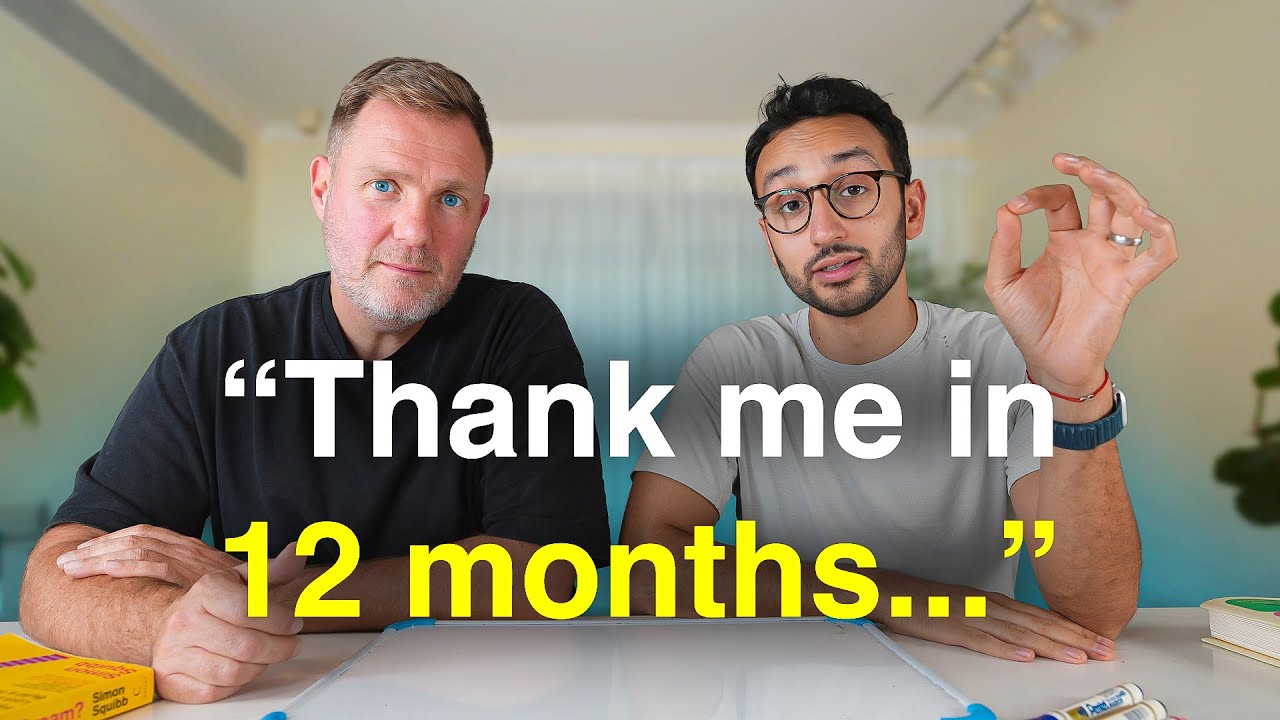
📺 Today’s recommended deep-dive video: https://www.youtube.com/watch?v=_of876Yi6V4
From Stethoscope to Startup: Ali Abdaal’s 8-Step Blueprint for Freedom
Many professionals feel trapped in careers that drain their energy, trading their best years for a paycheck while losing sight of their personal autonomy. Ali Abdaal reveals the exact tactical framework he utilized to transition from a full-time medical doctor to a multi-millionaire entrepreneur. This blueprint provides a structured path for anyone looking to escape the 9-to-5 grind and build a business centered on freedom, fun, and fulfillment.
Core Question: How can a structured eight-step framework bridge the gap between a traditional career and a high-revenue lifestyle business?
Highlights
- Identifying your “freedom number” to move from fight-or-flight into creative growth.
- The “Rule of 7” as a psychological tool to overcome the paralysis of starting.
- Why selling your product before you build it is the ultimate risk-mitigation strategy.
- Understanding that true freedom often requires deliberately leaving money on the table.
⏱️ Reading time: approx. 12 minutes · Saves you about 45 minutes vs. watching.
Want to take notes while watching? Click the image below and let AI Notebook capture the key points for you 👇

The Foundation: Setting the Goal and Choosing Your Stream
Defining Your Freedom Number
Most people start businesses because they want to be millionaires, but Ali suggests a much more grounded starting point. For him, the goal was £3,000 a month in passive income, a specific figure that would allow him to cut his medical hours down to three days a week. This number is your “freedom number,” and it acts as the pull factor that sustains discipline when the initial excitement of entrepreneurship inevitably wanes.
Financial freedom is rarely about the money itself; it is simply the currency used to buy back your time and control your own destiny.
When you are earning below your freedom number, your brain remains in a state of fight-or-flight, focused entirely on survival and bill-paying. Once that baseline is covered, you gain the cognitive bandwidth to pursue the “three Fs”: Fun, Fulfillment, and Freedom. This transition is crucial because money and time are only valuable when they are eventually cashed in for experiences or contributions that you actually care about.
Navigating the Three Streams
Ali describes three distinct paths to freedom: the Career Stream, the Side Hustle Stream, and the Entrepreneur Stream. The career path is stable but slow, requiring decades of compounding to reach independence. In contrast, the entrepreneur stream is like navigating high-risk rapids; it is significantly faster but demands total responsibility for the “ship” you are captaining.
Most people fail because they try to jump into the rapids without building a sturdy boat first.

💡 Digging Deeper
Q: Is entrepreneurship inherently riskier than a career?
A: Not necessarily. In a career, you are a crew member on someone else’s ship; they can let you go at any time, and you own zero equity. Entrepreneurship allows you to own the ship, providing more long-term security through asset ownership.
Q: How do I choose between a lifestyle business and a high-growth startup?
A: It depends on your values. A lifestyle business focuses on profit and personal time, while a high-growth startup often sacrifices freedom for years in hopes of a massive future payout.
The Execution: Mastering Time and Starting Small
The Rule of Seven and the Illusion of Certainty
The education system creates an “illusion of certainty” where we expect clear rubrics for success, but business offers no such guarantees. To combat the fear of the unknown, Ali suggests the “Rule of Seven” instead of more daunting challenges. Simply commit to doing the thing seven times—whether it is seven videos, seven cold calls, or seven newsletters—to break the seal of perfectionism and begin the habit loop.
Perfectionism is just a high-end form of procrastination that prevents you from ever reaching the feedback stage of growth.
Intentional Time Management
The most common excuse for not starting a business is a perceived lack of time, but Ali reframes this as a lack of intention. If you don’t have time blocked in a calendar for your side hustle, you are actively choosing to prioritize other things over your freedom. Professionals use calendars for their 9-to-5 because it creates accountability; you must apply that same rigor to your own dreams if you expect them to manifest.
You do not “find” time for a business; you must aggressively cordon it off from the rest of your life.

💡 Digging Deeper
Q: How do I stay consistent when I don’t feel motivated?
A: Lower the bar for what counts as a win. If you can’t film a full video, just film one stretch or write one headline so you don’t break the streak.
Q: Why is community important for consistency?
A: You become the average of the voices you listen to most. Surrounding yourself with other creators—even via podcasts—provides the mental scaffolding needed to keep going.
The Professional Pivot: Monetization and Scaling
Selling Before Building
A fatal mistake for many new entrepreneurs is spending months building a product that no one actually wants to buy. Ali advocates for a “Waitlist to Pre-sale” pipeline to validate demand before investing significant resources. By asking people to put their credit card details down for a product that hasn’t been finished yet, you receive the ultimate form of market feedback.
If people aren’t willing to pay for the idea, they certainly won’t pay for the finished product.
Shifting from B2C to B2B
There is a profound psychological difference between selling to consumers and selling to businesses. Consumers view a $2,000 price tag as a massive personal expense, whereas for a business, that same $2,000 is a tax-deductible investment that might save them $20,000 in time or labor. Shifting your focus to serving businesses (B2B) allows you to charge professional rates that reach your freedom number much faster.

💡 Digging Deeper
Q: When should I consider scaling my business?
A: Scaling is necessary when you want to move from being an “operator” to an “owner.” This usually happens when you have enough revenue to hire middle management.
Q: Why would someone “leave money on the table”?
A: At a certain level of success, making more money requires sacrificing more time. If you value your freedom more than an extra million in profit, you stop scaling and start living.
Key Takeaways
Building a business is less about a “lightbulb moment” and more about the discipline of consistent, intentional action. Ali Abdaal’s journey proves that the transition from a traditional career to entrepreneurship is a skill that can be learned, provided you are willing to embrace uncertainty. By setting a clear “freedom number,” you move out of survival mode and into a space where you can design a life based on your own values rather than someone else’s corporate goals.
The ultimate goal of this blueprint is to achieve a “lifestyle business” where the work serves you, not the other way around. This involves a shift in mindset: seeing time management as a professional obligation to yourself and viewing monetization as a process of validation rather than just sales. Whether you stay small and profitable or scale into a large organization, the power lies in the choice—and that choice is only possible once you own the equity in your own work.
Q&A
Q1: What is the very first step I should take if I feel stuck?
A: Set your “freedom number.” Calculate exactly how much money you need per month to cover your basic expenses so you can see the minimum threshold required to quit or go part-time.
Q2: I have no business ideas; what should I do?
A: Stop waiting for a perfect idea and start the “Rule of Seven.” Choose a medium—like YouTube or a service like gardening—and do it seven times. The ideas usually come during the process, not before it.
Q3: How do I manage a side hustle while working a 60-hour week?
A: Use a calendar to set an “intention” for your remaining hours. Even four hours a week, if consistently cordoned off and protected from social distractions, is enough to build significant momentum over a year.
Q4: Is it better to sell to individuals or companies?
A: If you want to reach your financial goals faster, sell to businesses. They have larger budgets and view your service as an investment toward their own growth or efficiency, making higher price points easier to justify.
Q5: Why should I pre-sell my product?
A: Pre-selling validates that there is real market demand. It prevents you from wasting months of your life building something that nobody is actually willing to pay for.
Q6: Does scaling a business always make it harder to manage?
A: Not necessarily. While the middle ground (15-30 people) can be painful, a larger business with professional management can actually be easier for the owner than a tiny one where they have to do everything themselves.
Q7: How do I handle the fear of being “uncertain”?
A: Recognize that the certainty of a 9-to-5 is often an illusion. You are more secure when you own the assets and skills required to generate your own income than when you rely on a single employer.