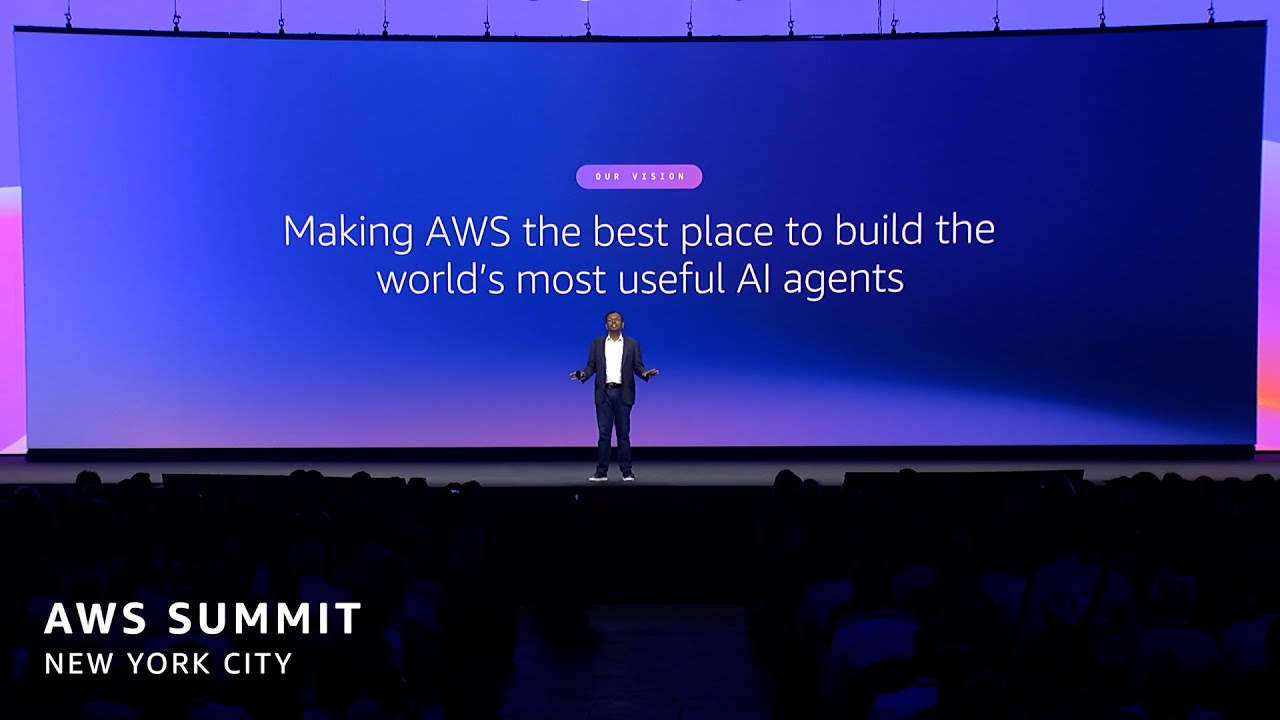
📺 Today’s recommended deep-dive video: https://www.youtube.com/watch?v=2890bEb61qQ
The Agentic Shift: Building the Future of Autonomous Software on AWS
Software is evolving from static, hand-coded logic to dynamic reasoning systems that can plan, reflect, and act on a user’s behalf. AWS is bridging the gap between experimental AI and scalable production with a massive suite of new tools designed to orchestrate complex, multi-step tasks across enterprise ecosystems.
Core Question: How is AWS enabling the transition from simple generative AI to fully autonomous agents through specialized models, infrastructure, and developer tools?
Highlights
- Launch of Amazon Bedrock AgentCore, a modular suite of seven services for secure, at-scale agent deployment.
- Introduction of Amazon Nova Act, a frontier model designed specifically for autonomous web browser navigation and task execution.
- Amazon S3 Vectors, providing a 90% cost reduction for long-term storage and retrieval of massive vector datasets.
- AWS Transform, an agentic solution that modernizes legacy codebases up to 80 times faster than manual processes.
⏱️ Reading time: approx. 9 minutes · Saves you about 73 minutes vs. watching.
Want to take notes while watching? Click the image below and let AI Notebook capture the key points for you 👇

The New Paradigm: Reasoning as a Programmable Resource
Beyond Codified Logic
For decades, software development was the art of explicitly wiring every logic gate and instruction. If the environment changed or an edge case appeared that wasn’t in the code, the application broke. Generative AI changed the input, but agentic AI is fundamentally changing the execution engine.
Agents aren’t just chatbots; they are autonomous systems that decompose high-level objectives into executable plans.
This transition represents a move toward “service as software.” Instead of users clicking through static menus, agents interact with tools, APIs, and data sources dynamically at runtime to achieve a desired outcome. This requires a model that doesn’t just predict the next word, but predicts the next best action.
Amazon Nova and Browser Automation
At the heart of this shift is the Amazon Nova family of models. While Nova Premier handles complex multimodal reasoning, Nova Act is specifically engineered to bridge the gap between AI and existing digital interfaces. It performs actions in web browsers—clicking, scrolling, and filling forms—just as a human would, making it resilient to website layout changes that traditionally break API-based automation.

💡 Digging Deeper
Q: Why is “self-reflection” critical for agents?
A: Unlike a linear script, agents evaluate their own intermediate outputs. If an action fails or a data source returns an error, the agent can pivot its strategy in real-time to try a different path toward the goal.
Q: What makes Nova Act different from standard robotic process automation (RPA)?
A: RPA relies on brittle, predefined scripts. Nova Act uses visual and semantic understanding to navigate websites dynamically, meaning it can handle a redesigned UI without needing a developer to rewrite the code.
Q: How does AWS handle the “80% accuracy” problem in models?
A: Reaching the 90%+ accuracy required for business-critical tasks involves SageMaker AI’s new customization recipes, including supervised fine-tuning and direct preference optimization (DPO) to align models with specific domain knowledge.
Bridging the Gap: Moving Agents from POC to Production
Introducing Bedrock AgentCore
Most AI agents today live on developer laptops because the infrastructure to scale them safely hasn’t existed. Security, session isolation, and long-term memory are massive hurdles. Amazon Bedrock AgentCore solves this by providing a serverless runtime specifically built for dynamic, long-running agentic workloads.
It is the industry’s first runtime to provide complete session isolation at the compute level.
This ensures that data from one user interaction never leaks into another, even when agents are generating and executing code in real-time. AgentCore includes seven distinct modules, including an Identity service for granular access control and a Gateway for discovering and connecting to tools like Salesforce, Jira, or Slack via the Model Context Protocol (MCP).
Memory and Contextual Intelligence
Standard LLMs suffer from “goldfish memory,” losing context as soon as a session ends. AgentCore Memory mimics the human brain by maintaining both short-term, granular logs and long-term, high-level conceptual maps. This allows an agent to remember a user’s preferences and past decisions across weeks or months without ballooning costs or latency.

💡 Digging Deeper
Q: How long can an agentic workload run in the AgentCore Runtime?
A: It supports workloads running up to eight hours, which is currently the longest in the industry, enabling complex research or data processing tasks.
Q: What is the benefit of the AgentCore Gateway?
A: It allows developers to turn any Lambda function or API into an MCP-compatible tool with a few lines of code, enabling agents to perform semantic searches to find the right tool for a specific task.
The Data Foundation: S3 Vectors and Marketplaces
Redefining Vector Economics
As organizations build knowledgeable agents, their vector embeddings grow from millions to billions. Traditional vector databases are optimized for high-frequency “hot” data, making them prohibitively expensive for storing years of historical context. Amazon S3 Vectors changes the economics by allowing sub-second query performance directly on top of S3 object storage.
This lowers the cost of long-term vector storage by up to 90%.
By integrating S3 Vectors with Amazon OpenSearch, companies can create a tiered data strategy. High-frequency queries stay in OpenSearch for low latency, while the massive “iceberg” of historical agent memory sits in S3, ready for batch processing or non-real-time retrieval.
Specialized Expertise in the Marketplace
No company can build every specialized agent from scratch. The AWS Marketplace now features a dedicated catalog for AI agents and tools. This allows businesses to procure pre-built agents for specific functions—like legal research or tax compliance—and deploy them instantly using AgentCore infrastructure.
💡 Digging Deeper
Q: How does S3 Vectors improve RAG (Retrieval-Augmented Generation)?
A: It allows Bedrock Knowledge Bases to access much larger datasets without the infrastructure overhead of managing a dedicated database cluster, scaling automatically with the data.
Q: What protocols ensure these marketplace agents work together?
A: AWS is leaning into the Model Context Protocol (MCP) and Agent-to-Agent (A2A) standards to ensure interoperability between different vendors and frameworks.
Transforming the Developer Experience
Agentic IDEs and Modernization
The developer interface is shifting from a text editor to a collaborative partner. Kiro, a new agentic IDE, allows developers to generate entire software specifications from natural language. It doesn’t just write code; it manages dependencies, updates documentation automatically via “hooks,” and ensures that the generated code follows strict software engineering practices.
For legacy systems, the burden of technical debt is being lifted by AWS Transform.
This agent automates the “undifferentiated heavy lifting” of migration. It can refactor .NET applications from Windows to Linux, convert VMware network configurations into AWS constructs, and even modernize decades-old mainframe code. Thomson Reuters reported a four-fold improvement in migration speed using these tools, modernizing 1.5 million lines of code per month.

💡 Digging Deeper
Q: Does Kiro replace the human developer?
A: No. It acts as a “coding buddy” that handles the boilerplate and documentation, allowing the developer to focus on high-level architecture and creative problem-solving.
Q: How much can companies save by using Transform for .NET?
A: Beyond the speed of migration, moving to Linux can cut Windows licensing costs by up to 40%.
Key Takeaways
The shift toward agentic AI represents a tectonic change in how software is built, deployed, and operated. By moving beyond simple prompt-response interactions, agents can now execute multi-step workflows with a level of autonomy that was previously impossible. AWS is positioning itself as the core infrastructure for this era, providing the “muck-free” environment developers need to focus on business logic rather than scaling runtimes or managing complex vector stores.
Success in this new era requires a focus on reliability and security. Tools like AgentCore provide the necessary guardrails—session isolation, granular identity management, and deep observability—to move AI from interesting experiments to production-grade services. Organizations that embrace these autonomous systems, particularly for undifferentiated tasks like code modernization and browser-based data entry, will see massive gains in operational velocity.
Ultimately, the future of AI is not about a single “god model” but a collaborative ecosystem of specialized agents, interoperable protocols, and cost-effective data foundations. Whether through the 90% cost savings of S3 Vectors or the 80x speedup of AWS Transform, the goal is to make the complex incredibly simple for the builder.
Q&A
Q1: What are the three core areas where agentic software differs from traditional apps?
A1: Agents excel at decomposition (breaking high-level goals into plans), self-reflection (evaluating and correcting their own steps), and tool use (autonomously calling APIs or browsers).
Q2: What is the “Strands Agents SDK”?
A2: It is an open-source framework released by AWS that simplifies building multi-agent systems. It is provider-agnostic and supports native integration with AWS services and MCP.
Q3: How does Intuit use agentic AI?
A3: Intuit built “GenOS,” an operating system that runs multiple agents simultaneously—finance, accounting, and payment agents—to automate workflows like estimate generation and credit applications for small businesses.
Q4: What is the significance of the $100M investment in the Gen AI Innovation Center?
A4: AWS is doubling down on professional services to help customers bridge the expertise gap and move their specific business use cases from prototype to production.
Q5: How does the AgentCore Browser Tool handle security?
A5: It provides VM-level isolation and federated identity integration, ensuring that when an agent handles sensitive tasks or secrets in a browser, the session is completely secure and isolated from other workloads.
Q6: What is the AWS AI League?
A6: It is a gamified learning platform, similar to DeepRacer, where developers can compete in prompt engineering and model customization challenges to win prizes and learn agentic AI skills.
Q7: Can I use AgentCore with models not hosted on AWS?
A7: Yes, AgentCore is designed to be framework and model-agnostic, allowing you to secure and scale agents regardless of which foundational model or open-source framework (like CrewAI or LangGraph) you choose.