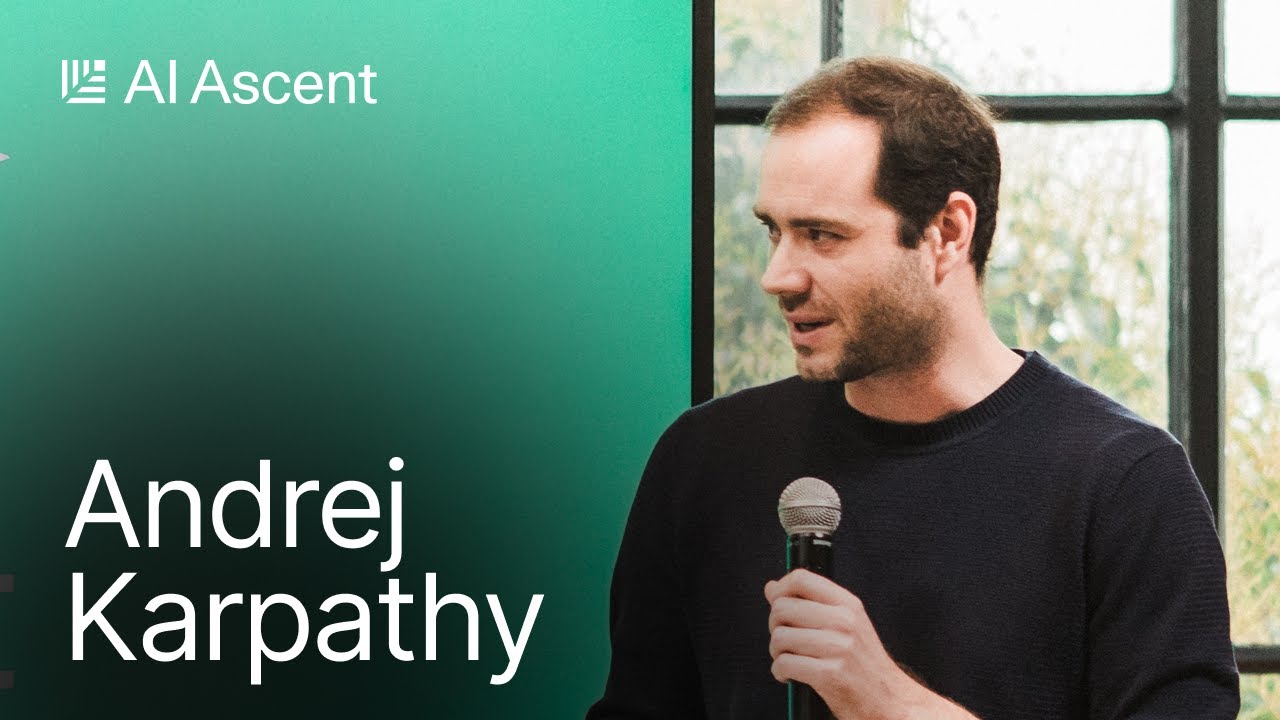
📺 Today’s recommended deep-dive video: https://www.youtube.com/watch?v=c3b-JASoPi0
The LLM OS: Andre Karpathy on the Future of AGI and AI Architecture
From co-founding OpenAI to leading Tesla’s Autopilot team, Andre Karpathy has been at the epicenter of the deep learning revolution. Now operating as an independent builder, he shares his mental model for the next decade of AGI, the “LLM OS,” and the massive efficiency gaps that still exist in modern silicon.
Core Question: How will the shift toward an “LLM Operating System” and true reinforcement learning redefine the boundaries of artificial intelligence?
Highlights
- The emergence of the “LLM OS” where the Transformer acts as a CPU managing text, image, and audio peripherals.
- The critical distinction between “open weights” and true “open source” in the model ecosystem.
- A “factor of a million” efficiency gap between the human brain (20W) and current GPU-heavy supercomputers.
- Why current AI models are only at “Step 1” of the AlphaGo journey, lacking true self-correcting reinforcement learning.
⏱️ Reading time: approx. 8 minutes · Saves you about 29 minutes vs. watching.
Want to take notes while watching? Click the image below and let AI Notebook capture the key points for you 👇

The Emergence of the LLM Operating System
From Academic Concept to Optimization Problem
A few years ago, Artificial General Intelligence (AGI) felt like a distant academic pursuit, characterized by fragmented approaches and uncertain timelines. Today, the path has clarified into a massive optimization problem that the entire industry is racing to solve simultaneously.
We are witnessing the birth of what I call the “LLM OS.”
In this framework, the Large Language Model—specifically the Transformer—acts as the central CPU. It isn’t just a text generator; it is a processor that coordinates a suite of peripherals including text, images, audio, and legacy Software 1.0 infrastructure. This system allows for the deployment of self-contained agents capable of handling high-level tasks across every niche of the economy.

💡 Digging Deeper
Q: How does the LLM OS handle legacy software?
A: It treats existing software as tools to be called, similar to how a traditional OS manages disk access or network protocols.
Q: Is this OS model proprietary?
A: Companies like OpenAI are building the “Windows” version with default apps, but there is space for a vibrant ecosystem of specialized “third-party” agents.
Scale, Efficiency, and the Silicon Gap
The Brutal Reality of Large-Scale Training
Scale remains the primary determining factor in model capability, acting as a functional “speed limit” for what AI can achieve. However, having the capital to buy 10,000 GPUs does not guarantee a working model; the talent required to manage distributed optimization on “creaking” infrastructure is still vanishingly scarce.
Infrastructure is the bottleneck.
Current training runs are plagued by GPUs failing at random and distributed systems struggling under the weight of massive workloads. We are essentially trying to build a cathedral while the ground is constantly shifting beneath the construction equipment.
We are also facing a staggering energy crisis in computation. The human brain operates on roughly 20 watts of power, while the latest supercomputers require megawatts to perform similar reasoning tasks. We are likely off by a factor of a thousand to a million in terms of energetic efficiency.

💡 Digging Deeper
Q: Why is the brain so much more efficient than a GPU?
A: Our silicon follows the Von Neumann architecture, which wastes immense energy moving data between memory and processors—a problem biological brains don’t have.
Q: Will precision reduction help?
A: Yes, moving from 64-bit to 1.58-bit or 4-bit precision is a major lever for efficiency, along with sparsity (not activating the whole “brain” for every task).
Management Lessons from the Frontier
The Elon Musk Philosophy of Building
Working at Tesla provided a front-row seat to an extremely unique management style that prioritizes technical depth over organizational growth. Elon Musk acts as a “force against growth,” requiring leaders to plead for new hires rather than rewarding headcount expansion.
He fires the steerers to save the rowers.
The goal is to maintain a small, high-intensity team where the engineers are the absolute source of truth. In this culture, middle management is viewed as a potential bottleneck. Musk will often skip five levels of hierarchy to talk directly to an engineer because the code, not the status report, is the reality.

💡 Digging Deeper
Q: How does Musk handle technical blockers?
A: He applies a “large hammer,” such as calling the CEO of a supplier (like NVIDIA) directly to remove procurement delays for his engineers.
Q: Should startups copy this?
A: Only if it’s in the founder’s DNA; consistency from day one is more important than the specific management model used.
Beyond Imitation: The Missing AlphaGo Step
The Limits of Imitation Learning
Most current LLMs are essentially stuck in “Step 1” of the AlphaGo journey: imitation learning. They are trained to mimic human-written text, but human psychology is a poor fit for model psychology. What a human finds “easy” to explain might be a massive logical leap for a Transformer, leading to “polluted” reasoning traces.
We haven’t reached the “AlphaGo Zero” stage yet.
True reinforcement learning (RL) requires the model to practice against an objective function, discovering its own internal “psychology” and logical shortcuts. Current RLHF (Reinforcement Learning from Human Feedback) is more of a “vibe check” than actual RL; it is a weak form of optimization that is easily overfitted and lacks a clear, mathematical objective.

💡 Digging Deeper
Q: What is the biggest algorithmic challenge today?
A: Unifying diffusion models (used in images) with autoregressive models (used in text) into a single, cohesive architecture.
Q: Can LLMs learn like students?
A: Ideally, yes. They need the equivalent of “graduate school”—quietly questioning themselves and solving textbook exercises rather than just reading left-to-right.
Key Takeaways
The transition from LLMs as chatbots to LLMs as the “kernel” of a new operating system is the defining shift of the current era. While scale is the “first principal component” of progress, the industry is still struggling with the fundamental physics of computation. Our current hardware is a “broken” fit for these workloads, and we are only beginning to bridge the gap between biological efficiency and silicon power.
Furthermore, the “imitation” phase of AI development is reaching its local maximum. The next great leap will likely come from models that can “think” through problems via true reinforcement learning, moving beyond simply mimicking human labels to discovering superhuman reasoning paths. As this happens, the distinction between proprietary “closed” models and “open weights” models will become a central tension in the ecosystem.
Q&A
Q1: Would you recommend founders follow Elon Musk’s management style?
A: It depends on the founder’s DNA. You have to be consistent from the start. People are happy to go along with high intensity if they sign up for it, but changing the culture mid-stream is messy and usually fails.
Q2: Do you think we need to throw out the Transformer architecture for AGI?
A: The Transformer has been remarkably resilient, but I don’t believe it’s the “final” neural network. We will likely see significant changes as we better align algorithms with hardware constraints like sparsity and low-precision compute.
Q3: What is the difference between “open weights” and “open source” in AI?
A: It’s a subtle but vital distinction. If you only have the weights (the binary), you can’t fully fine-tune the model without regressing its other capabilities. You need the original training loop and the data distribution to truly build upon the “operating system.”
Q4: How should builders approach cost vs. performance?
A: Always go after accuracy and performance first. Use the most expensive model (like GPT-4) to get the thing to work. Once you have a high-performing flow, you can distill that knowledge into smaller, cheaper models.
Q5: What keeps you up at night regarding AI research?
A: The gap in energetic efficiency. We are using megawatts to do what a 20-watt brain does. Also, the split between diffusion and autoregressive models feels “wrong”—there should be a unified architecture that handles both elegantly.
Q6: Can we build a model that understands physics as well as a human genius?
A: Yes, but it requires the model to “practice” and solve problems itself. Current models just read about physics; they don’t yet have the internal “psychology” to verify their own mental models of the world.
Q7: What gives you the most meaning in your work right now?
A: I care about the health of the ecosystem. I want to see a “coral reef” of cool startups in every nook and cranny of the economy, rather than just five mega-corporations dominating everything through AGI.