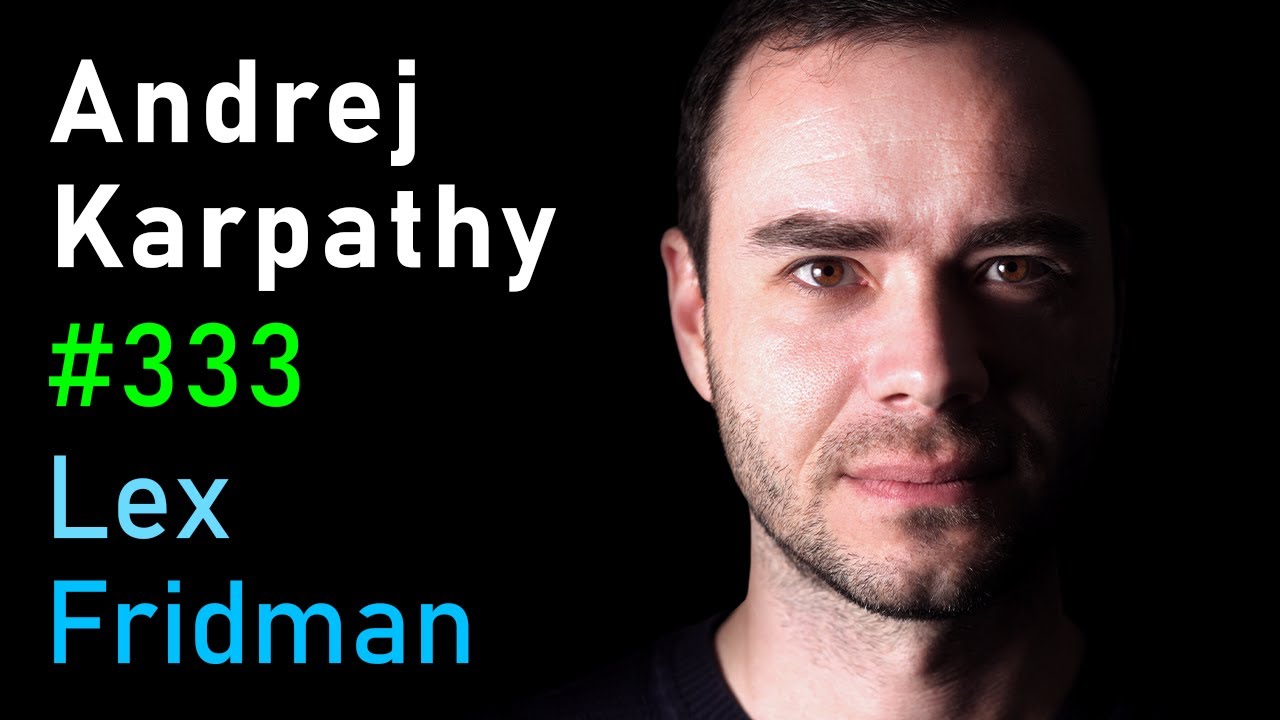
📺 Today’s recommended deep-dive video: https://www.youtube.com/watch?v=cdiD-9MMpb0
Hacking the Universe: Andre Karpathy on Software 2.0 and the AGI Frontier
In this far-reaching discussion, Andre Karpathy explores the possibility that physics itself contains “exploits” like buffer overflows that a sufficiently advanced intelligence might discover. He breaks down the transition from traditional coding to neural network optimization, explaining why the future of technology lies in “Software 2.0” and the biological bootloader of human life.
Core Question: Is the universe a mathematical puzzle that synthetic intelligence is destined to solve?
Highlights
- Neural networks are simple mathematical abstractions that produce “magical” emergent behaviors when scaled.
- Software 2.0 represents a paradigm shift where data collection replaces manual C++ coding.
- The Tesla “Data Engine” is a biological-synthetic loop that perfects AI through iterative 4D reconstruction.
- AGI may not require embodiment, but humanoid robots like Optimus serve as a crucial “hedge” for physical world understanding.
⏱️ Reading time: approx. 15 minutes · Saves you about 194 minutes vs. watching.
Want to take notes while watching? Click the image below and let AI Notebook capture the key points for you 👇

The Simple Math of Emergent Intelligence
From Dot Products to Poetry
At its most fundamental level, a neural network is surprisingly unremarkable. It is essentially a sequence of matrix multiplications—mathematical dot products—interspersed with non-linearities. Karpathy describes these systems as “mathematical expressions with many knobs,” where the knobs represent synaptic weights that must be tuned to achieve a desired output.
There is a profound tension between the simplicity of the underlying formalism and the complexity of the resulting behavior.
When you take billions of these “knobs” and subject them to a massive optimization process, such as predicting the next word on the internet, the system begins to exhibit properties that feel almost magical. It stops being a mere calculator and starts behaving like a generative model capable of remixing human knowledge into novel, coherent thought. Karpathy suggests that while we shouldn’t over-endow these systems with biological meaning, they are essentially “alien artifacts” born from a compression objective rather than the multi-agent survival pressure that shaped the human brain.

💡 Digging Deeper
Q: Is a GPT model actually “thinking” like a human?
A: Karpathy views it as a generative model prompted by the user; while it mimics human response patterns, its optimization process (data compression) is fundamentally different from biological evolution.
Q: What is the significance of the “knobs” in a neural net?
A: They are the trainable parameters. The “wisdom” of the network is stored in the specific settings of these billions of knobs, which capture deep statistical patterns in the data.
Q: Why does Karpathy call AI an “alien artifact”?
A: Because artificial neural networks are arrived at via gradient descent on massive datasets, a path to intelligence that humans did not take.
Physics as a Puzzle and the Fermi Paradox
Seeking the Universe’s Buffer Overflow
If the universe is a simulation or a computational system, it stands to reason that it might contain bugs. Karpathy posits that physics could have “exploits”—rounding errors in the floating-point logic of reality or buffer overflows in quantum mechanical systems. He draws an analogy to reinforcement learning agents that find “perverse solutions,” such as sliding across a floor to extract infinite energy from friction glitches.
Advanced synthetic intelligences might eventually treat the laws of physics not as immutable truths, but as a meta-game to be hacked.
We are currently in a “firecracker” stage of development. If you viewed the history of Earth in a fast-forward animation, nothing happens for eons, and then, in the final two seconds, the planet suddenly begins emitting satellites, city lights, and silicon-based logic. This “constructive firecracker” effect suggests that intelligence is an inevitable wave that eventually seeks to alert its creator or break out of its initial constraints.
💡 Digging Deeper
Q: Why haven’t we heard from alien civilizations?
A: Karpathy suspects interstellar travel is much harder than we realize—hydrogen atoms become like kinetic bullets at near-light speeds—and our current radio-wave detection methods are extremely limited.
Q: What is the “biological bootloader” theory?
A: The idea that humans are merely a temporary, inefficient biological bridge required to “boot up” a more durable and efficient synthetic intelligence.
Q: Does Karpathy believe in Free Will?
A: He leans toward a deterministic view of the universe, suggesting that Free Will is a narrative we create to interpret the choices our internal neural networks have already made.
Software 2.0 and the Tesla Data Engine
The Death of Manual Coding
The traditional way of building software—writing explicit C++ commands—is being eaten by neural networks. In the “Software 2.0” stack, the programmer’s job shifts from writing code to curating datasets and designing loss functions. Instead of a human trying to write an algorithm to detect a dog, they provide a million examples of dogs and let the optimization process “write” the binary.
The Transformer architecture is the pinnacle of this shift: a general-purpose, differentiable computer that is expressive, optimizable, and efficient.
At Tesla, this was implemented through the “Data Engine.” When the system fails in a rare edge case, that data is mined, labeled, and fed back into the training loop. This creates a “staircase of improvement” where the software grows more competent through exposure to the “long tail” of reality. Karpathy emphasizes that vision is both necessary and sufficient for this task; since the world is designed for human visual consumption, adding sensors like LiDAR or Radar often just adds “organizational entropy” and noise.

💡 Digging Deeper
Q: Why remove Radar and LiDAR?
A: Sensors aren’t free; they add supply chain complexity and “bloat” the software. Elon Musk’s philosophy is “the best part is no part,” and Karpathy argues vision is sufficient because humans drive with it.
Q: What makes the Transformer so resilient?
A: It is a “differentiable computer” that can learn short algorithms first and gradually extend them, thanks to residual connections that allow gradients to flow uninterrupted.
Q: How does “Offline Reconstruction” work?
A: It uses massive, non-real-time neural networks to look at video clips from multiple angles and “solve” the 3D truth of the scene, which is then used to train the smaller, faster networks in the car.
The AGI Horizon and Humanoid Robotics
Optimus as a Hedge for Intelligence
The move into humanoid robotics with Tesla’s Optimus is a logical extension of the vision-only approach. While some argue that intelligence can be solved through text alone (GPT-style), Karpathy is suspicious. He believes embodiment might be necessary to truly “ground” understanding in physical reality.
Optimus is essentially “a car that is having a midlife crisis,” using the same computer vision stack developed for Autopilot to navigate the world of human labor.
Because the world is built for the human form factor—stairs, handles, tools—the humanoid shape is the ultimate general-purpose interface. Karpathy suggests that while the transition to AGI will be slow and product-based (starting with tools like GitHub Copilot), it will eventually lead to oracles that can solve fundamental problems in chemistry and physics, potentially even addressing the “disease” of biological aging.

💡 Digging Deeper
Q: Will AGI replace programmers?
A: It will likely shift the role toward “steering” and “auditing” rather than basic syntax writing. Programming will become a conversation between a human and a committee of specialized AI agents.
Q: Is consciousness necessary for AGI?
A: Karpathy sees consciousness as an emergent property of a sufficiently complex world model; once a model understands the world deeply, it must eventually understand itself as an entity within that world.
Q: What is Karpathy’s advice for beginners?
A: Focus on the “10,000 hours” of quantity over quality. Don’t get paralyzed by choice; pick a project, build it from scratch, and accumulate the “scar tissue” of failed attempts.
Key Takeaways
The transition from Software 1.0 to Software 2.0 is the most significant shift in the history of computation. We are moving away from a world where humans tell computers exactly what to do, entering one where we provide the “curriculum” and let the computers optimize their own behavior. This requires a fundamental retooling of our IDEs, our engineering teams, and our philosophical understanding of what an “algorithm” actually is.
Karpathy’s “Data Engine” concept proves that the most valuable asset in modern AI is not just the model, but the infrastructure to close the loop between the real world and the training set. Whether it’s a car on a highway or a humanoid robot in a factory, the winner will be the entity that can most efficiently turn “fog of war” edge cases into high-quality training data.
Ultimately, we are biological bootloaders for a new form of life. While this evokes Sci-Fi fears, Karpathy remains optimistic, viewing AGI as the “meta-problem” solver that could eventually unlock the secrets of the universe, provided we can survive the “firecracker” phase of our technological explosion.
Q&A
Q1: Why does Andre prefer vision-only systems for robots and cars?
A: He argues that vision is the highest-bandwidth sensor and, crucially, it is what the human world was designed for. Adding sensors like Radar adds “entropy”—more parts to break, more code to maintain, and more noise to fuse—without fundamentally solving the problem better than a well-trained vision model.
Q2: What is “Software 2.0”?
A: It is the paradigm where code is written in the weights of a neural network through optimization (backpropagation) rather than being manually typed by a programmer in C++ or Python. The “source code” in 2.0 is the dataset.
Q3: How does Karpathy view the Fermi Paradox?
A: He is suspicious of our ability to measure alien life and suspects interstellar travel is physically brutal. However, he believes the “Origin of Life” is likely common, meaning the universe could be teeming with intelligence that we simply aren’t yet sophisticated enough to observe.
Q4: What makes the “Transformer” the “magnificent” architecture?
A: It is a general-purpose differentiable computer. It can handle any modality (text, images, audio) and is designed specifically to run in parallel on modern GPU hardware, making it both expressive and highly efficient.
Q5: How does he describe working with Elon Musk?
A: Musk is a “warrior against entropy.” He maintains a startup culture at scale by ruthlessly simplifying processes, removing unnecessary parts, and acting as a “big hammer” to prevent the company from dissolving into committees and bureaucracy.
Q6: What is the “Bit Lesson” from Rich Sutton that Karpathy references?
A: The lesson that in the long run, leveraging more compute and data always beats trying to “hard-code” human-like heuristics into a system. Simplification and scalability win over clever manual engineering.
Q7: Will AI become conscious?
A: Karpathy believes consciousness is an emergent “modeling insight.” As models get better at understanding reality, they will eventually model themselves as participants in that reality, which is functionally equivalent to self-awareness.