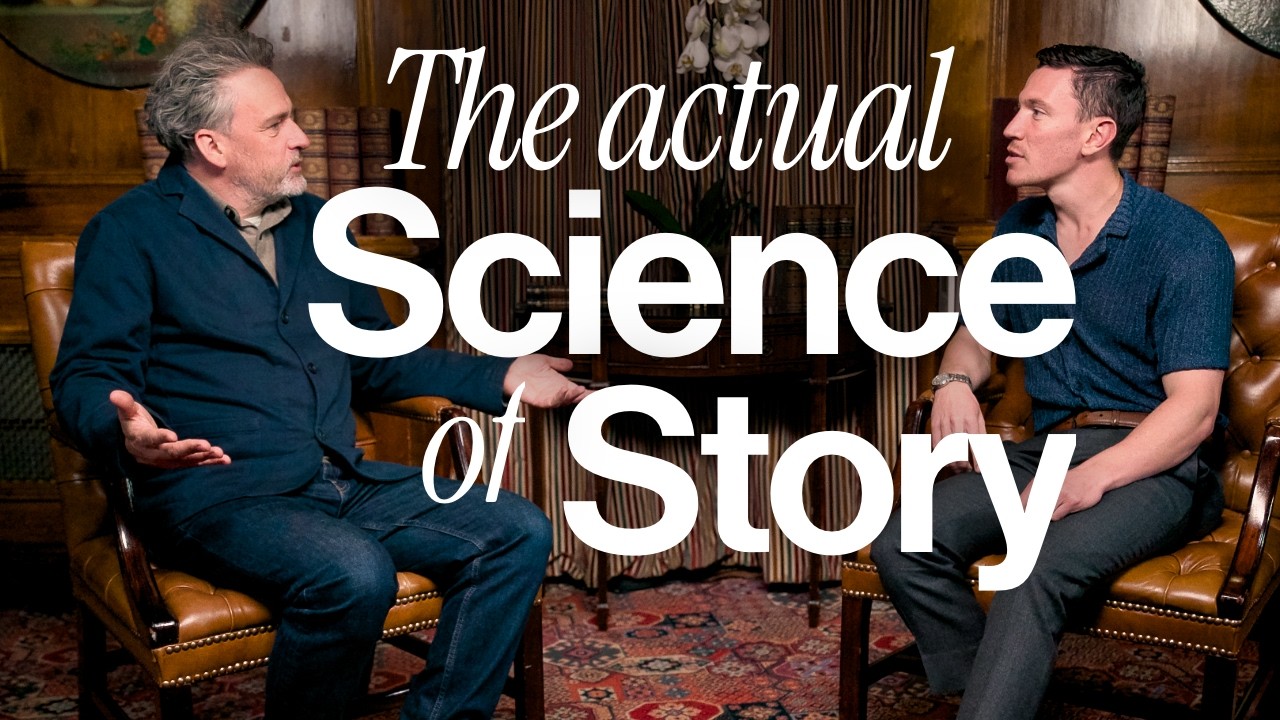
📺 Today’s recommended deep-dive video: https://www.youtube.com/watch?v=kDrsYMW_EYg
The Biology of Narrative: Why Character Change Trumps Plot
While most writing advice focuses on the “Hero’s Journey” or mechanical plot points, Will Storr argues that great stories are actually built from the inside out. By treating storytelling as a science of the human brain, we can unlock why certain characters resonate across centuries while others feel like hollow caricatures.
Core Question: How does the human brain’s evolutionary need for control and social status dictate the structure of a successful story?
Highlights
- The “Theory of Control” is the internal engine that drives every memorable character.
- Stories are not just about events; they are symphonies of internal change and transformation.
- All human narratives revolve around three primal drives: Survival, Connection, and Status.
- Plotting is an engineering task that requires understanding causality rather than relying on random “artistic” sparks.
⏱️ Reading time: approx. 8 minutes · Saves you about 60 minutes vs. watching.
Want to take notes while watching? Click the image below and let AI Notebook capture the key points for you 👇

The Theory of Control
The Internal Engine of Character
Storytelling is our superpower for simplifying an incredibly complex and chaotic reality into a linear, manageable experience. Will Storr suggests that instead of starting with a sequence of events, writers should start with a “theory of control.” This is the specific mental model a character uses to navigate the world and stay safe, even if that model is fundamentally flawed or outdated.
Every person—and every great character—operates under a sentence like: “I am only safe if I [blank].”
For Ebenezer Scrooge, that sentence was “I am only safe if I keep all the money and love to myself.” This isn’t just a personality trait; it is his survival strategy. The story only truly begins when life presents a challenge that his hoarding cannot solve, forcing him to confront the damage his theory is causing to himself and those around him.

💡 Digging Deeper
Q: Is a character flaw always a moral failing?
A: Not necessarily. In Storr’s view, a “flaw” is simply a mistake about how the world works. It is a model of reality that is “wrong” rather than “evil.”
Q: Can a theory of control be positive?
A: It usually starts as a protective mechanism that feels positive to the character, but the story exists to show where that protection becomes a prison.
Q: Do you need to state the theory of control explicitly in the text?
A: No, but the writer must know it intimately so every action the character takes feels causal and authentic to their specific worldview.
The Five-Act Transformation
Mapping the Internal Journey
Storr proposes a five-act structure that prioritizes character evolution over external milestones. In Act One, we see the character’s flawed theory of control failing to meet their needs. By Act Three, they reach a transformation point where they embrace a new way of being, such as Sheriff Brody in Jaws finally getting on the boat despite his phobia of the ocean.
Plot is merely the series of obstacles designed to break a character’s old self.
Acts Four and Five are the most critical, as they test whether the character can handle the “pain of change.” Transformation is psychologically expensive because it requires abandoning a lifelong identity. A happy ending usually confirms the internal floor is fixed, while a tragedy shows the character doubling down on their flaw until it destroys them.

The Evolutionary Drivers
Survival, Connection, and Status
We are social apes that solve the problems of existence by forming highly cooperative groups. Because of this, the human brain is evolutionarily hardwired to prioritize three specific buckets: survival, connection, and status. Every story ever told—from ancient myths like Beowulf to modern hits like Succession—is essentially a manual on how to navigate these three primal needs.
If a story feels boring, it is likely because the stakes for the character’s survival, social connection, or status have not been clearly defined.
Status is perhaps the most misunderstood of the three, as it represents our perceived value to the group. We seek status because being valuable to the tribe ensures we won’t be ostracized, which was a death sentence for our ancestors. Consequently, stories about losing status or gaining it through struggle tap directly into our deepest subconscious anxieties and desires.

Key Takeaways
Great storytelling is an exercise in causality, not chaos. Because the human brain is designed to see causes and effects everywhere—even where they don’t exist—a writer must ensure that every event in a story is triggered by the preceding one. When a narrative lacks this “domino effect,” the reader’s brain has to work too hard to bridge the gaps, leading to disengagement and boredom.
The most profound stories often involve a battle between a character’s conscious goals and their unconscious “origin damage.” Writers should know the specific childhood or past trauma that created the character’s flawed theory of control, even if they never mention it on the page. This hidden depth ensures that the character’s reactions feel specific and human rather than generic.
Finally, the debate between “literary” spontaneity and “commercial” planning is a false dichotomy. Mastering the craft of plot and character structure does not dilute the art; it provides the engineering necessary for the art to stand up. Whether you are writing a blockbuster or a quiet character study, understanding the biology of how we process change is the key to gripping an audience.
Q&A
Q1: What is “origin damage”?
A1: It is the specific past event or environment that taught a character their flawed theory of control. Knowing this allows a writer to understand why a character reacts irrationally to certain triggers.
Q2: Why is causality so important in a plot?
A2: The human brain thinks in causes and effects. If a story is just a series of disconnected events (“this happened, then this happened”), the brain rejects it as “hard work” rather than an immersive experience.
Q3: How do survival, connection, and status help with personal mental health?
A3: Storr suggests that most personal distress comes from a threat to one of these three buckets. Identifying which bucket is “leaking” can help you diagnose and address the root cause of anxiety or depression.
Q4: What is the “threat of change” in suspense?
A4: Suspense isn’t just about big explosions; it’s about the anticipation of change. Hitchcock famously noted that terror lies in the lead-up to the bang, not the bang itself.
Q5: Should I outline my story or just start writing?
A5: Storr strongly advocates for planning. He believes the “blank page” approach often leads to agonizing rewrites and structural chaos that could be avoided by understanding character change acts in advance.
Q6: How does literary fiction differ from commercial storytelling in this model?
A6: Commercial stories often show a total character transformation (a “full arc”), whereas literary fiction tends to be more realistic, showing only a slight hint or possibility of change, reflecting how difficult it is for humans to truly rewire themselves.
Q7: Why do humans identify so strongly with groups?
A7: Evolutionarily, we are “collaborative super-organisms.” Stories help fuse individual brains into a single consciousness, allowing a group of people to think and act as one unit toward a common goal.