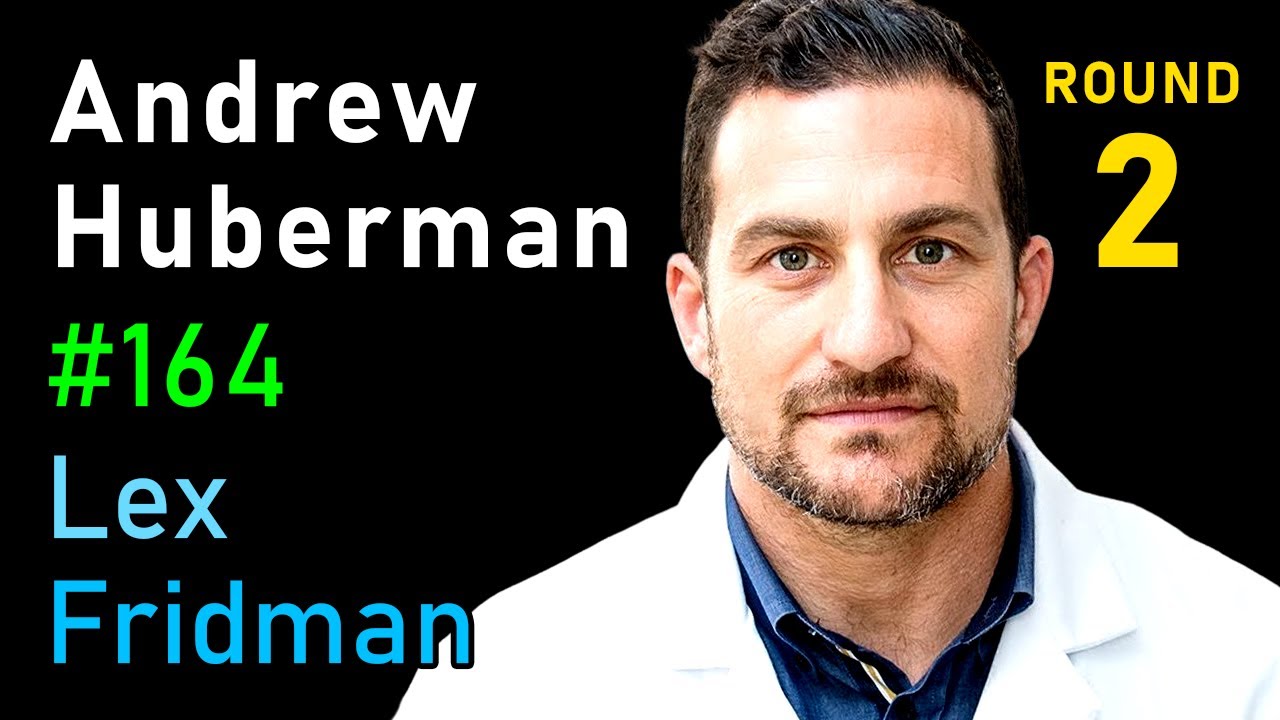
📺 Today’s recommended deep-dive video: https://www.youtube.com/watch?v=ClxRHJPz8aQ
The Biology of Performance: Sleep, Stress, and the Neural Architecture of Effort
In this deep-dive conversation, neuroscientist Andrew Huberman and Lex Fridman unpack the precise mechanisms governing human alertness and recovery. They explore why temperature—not just light—is the master conductor of our biological clocks and how we can strategically manipulate our neurochemistry to survive extreme physical and mental stress.
Core Question: How can we leverage our understanding of temperature, adenosine, and dopamine to optimize sleep, accelerate learning, and push the boundaries of human endurance?
Highlights
- The “Two-Mechanism” sleep model: How adenosine accumulation and the 24-hour temperature oscillation dictate your energy.
- Why “Non-Sleep Deep Rest” (NSDR) and 20-minute naps can reset dopamine levels in the brain’s motor-planning centers.
- The biochemical trade-off between Cortisol and Testosterone: Why “making effort feel good” is a survival necessity.
- The role of REM sleep as “nocturnal therapy” for uncoupling traumatic emotions from past experiences.
⏱️ Reading time: approx. 15 minutes · Saves you about 158 minutes vs. watching.
Want to take notes while watching? Click the image below and let AI Notebook capture the key points for you 👇

The Physics of Sleep and Wakefulness
Temperature as the Master Conductor
Sleep is not merely a passive state of rest; it is a highly regulated biological competition between chemical pressure and environmental timing. Adenosine is the primary molecule of sleep debt, accumulating steadily from the moment we wake up and binding to specific receptors to signal the brain that it is time to shut down. However, the Circadian cycle—a temperature-driven oscillation synchronized with the Earth’s rotation—can override this pressure. This explains why we often feel a “second wind” in the morning even after pulling an all-nighter; the body’s rising temperature signals alertness despite the heavy adenosine load still sitting in our system.
Temperature is the most efficient signal for a distributed system like the human body.
Because every cell in our body has its own internal 24-hour clock, the master clock in the brain (the suprachiasmatic nucleus) requires a universal signal to keep the entire orchestra in sync. It uses systemic temperature to do this. Your body temperature hits its lowest point about two hours before you naturally wake up—a landmark known as your “temperature minimum.” If you view bright light in the window before this minimum, you delay your clock and will want to stay up later the next night. Conversely, light exposure after the minimum advances your clock, making you an earlier riser.

💡 Digging Deeper
Q: Why do shift workers often suffer from poorer health?
A: Humans are diurnal. Being active during the temperature peak (daytime) and resting during the trough (nighttime) optimizes immune and metabolic function. When these are uncoupled, the system experiences chronic stress.
Q: How can I quickly “reset” my clock if I’m traveling?
A: Identify your temperature minimum (2 hours before typical wake time). Use bright light in the hours following that point to “push” your internal clock earlier.
Q: Does caffeine actually “get rid” of adenosine?
A: No. Caffeine acts as an adenosine antagonist. It blocks the receptors so you don’t feel the sleepiness, but the adenosine continues to build up in the background, leading to the “crash” when the caffeine wears off.
Pushing the Limits: Effort, Dopamine, and Stress
The Neurochemistry of the “Quit Point”
When facing extreme physical challenges, the brain reaches a “quit point” driven by accumulating levels of epinephrine (adrenaline) in the brainstem. If adrenaline levels spike too high without a reward signal, the nervous system concludes that the effort is no longer sustainable and triggers a shutdown.
Dopamine is the molecular buffer that pushes back this quit point.
There is a fascinating trade-off in the body’s hormonal production line involving cholesterol. Cholesterol can be diverted toward cortisol, the stress hormone, or toward testosterone, which makes effort feel pleasurable. By reframing a challenge as something enjoyable or mission-driven—using tools like gratitude or “third-personing” your own irritability—you can maintain higher testosterone and dopamine stores. This ensures that the process of pushing through pain becomes its own reward rather than a source of crushing biological distress.

💡 Digging Deeper
Q: Is anger a good fuel for performance?
A: It is powerful but costly. Anger and love look identical in terms of “alertness” (epinephrine), but love and joy provide a dopamine replenishment that anger lacks, making them more sustainable for long-duration efforts.
Q: What is the benefit of “Non-Sleep Deep Rest” (NSDR)?
A: Protocols like Yoga Nidra or self-hypnosis allow the brain to drop into states of deep calm that reset dopamine levels in the basal ganglia, mimicking the recovery of a full night’s sleep in just 20 minutes.
Q: How does fasting affect alertness?
A: Fasting increases epinephrine. From an evolutionary standpoint, if you are hungry, your brain ramps up adrenaline to give you the energy and focus required to hunt or forage for food.
The Architecture of the Dreaming Mind
REM Sleep as Nocturnal Therapy
Rapid Eye Movement (REM) sleep serves as a vital form of nocturnal therapy that allows the brain to process intense emotional memories without the presence of norepinephrine. During this phase, the brain is highly active but the body is paralyzed, preventing us from acting out our internal “psychedelic” experiences. By replaying stressful events in this “safe” chemical environment, the brain effectively strips the trauma from the memory. This uncoupling allows us to recount difficult experiences the next day without the same visceral trigger of terror or dread.
Without sufficient REM sleep, humans become increasingly psychotic, irritable, and lose the ability to differentiate between minor annoyances and major threats.
Furthermore, neuroplasticity in adulthood requires a specific chemical gate: acetylcholine. When we focus intensely on a task, the nucleus basalis releases acetylcholine, marking specific neural circuits for reorganization. This is the mechanism for “single-trial learning,” where a profound experience—or a drug-induced state—can permanently change the brain’s hardware. The future of neuroscience lies in merging these chemical gates with behavioral protocols to accelerate how we learn languages, motor skills, and emotional resilience.
💡 Digging Deeper
Q: Why do we feel paralyzed during dreams?
A: This is called atonia. It is a safety mechanism to prevent the motor cortex from actually moving the limbs while the brain is simulating high-intensity environments or “theory of mind” scenarios.
Q: Can you “catch up” on lost sleep?
A: You can’t truly pay back a “sleep debt,” but the brain compensates by dropping more quickly into REM sleep during subsequent naps or sleep cycles to prioritize emotional recovery.
Q: How does the eye relate to time perception?
A: Blinking is linked to a dopaminergic mechanism that resets our perception of time. When we are highly alert, we blink less and perceive time more linearly; when fatigued, blinks increase, and our sense of “now” becomes fragmented.
Key Takeaways
The human nervous system is an adaptive machine designed to function under variable conditions, but it operates best when we respect its underlying “rhythms.” By managing light exposure relative to our temperature minimum and understanding that sleep is a 90-minute ultradian process, we can significantly improve our cognitive and physical output. The mastery of sleep is not just about duration; it is about the consistency of that duration and the quality of the transitions between alertness and rest.
In the realm of high performance, the “will to push” is a chemical equation. Maintaining a sense of play, gratitude, or mission-driven focus preserves the dopamine-to-epinephrine pipeline, preventing the brain from hitting its biological “quit point.” Whether through fasting to increase alertness or using NSDR to reset motor circuits, we have the tools to manually override our default states.
Ultimately, the future of neuroscience is moving toward a synthesis of pharmacology, technology, and behavior. As we learn to “open the gates” of neuroplasticity using cholinergic stimulation and focused attention, the speed at which we can acquire new skills will increase. The goal is to move from being passive observers of our biology to active engineers of our own neural experience.
Q&A
Q1: Does the “8-hour sleep rule” apply to everyone?
A1: Not necessarily. Consistency of sleep duration is often more important for performance than total hours. Many people perform better on a consistent 6 hours than an inconsistent 8 hours.
Q2: Is nasal breathing actually better for exercise?
A2: Yes, for low-to-moderate intensity. It improves immunity via the nasal microbiome and regulates CO2. However, for “fifth-gear” maximum effort, mouth breathing is often necessary to offload CO2 quickly.
Q3: What should I eat if I want to feel sleepy at night?
A3: Complex carbohydrates like rice or grains increase tryptophan, which is a precursor to serotonin, the “calming” neurochemical that aids the transition to sleep.
Q4: How does salt affect the nervous system during a fast?
A4: Nerve cells require sodium, potassium, and magnesium to fire action potentials. Many people feel “jittery” while fasting not because of low sugar, but because of low electrolytes. Adding salt to water can often instantly restore focus.
Q5: What is “Theory of Mind” in dreaming?
A5: It’s the ability to attribute motives and emotions to others. REM sleep is where the brain practices these social simulations, which is why REM-deprived individuals often struggle with social cues and empathy.
Q6: How can double-inhaling help during a run?
A6: A “double inhale” followed by a long exhale re-inflates the alveoli (sacs) in the lungs that collapse during fatigue. This allows you to offload more carbon dioxide and lowers your heart rate in real-time.
Q7: What is the best time for a nap?
A7: Usually in the late afternoon, correlating with your post-peak temperature dip. Aim for either 20 minutes (to stay out of REM) or a full 90-minute cycle to avoid waking up groggy.