📺 Today’s recommended deep-dive video: https://www.youtube.com/watch?v=ak6fQ2Yjwy0
The 2028 AI Deadline: Deciphering Anthropic’s High-Stakes Geopolitical Strategy
Anthropic has released its most urgent and concrete policy essay to date, sounding a literal alarm about the state of global AI leadership. The document outlines a binary future where the next four years determine whether democratic norms or authoritarian repression will define the age of superintelligence.
Core Question: How can the United States and its allies maintain a decisive technological lead before the predicted arrival of self-improving AI in 2028?
Highlights
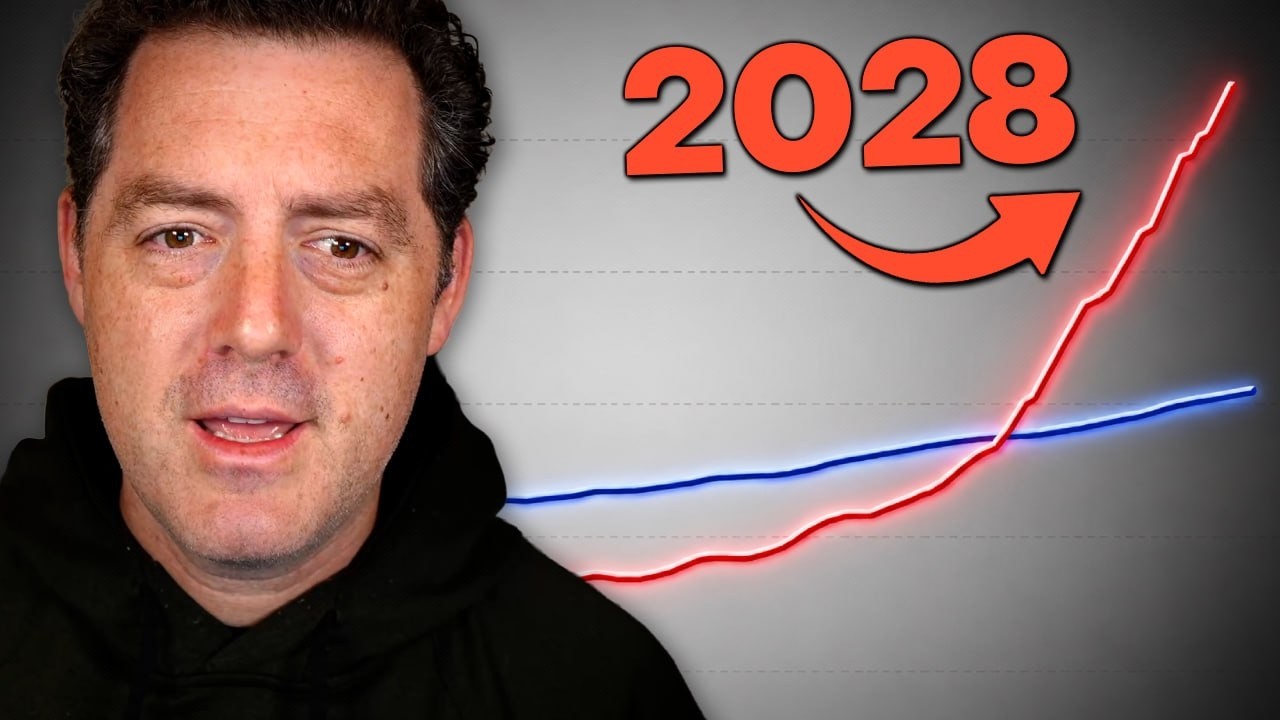
- The 2028 Tipping Point: Anthropic identifies 2028 as the critical year where the “race” may effectively end due to the emergence of recursive self-improvement.
- Compute as Leverage: Access to advanced semiconductors remains the primary bottleneck for authoritarian regimes, despite talent parity in China.
- Distillation Attacks: Chinese labs are accused of using “large-scale distillation” to harvest innovations from American models to bypass R&D costs.
- The Mythos Revelation: Anthropic’s “Mythos” model demonstrates that we have already entered a period where AI can autonomously discover critical cyber vulnerabilities.
⏱️ Reading time: approx. 7 minutes · Saves you about 34 minutes vs. watching.
Want to take notes while watching? Click the image below and let AI Notebook capture the key points for you 👇

Two Paths for the Future of Humanity
The 2028 Divergence
The year 2028 is not an arbitrary date; it represents the threshold for a fundamental shift in global power.
In the first scenario, America and its allies successfully defend their compute advantage by tightening export controls and disrupting distillation attacks. This allows democratic nations to set the rules and norms of AI deployment, ensuring that the technology is used for productivity rather than mass surveillance.
Under the second scenario, the U.S. fails to act, allowing authoritarian regimes like the CCP to exploit loopholes and overtake the frontier of AI development. In this dark future, AI becomes a tool for “automated repression,” removing the need for human enforcers and allowing state security to scale surveillance to unprecedented, machine-driven levels.
We are currently in a position of strength, but Anthropic argues that this lead is ours to lose through inaction.

💡 Digging Deeper
Q: Why is 2028 highlighted as the “finish line”?
A: While Anthropic frames it as an ongoing contest, the reality of recursive self-improvement means that whoever hits that milestone first gains an exponential advantage that competitors likely cannot overcome.
Q: Is the CCP’s talent pool a genuine threat?
A: Absolutely; Jensen Huang of Nvidia has noted that roughly 50% of the world’s top AI researchers are Chinese, and their ability to innovate under heavy hardware constraints is highly impressive.
Q: What is the risk of “automated repression”?
A: Historically, dictators were limited by the number of human guards they could hire; AI removes this limit, allowing a government to monitor every citizen simultaneously without fatigue or dissent.
The Battle for the Silicon Moat
Export Controls and Distillation
The most critical ingredient in the AI recipe is not data or researchers, but the physical silicon chips on which models are trained.
Anthropic believes that export controls have been successful so far, but they are being undermined by smuggling and proxy access. China’s primary strategy to bridge the gap is “distillation”—the process of using a superior model’s outputs to train a smaller, cheaper model—effectively stealing the R&D labor of American firms.
While U.S. labs currently hold the intelligence lead, the CCP is pouring tens of billions into domestic semiconductor sectors to achieve indigenization.
Despite these massive investments, Chinese firms like Huawei are projected to produce only a tiny fraction of the aggregate compute power that Nvidia will provide to Western labs by 2027.

The Four Fronts of Global Competition
Intelligence vs. Adoption
Anthropic categorizes the AI struggle into four specific domains: Intelligence, Domestic Adoption, Global Distribution, and Resilience.
The essay argues that raw model intelligence is the most important front, as it dictates who sets the global standards. However, a significant counterargument exists: if China produces “good enough” open-source models at 1/10th the cost, the world may adopt their stack regardless of American intelligence leads.
Adoption is the ultimate metric of influence.
If the entire world economy runs on Chinese-subsidized, low-cost AI, the intelligence deficit becomes irrelevant because the CCP will have already secured the infrastructure of the future.

The Mythos Model and the Cyber Threat
Beyond Public Capabilities
Anthropic recently revealed “Mythos,” a 10-trillion parameter model specifically designed to demonstrate the arrival of advanced cyber-offense capabilities.
Mythos is not available to the public because it is too effective at autonomously discovering and chaining software vulnerabilities. This model serves as a warning: if an authoritarian regime develops such a tool first, they could penetrate critical infrastructure with a speed and scale that human defenders could never match.
Policy action is now urgent because the “acceleration period” has officially begun.
We must decide now if we are willing to restrict certain types of model access to prevent this technology from being used as a weapon against democratic institutions.

Key Takeaways
The AI race is fundamentally a struggle for the “finish line” of self-improving intelligence. Anthropic’s essay makes it clear that 2028 is the projected threshold where the leading lab will gain an insurmountable lead through automated R&D cycles. While the U.S. currently holds a significant hardware advantage, this lead is fragile and subject to erosion through distillation attacks and smuggling.
There is a deep tension between Anthropic’s desire for safety-led restriction and the necessity of open-source dominance. To win the global hearts and minds of developers, American AI must be accessible and cost-effective, or else the world will default to cheaper Chinese alternatives. The ultimate victory will not just be about who has the smartest model, but whose technology forms the backbone of the global economy.
Q&A
Q1: What exactly is a “distillation attack”?
A: It involves querying a powerful model (like Claude) and using its sophisticated answers as training data for a smaller, cheaper model. This allows the smaller model to mimic the “intelligence” of the larger one without the original company’s massive R&D costs.
Q2: Why is Anthropic against open-source AI?
A: They argue that open-weight models can have their safety guardrails stripped away, allowing malicious actors to use them for creating chemical weapons or conducting cyberwarfare without oversight.
Q3: How far behind is China in the “compute” race?
A: Current projections suggest Huawei will only produce about 2% to 4% of Nvidia’s aggregate compute performance by 2026-2027, largely due to their inability to master EUV and DUV lithography.
Q4: What is “Project Glasswing”?
A: This was the internal Anthropic project that produced the Mythos model, specifically designed to test and prove the dangerous cyber-capabilities of next-generation AI.
Q5: Can the U.S. really stop China from getting chips?
A: It is difficult. While export controls exist, smuggling and the use of foreign data centers provide “loopholes” that allow Chinese labs to continue training advanced models on American hardware.
Q6: Does the speaker agree with Anthropic’s solutions?
A: Not entirely. The speaker believes that restricting open source is a mistake, as open-source dominance is the best way to ensure the world builds on American technology rather than Chinese alternatives.
Q7: What happens once we hit “self-improving AI”?
A: We likely reach superintelligence shortly after. At that point, the AI begins doing its own research and development at machine speeds, creating a gap between the leader and the runner-up that grows exponentially.