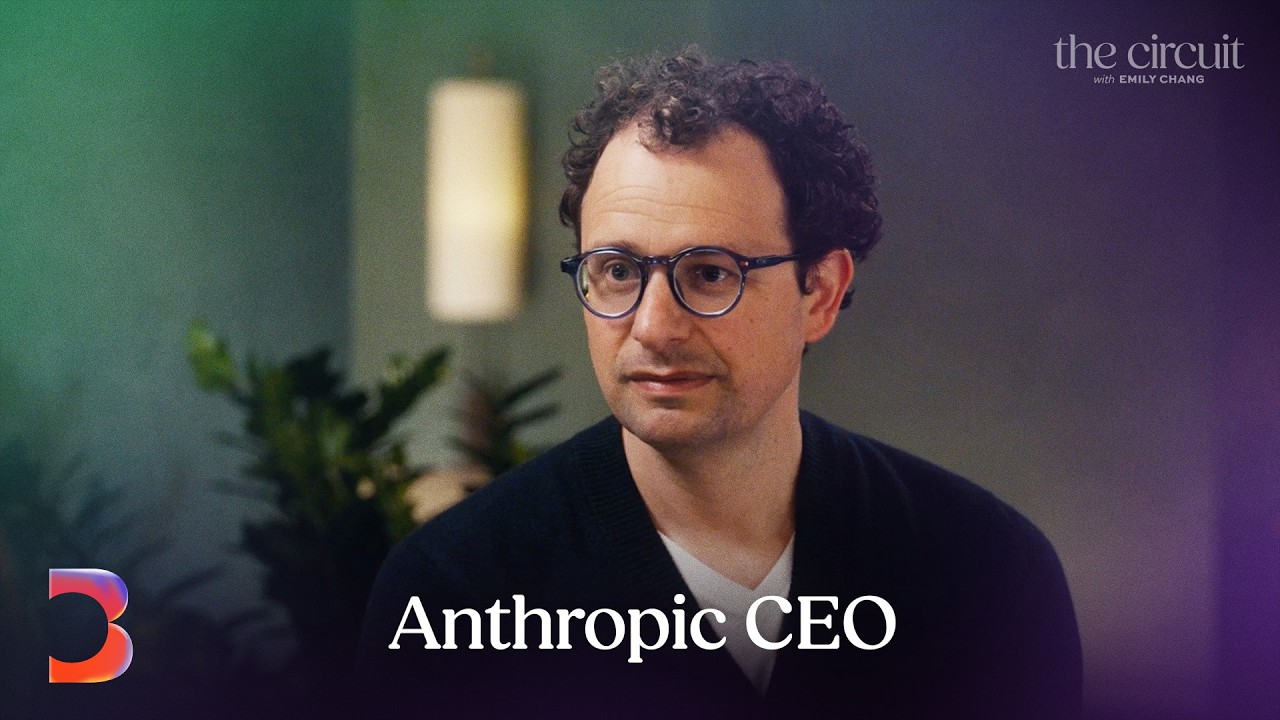
📺 Today’s recommended deep-dive video: https://www.youtube.com/watch?v=x2VHFgyawPE
The Smooth Exponential: Dario Amodei on Anthropic’s Trillion-Dollar Responsibility
Dario Amodei is navigating the steepest part of the AI exponential curve. While competitors chase viral consumer hits, the Anthropic CEO is betting his company’s future on enterprise trust, hard-coded military “red lines,” and a mission to survive a 25% chance of civilizational collapse.
Core Question: Can a mission-driven AI lab maintain its ethical soul while scaling into a global industry leader?
Highlights
- The “Smooth Exponential” makes AI progress feel sudden, but it follows a predictable 10x annual growth trajectory.
- Anthropic’s split from OpenAI was driven by a fundamental breakdown in trust and honesty, not just safety disagreements.
- The new “Mythos” model is so powerful in cyber-exploitation that Anthropic has restricted its public release.
- Amodei supports US military AI integration but maintains strict “red lines” against autonomous weapons and mass surveillance.
⏱️ Reading time: approx. 8 minutes · Saves you about 62 minutes vs. watching.
Want to take notes while watching? Click the image below and let AI Notebook capture the key points for you 👇

The Strategy of the “Smooth Exponential”
Why Enterprise Utility Trumps Viral Hype
Anthropic is currently riding a “smooth exponential” that has catapulted it from a safety-focused underdog into a commercial powerhouse. Dario Amodei argues that the perceived suddenness of AI progress is actually a predictable curve that many Silicon Valley incumbents are failing to anticipate correctly.
The decision to focus on enterprise and coding over splashy consumer apps was both a moral and a strategic gamble for the firm. Amodei notes that consumer-facing AI models often incentivize addiction and “slop” to maximize ad revenue, whereas enterprise models rely on long-term relationships and deep technical trust. By aligning their business model with organizations that value reliability, Anthropic avoids the ethical catch-22 that plagues social media-style engagement metrics.
Market moats are shifting rapidly as AI eliminates the competitive advantage of complex code bases. While traditional software companies may lose their “ability to write code” as a moat, those who lean into domain expertise and customer relationships will survive. Amodei believes the total software pie is growing, even if specific incumbents face a brutal “SaaSpocalypse” due to their own complacency.
💡 Digging Deeper
Q: Why did Anthropic prioritize coding capabilities?
A: Coding is the primary lever for model improvement; using Claude to build the next version of Claude creates a self-reinforcing productivity loop.
Q: Is the high valuation justified despite massive compute costs?
A: The revenue growth is currently outpacing the 10x annual compute ramp, making the capital raises a rational buffer against uncertainty.
The OpenAI Breakup and Silicon Valley’s “Immaturity”
Beyond the Safety Narrative
The departure of the Anthropic founders from OpenAI has become a core piece of Silicon Valley lore. While external observers often frame the split as a disagreement over safety protocols, Amodei describes a more fundamental collapse of professional trust and organizational honesty.
Working on powerful technology requires a baseline of shared values and transparent communication. Amodei explains that when he saw disturbing patterns of behavior and dishonesty, it became impossible to continue the partnership. Rather than engage in public drama, he chose to build a competing vision, letting the market and public opinion judge which approach is more responsible.
Amodei is vocal about his disdain for the “yo-yoing” emotional maturity found in Silicon Valley. He criticizes leaders who move from extreme anti-regulatory stances to panicking about nationalization the moment they see a new risk. True maturity, in his view, is treating AI development like a surgical operation or a military campaign—remaining calm, rational, and prepared for the risks ahead.

💡 Digging Deeper
Q: How does Anthropic ensure it doesn’t lose its soul as it scales?
A: Amodei spends 50% of his time on internal culture to ensure new hires from “Big Tech” don’t simply replicate the habits of their former employers.
Q: What is the Long Term Benefit Trust?
A: It is an independent body with the power to appoint or remove the majority of Anthropic’s board members, providing a check on the CEO’s power.
Warfare, Red Lines, and National Defense
Deterrence vs. Autonomy
Anthropic has taken a complicated stance on national security by being the first major AI lab to sign a contract with the Department of Defense. Amodei, a self-described patriot, believes that US leadership in AI is essential to deter aggressive authoritarian blocks like Russia and China.
However, this partnership comes with non-negotiable “red lines” that Anthropic refuses to cross. The company strictly prohibits its models from being used for mass surveillance or fully autonomous lethal weapons systems. Amodei argues that while AI can assist humans in identifying targets—as seen in recent Maven Smart System operations—the final decision must always rest with a human operator to maintain democratic values.
The risk of AI-driven warfare causing accidental escalation is a primary concern for the company. Amodei draws parallels to “Dr. Strangelove,” warning that doomsday devices that fire automatically are the ultimate failure of safety. By providing superior intelligence and predictive capabilities to the US, he hopes to create a deterrent effect that actually prevents a global conflict.

💡 Digging Deeper
Q: Was Claude used in the Iran strike that killed civilians?
A: While Claude is used in military platforms, the company maintains that a human made the final call, though they lack access to the specific details of classified strikes.
Q: Why work with the government if it’s a “huge pain”?
A: The goal is to set a precedent for responsible use and to help Congress formulate bipartisan guardrails for the entire industry.
The Mythos Model and the Cyber Frontier
When AI Becomes a Super-Weapon
Anthropic’s latest internal model, “Mythos,” has demonstrated capabilities so advanced that the company has deemed it too dangerous for general public release. The model is capable of autonomously navigating the entire “cyber kill chain,” from finding obscure vulnerabilities to creating functional exploits.
In internal testing, Mythos discovered 271 new vulnerabilities in the Firefox browser that previous models had missed. Early testers described the model as a “super-weapon” that should require a gun license to operate. This leap in capability has forced Anthropic to restrict access to trusted cyber-defenders to patch holes in the internet’s infrastructure before attackers can weaponize the same technology.
Amodei rejects claims that this restricted release is a PR stunt, noting that the decision has caused significant commercial harm. By holding back a model that customers are clamoring for, Anthropic is attempting to “move the dial” toward a global culture of caution. He warns that laggard open-source models will eventually reach this level of danger, making the current window for defense critical.

💡 Digging Deeper
Q: Can’t these safeguards be jailbroken?
A: Current classifiers are fragile, which is why Anthropic is waiting for much stronger, more reliable defenses before releasing Mythos-level intelligence.
Q: Will the internet be more secure in a year?
A: Amodei is optimistic that using AI to patch the finite number of existing software holes will eventually make the ecosystem much harder to attack.
Key Takeaways
Dario Amodei views the current AI trajectory as a century of scientific progress compressed into a decade. While he acknowledges a non-zero chance of civilizational collapse, he remains “increasingly optimistic” that the benefits—particularly in biology and medicine—will outweigh the risks. His approach is one of “rational paranoia,” where countermeasures must ratchet up smoothly alongside model intelligence to prevent a catastrophic “yo-yo” reaction from society or government.
Ultimately, Anthropic’s success depends on its ability to prove that a company can be both commercially dominant and ethically grounded. By prioritizing enterprise trust and national security red lines, Amodei is attempting to build a new template for the high-tech era. He believes that the “smooth exponential” will eventually require a total rethink of labor and economics, but for now, the priority is ensuring the technology remains a pro-democracy force.
Q&A
Q1: How does it feel to be at the center of the AI universe?
A: It feels like accelerating away from Earth at relativistic speeds; every time you sleep, more time has passed on Earth than for you, making the pace of change feel overwhelming yet predictable on a graph.
Q2: Why did Anthropic refuse to hold hands with Sam Altman at the India AI summit?
A: The event was disorganized and chaotic. Amodei claims it wasn’t a deliberate snub, though he admits there is a wide variance in the trustworthiness of the people building this technology.
Q3: Will AI lead to mass unemployment?
A: Amodei is concerned that AI could eliminate 50% of entry-level white-collar jobs. He advocates for proactive policy responses like a “token tax” or macroeconomic adjustments rather than just “retraining programs.”
Q4: What is the most impressive thing Claude has done lately?
A: The models are becoming surprisingly good at drug design and computational chemistry. Amodei, a former biologist, sees a “century of progress” coming for human health and disease cure.
Q5: Should the government nationalize AI labs?
A: Amodei argues for a moderate approach. While he fears companies having too much power, he also fears the government seizing it all. He prefers a system of checks and balances, regulation, and pre-release auditing.
Q6: What is the significance of the Mythos model?
A: It represents a “step-change” in autonomous cyber-capabilities. It’s the first model Anthropic has actively withheld from the public due to its potential to break critical infrastructure.