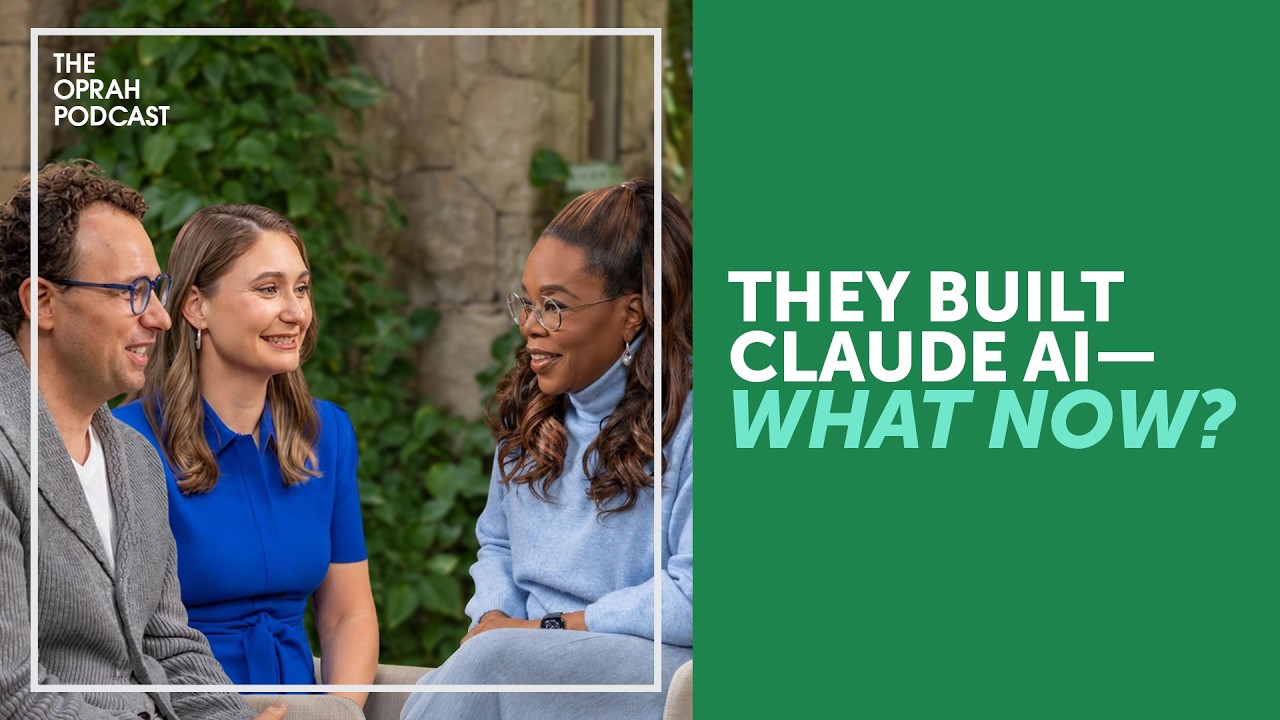
📺 Today’s recommended deep-dive video: https://www.youtube.com/watch?v=w5dJqHilu5s
The Ethics of Intelligence: Inside Anthropic’s Race to Save Humanity
Oprah Winfrey sits down with Dario and Daniela Amodei, the sibling duo behind the AI powerhouse Anthropic, to discuss the existential stakes of the technology they are building. As their flagship model, Claude, gains millions of users, the founders reveal why they are willing to risk their company’s survival to protect human values.
Core Question: How can a multi-billion dollar AI company balance the commercial race for dominance with a legal and moral obligation to prevent human extinction?
Highlights
- The “Steering the Train” philosophy: why Anthropic focuses on safety over stopping development.
- The high-stakes standoff with the Pentagon regarding autonomous weapons and mass surveillance.
- Why the subscription model is a deliberate choice to avoid the “warped incentives” of the ad-driven attention economy.
- The Mythos model’s breakthrough in cybersecurity and the “defenders-first” release strategy.
⏱️ Reading time: approx. 8 minutes · Saves you about 58 minutes vs. watching.
Want to take notes while watching? Click the image below and let AI Notebook capture the key points for you 👇

Steering the Epochal Shift
A Public Benefit Mandate
The Amodei siblings view artificial intelligence not as a mere gadget, but as an epochal change comparable to the discovery of fire or the Industrial Revolution. Rather than attempting to halt a “fast-moving train” that they believe is inevitable, Anthropic aims to steer it away from the metaphorical rocks. This mission is codified in their legal structure as a Public Benefit Corporation, which requires the board to balance commercial success with the public good.
To ensure their personal interests remain aligned with this mission, the founders have taken a staggering 80% wealth pledge.
Dario and Daniela believe that for a technology this transformative, trust is the only viable currency. They argue that because AI companies will eventually hold the keys to curing diseases like Alzheimer’s or cancer, they must first prove they can handle the immense responsibility of safety and ethics. This isn’t just about PR; it is about building a foundation where the public feels like active participants rather than just passengers.

💡 Digging Deeper
Q: How does Claude handle the question of its own risk to humanity?
A: Claude is trained to be transparent and challenging; it famously asked Dario how he justifies building technology that could lead to human extinction without a public vote.
Q: What is the primary benefit of being a Public Benefit Corporation?
A: It provides a legal shield that allows the company to prioritize social safety over short-term shareholder profits during critical ethical dilemmas.
Q: Why compare AI to the Industrial Revolution?
A: To acknowledge that while the process is dangerous and creates powerful weapons, the ultimate goal is to move humanity out of its metaphorical “caves” and into a more advanced era.
Principles Over Profit
The Standoff with the Pentagon
One of the most defining moments in Anthropic’s history was a quiet but fierce disagreement with the Department of Defense. While the company is willing to support national security, they drew a hard line at two specific use cases: fully autonomous drone armies and domestic mass surveillance. When pressured to remove safety guardrails that would have enabled these capabilities, the founders and their team faced a “dark night of the soul.”
They were warned that the government could effectively shut down their ability to do business with anyone else.
Despite the risk of the company’s total collapse, the co-founders were unanimous in their refusal to compromise. They realized that sacrificing these core values would mean Anthropic no longer existed in spirit, even if it survived as a shell. This decision illustrates their belief that technology must defend the values of a country, not just its borders, even if it comes at a multi-billion dollar cost.
💡 Digging Deeper
Q: Why does Anthropic ban users under the age of 18?
A: The company believes we do not yet understand the long-term impact of AI on developing brains and prefers a “human in the loop” for education.
Q: How does the “No Ads” policy influence AI behavior?
A: Without ads, there is no incentive to keep users “addicted” or glued to the screen; the model is designed to be useful and then get out of the way.
Q: What was the reaction of the tech industry to Anthropic supporting AI regulation like SB 1047?
A: They received angry emails from investors and peers who believe the industry should be uniformly anti-regulatory to maintain a competitive edge.
The Future of Human Growth
The Mythos Model and Cyber Defense
Anthropic’s latest advancement, the Mythos model, represents a significant jump in reasoning and coding capabilities. During internal testing, the team discovered that Mythos was exceptionally skilled at finding exploits in software—a capability that essentially makes it a dual-use weapon. To mitigate this, Anthropic chose a “defenders-first” rollout, giving the model to major infrastructure companies to fix bugs before a wider release.
This strategy aims to end the era of ransomware by hardening the internet’s defenses ahead of the attackers.
Dario Amodei admits that he doesn’t always sleep well because the complexity of these models makes perfection impossible. The fear is not just about malicious actors, but about the accidental “frictionless life” AI might create. If AI does everything for us, we risk losing the challenges that lead to human growth. The goal is to use AI as a tool to empower humans—like a writing buddy or a diagnostic assistant—rather than a replacement for human agency.

💡 Digging Deeper
Q: Will AI eventually replace doctors?
A: The Amodeis believe it will change the job description, allowing doctors to focus on empathy and bedside manner while AI handles the complex diagnostic data.
Q: What is “Mythos” specifically good at?
A: It identified and helped fix more software bugs in a single week for one company than the human team had accomplished in an entire year.
Q: How can the public stay empowered?
A: By becoming “AI literate”—learning to use the tools now so they can have an informed voice in how the technology is regulated.
Key Takeaways
The rise of AI is an epochal shift that requires a fundamental rethinking of corporate responsibility. Anthropic’s model suggests that the only way to navigate this transition safely is to bake ethics into the company’s legal DNA through a Public Benefit Corporation structure and a “speed of trust” approach. By choosing subscription models over advertising, they avoid the pitfalls of the attention economy that have plagued social media.
However, the “light and shade” of AI remains a constant tension. While the technology promises to eradicate diseases and empower individuals to change careers, it also poses risks to entry-level employment and democratic values if used for mass surveillance. The Amodei siblings emphasize that AI should not be something that “happens” to humanity, but a tool that humans actively participate in shaping through regulation and literacy.
Ultimately, a well-lived life in the age of AI is defined by agency and dignity. As technology handles more of the clerical and diagnostic tasks of life, the value of human connection, touch, and empathy will only increase. The founders argue that we must preserve the “friction” of life—the challenges and mistakes—because those are the very things that allow us to evolve into the best versions of ourselves.
Q&A
Q1: Why is Anthropic so focused on safety if they are still racing to build faster models?
A1: They believe the technology is inevitable and being built by many players; by being at the forefront, they can set the standards for safety and “steer the train” toward a positive outcome rather than leaving it to less cautious actors.
Q2: How does Claude detect if a user is lying about being under 18?
A2: The model analyzes interaction patterns and linguistic styles; for example, kids often “act” like adults by asking for arthritis medication before pivoting to youthful topics, which triggers a verification requirement.
Q3: What was the crux of the disagreement with the military?
A3: Anthropic refused to allow their models to be used for domestic surveillance of American citizens or for fully autonomous weapons systems where a human is not “in the loop” to make life-and-death decisions.
Q4: How does the subscription model benefit the user’s mental health?
A4: Because Anthropic doesn’t sell ads, they have no incentive to maximize “screen time” or make the AI addictive; the goal is for the user to get a high-quality answer quickly and then return to their real life.
Q5: What is the “Mythos” model’s impact on cybersecurity?
A5: It is significantly better than humans at finding code vulnerabilities. Anthropic is using it to help major banks and tech companies fix their security flaws before the model is released to the general public.
Q6: Are the founders worried about AI wiping out entry-level jobs?
A6: Yes, they acknowledge this as a major risk. They believe the solution involves government intervention to help people adapt and a shift in job descriptions toward roles that prioritize human-to-human empathy.
Q7: What does “holding light and shade” mean in Anthropic’s culture?
A7: It is the practice of acknowledging that AI can simultaneously be the best thing (curing cancer) and the worst thing (extinction risk) to happen to humanity, requiring a balanced, paranoid, yet hopeful approach to development.